RSS volunteer urges ideological awareness to counter urban Naxal thinking in Gandhinagar
Synopsis
At BJP Gujarat's Independence Day event in Gandhinagar, RSS volunteer Bhanu Chauhan argued that 'urban Naxalism' and evolving left-wing ideologies — which he linked to 'wokeism' — must be countered through ideological engagement, not just security measures. With 126 districts once affected by Naxalism and thousands of lives lost, his remarks reflect a broader push to shift the anti-Naxal debate from the jungle to the ideological arena.
Key Takeaways
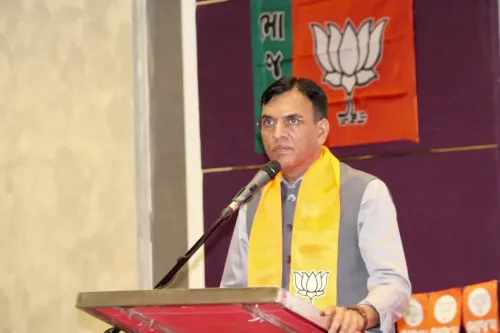
RSS volunteer Bhanu Chauhan addressed a BJP Gujarat Independence Day gathering at Gandhinagar on 15 August .
He called for ideological awareness to counter 'urban Naxal' ideology and contemporary left-wing thinking.
Chauhan stated that 126 districts had at one point been affected by Naxalism, with thousands of security personnel and civilians losing their lives.
He linked evolving forms of left-wing ideology with 'wokeism,' urging ideological engagement as the primary response.
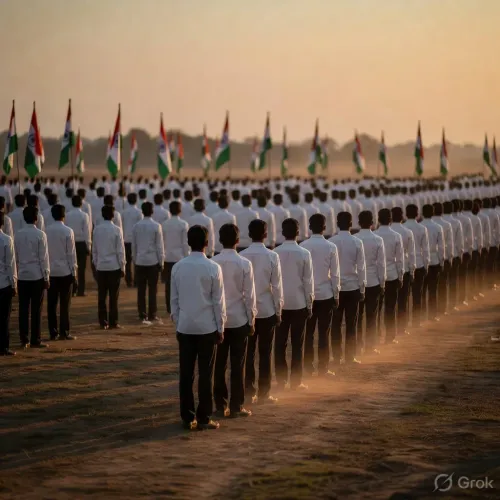
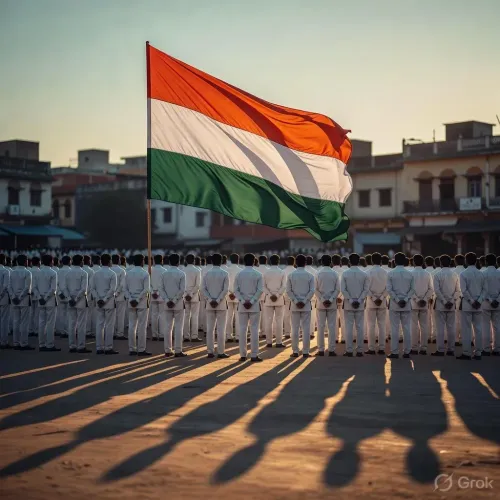
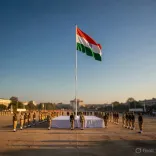
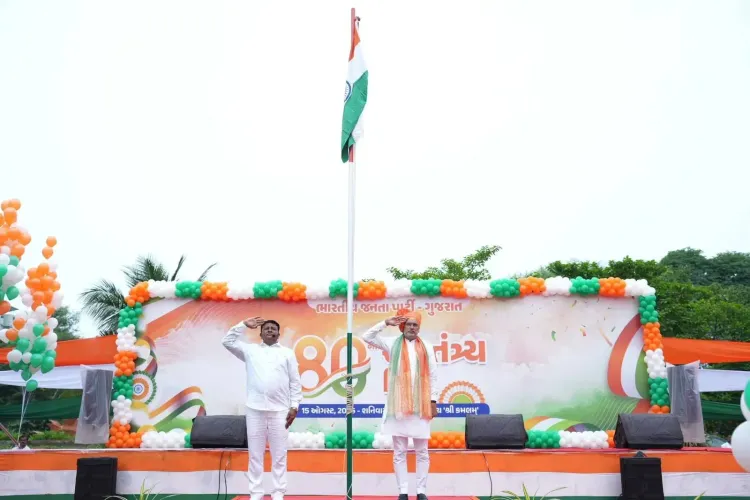
The event was attended by BJP MPs, MLAs, state office-bearers, and party workers; it included flag-hoisting and the singing of 'Vande Mataram' and 'Jana Gana Mana.'
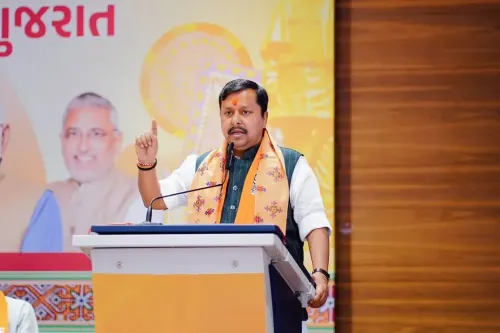
Rashtriya Swayamsevak Sangh (RSS) volunteer Bhanu Chauhan on 15 August called for heightened ideological awareness to understand and confront what he termed the 'urban Naxal' ideology and contemporary forms of left-wing thinking. Speaking at an Independence Day gathering at the Bharatiya Janata Party (BJP) Gujarat headquarters in Gandhinagar, Chauhan framed the challenge as one requiring reasoned engagement rather than mere opposition.
Core Argument: Nation First, Dialogue Over Violence
Chauhan asserted that India's foundational idea rested on placing the nation above all else — national prosperity and the preservation of India's integrity. He urged that Independence Day be used as an occasion to reaffirm commitment to patriotism and national unity. 'Understanding anti-national ideologies with reason and critical thinking and confronting them is the need of the hour,' he said.
He also invoked the constitutional preamble's phrase 'We, the People of India,' arguing that the spirit of 'Vande Mataram' and 'Nation First' defined India's identity. Chauhan maintained that India's path to change was not through violence but 'through dialogue, justice and organisation.'
Naxalism: Origins, Spread and Human Cost
Chauhan traced the origins of the Naxal movement, noting it had initially emerged in the name of opposing injustice against farmers before adopting violence as its primary method. He claimed the movement's influence had spread across several parts of the country, drawing innocent people in tribal areas towards violence.
According to Chauhan, 126 districts had at one point been affected by Naxalism, and thousands of security personnel and ordinary citizens had made sacrifices during the prolonged conflict. This comes amid the Centre's sustained anti-Naxal operations in states such as Chhattisgarh, where security forces have recorded significant operational gains in recent years.
Urban Naxalism and the 'Woke' Link
Chauhan extended his critique beyond traditional Naxalism to what he described as its urban variant and evolving forms of left-wing ideology. He linked these, in his framing, with 'wokeism,' arguing that 'these challenges needed to be addressed through ideological engagement.' He called on India to centre its response on its 'motherland, culture, values, national identity and the legacy of its sages and seers.'
Notably, the term 'urban Naxal' has been a contested label in Indian public discourse — used by ruling-party voices to describe alleged ideological sympathisers in cities, while critics argue the term has been applied broadly to suppress dissent. Chauhan did not elaborate on specific individuals or organisations in his remarks.
Event and Audience
The Independence Day programme was attended by BJP state office-bearers, senior leaders, Members of Parliament, Members of the Legislative Assembly, party workers, and citizens. The ceremony included the hoisting of the national flag and collective singing of 'Vande Mataram' and 'Jana Gana Mana.'
As India marks another Independence Day, the debate over how to define and respond to ideological challenges — from insurgency to urban activism — is likely to remain a live fault line in national politics.
Point of View
Worth noting for readers parsing the ideological weight of the occasion.
NationPress
15 Aug 2026
Frequently Asked Questions
Who is Bhanu Chauhan and what did he say on Independence Day?
Bhanu Chauhan is a Rashtriya Swayamsevak Sangh (RSS) volunteer who, on 15 August, addressed a BJP Gujarat Independence Day gathering in Gandhinagar. He called for ideological awareness to understand and counter what he described as 'urban Naxal' ideology and contemporary left-wing thinking.
What is 'urban Naxalism' as described by Chauhan?
Chauhan used the term 'urban Naxal' to refer to what he characterised as ideological sympathisers of Naxalism operating in urban settings, which he linked to evolving forms of left-wing thought and 'wokeism.' The term is contested in Indian public discourse; critics argue it has been used broadly to target dissent.
How widespread has Naxalism been in India, according to Chauhan?
According to Chauhan, 126 districts across India had at one point been affected by Naxalism. He said thousands of security personnel and ordinary citizens had made sacrifices during the prolonged conflict with Naxal groups.
What solution did Chauhan propose to counter these ideologies?
Chauhan argued that the response must be ideological — through reasoned engagement, critical thinking, and a reaffirmation of India's cultural values and national identity. He explicitly stated that India's approach to change was 'through dialogue, justice and organisation,' not violence.
Who attended the Independence Day event in Gandhinagar?
The event at the BJP Gujarat headquarters was attended by state office-bearers, senior BJP leaders, Members of Parliament, Members of the Legislative Assembly, party workers, and citizens. It included national flag-hoisting and collective singing of 'Vande Mataram' and 'Jana Gana Mana.'