Pradhan Hails IIM Bangalore Campus Launch in Indonesia
Synopsis
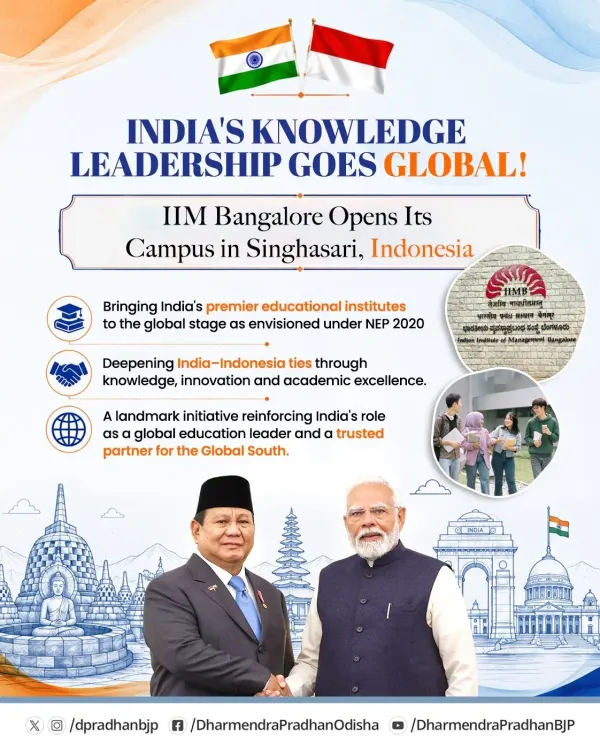
Union Education Minister Dharmendra Pradhan hailed the launch of IIM Bangalore's first overseas campus in Indonesia — the Singhasari Campus — jointly inaugurated by PM Modi and President Prabowo, as a landmark outcome of NEP 2020 and a step forward in India–Indonesia strategic ties.
Key Takeaways
IIM Bangalore (Singhasari) Campus in Indonesia is the first international campus of any Indian Institute of Management.
The campus was jointly launched by Prime Minister Narendra Modi and Indonesian President Prabowo Subianto on July 7, 2026 .
Academic focus areas include Global Supply Chains , Digital Transformation , Artificial Intelligence , Climate and Sustainability , and Healthcare .
MoUs were signed on the same day to deepen bilateral cooperation in AI , telecommunications , Digital Public Infrastructure , and startups .
The initiative is framed as a direct outcome of the National Education Policy 2020 , which first permitted Indian institutions to set up overseas campuses.
The campus aims to create opportunities for students across the ASEAN region, not just Indonesia.
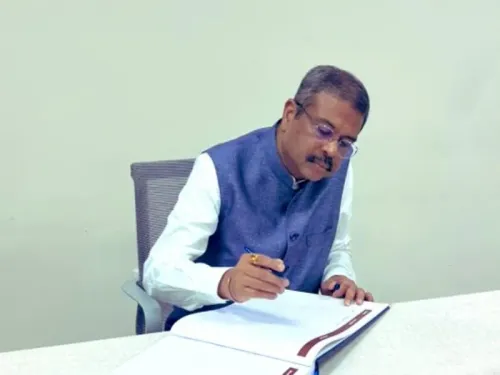
Union Education Minister Dharmendra Pradhan on Tuesday, July 7, 2026, called the inauguration of the IIM Bangalore (Singhasari) Campus in Indonesia a 'landmark moment' in the India–Indonesia Comprehensive Strategic Partnership, crediting the milestone to the vision embedded in the National Education Policy 2020. The campus was jointly launched by Prime Minister Narendra Modi and Indonesian President Prabowo Subianto, marking the first time an Indian Institute of Management has established a permanent presence on foreign soil.
Context
Pradhan, in his post on X, described the launch as 'a defining outcome of #NEP2020 and a major milestone in the internationalisation of Indian higher education.' He noted that the campus will anchor its academic focus on five domains: Global Supply Chains, Digital Transformation, Artificial Intelligence, Climate and Sustainability, and Healthcare. The minister also flagged a set of MoUs signed on the same day to strengthen bilateral cooperation in AI, telecommunications, Digital Public Infrastructure, and startups.
The campus is named after Singhasari, a reference to the medieval Javanese kingdom that historians link to ancient civilisational and maritime connections between the Indian subcontinent and the Indonesian archipelago. Pradhan invoked this heritage, stating that the initiative is 'rooted in centuries of civilisational ties.'
Policy Backdrop
The National Education Policy 2020, approved by the Union Cabinet under Prime Minister Modi, was the first Indian education reform framework to explicitly permit domestic higher education institutions to establish campuses abroad and to invite foreign universities to operate in India. Before NEP 2020, regulatory barriers effectively prevented institutions such as the IIMs and IITs from setting up overseas operations.
IIM Bangalore becomes the first IIM to operationalise this provision internationally. The Indonesia campus sits within a broader pattern of India deploying its premier education brands as instruments of strategic engagement across the Indo-Pacific, alongside the export of Digital Public Infrastructure tools and technology-cooperation frameworks that India has shared with several ASEAN partners in recent years.
Stakeholders and Impact
The campus is positioned to serve students not only from Indonesia but from across the ASEAN region, offering postgraduate and executive-level programmes in high-demand, future-facing disciplines. For IIM Bangalore, the move expands its global academic footprint and opens pathways to research partnerships with Southeast Asian institutions and industry.
The simultaneously signed MoUs on AI, Digital Public Infrastructure, and startups signal that the education initiative is embedded in a wider technology-and-innovation compact between the two countries. Pradhan framed this as part of a 'shared commitment of India and Indonesia to empowering their youth through technology and innovation,' suggesting that the campus will function as a node in a broader bilateral knowledge ecosystem rather than a standalone academic facility.
What's Next
Attention will now shift to the operational rollout of the Singhasari Campus, including faculty recruitment, curriculum finalisation, and the launch of student admissions — processes expected to gather pace ahead of a prospective academic intake. Follow-up agreements on AI cooperation and Digital Public Infrastructure are also anticipated during subsequent bilateral engagements between New Delhi and Jakarta.
The IIM Bangalore precedent could accelerate similar moves by other Indian institutions. With NEP 2020's internationalisation provisions now tested on the ground, the Ministry of Education is likely to encourage additional IIMs and IITs to explore comparable partnerships, particularly with countries in the Indo-Pacific where India is deepening its strategic presence.
Point of View
Digital infrastructure, and sustainability, New Delhi is signalling that its educational exports are aligned with the technology-cooperation agenda it is simultaneously pursuing through bilateral MoUs. For Minister Pradhan, the launch validates NEP 2020's internationalisation provisions as a workable foreign-policy instrument, not merely a domestic reform. The Singhasari precedent will likely be cited as a template to push other IIMs and IITs toward similar ventures in the region.
NationPress
6 Oct 2026
Frequently Asked Questions
What is the IIM Bangalore Singhasari Campus in Indonesia?
The IIM Bangalore (Singhasari) Campus is the first international campus of IIM Bangalore and the first overseas campus of any Indian Institute of Management, launched in Indonesia on July 7, 2026, jointly by Prime Minister Narendra Modi and Indonesian President Prabowo Subianto.
What subjects will the IIM Bangalore Indonesia campus teach?
The campus will focus on five key areas: Global Supply Chains, Digital Transformation, Artificial Intelligence, Climate and Sustainability, and Healthcare, targeting students from Indonesia and the broader ASEAN region.
How is NEP 2020 connected to the IIM Bangalore Indonesia campus?
The National Education Policy 2020 was the first Indian education reform to explicitly permit Indian higher education institutions to set up campuses abroad. The IIM Bangalore Indonesia campus is considered a direct outcome of that provision.
What MoUs did India and Indonesia sign alongside the campus launch?
India and Indonesia signed MoUs to strengthen cooperation in Artificial Intelligence, telecommunications, Digital Public Infrastructure, and startups on the same day as the campus launch, according to Minister Pradhan's statement.
Who inaugurated the IIM Bangalore campus in Indonesia?
Prime Minister Narendra Modi and Indonesian President Prabowo Subianto jointly inaugurated the IIM Bangalore (Singhasari) Campus in Indonesia on July 7, 2026.