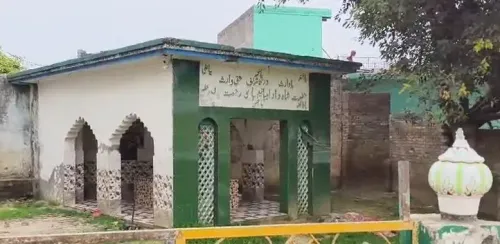
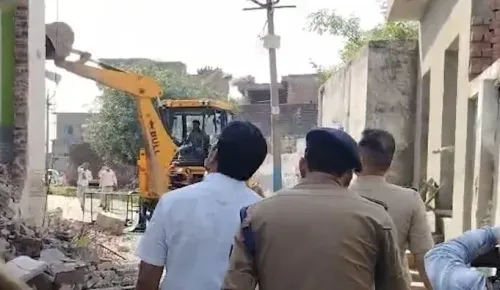
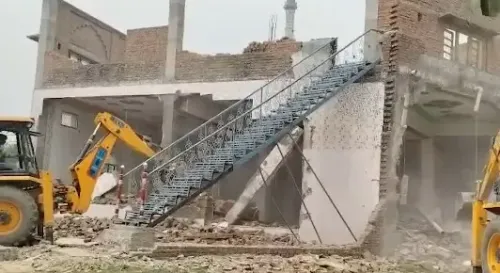
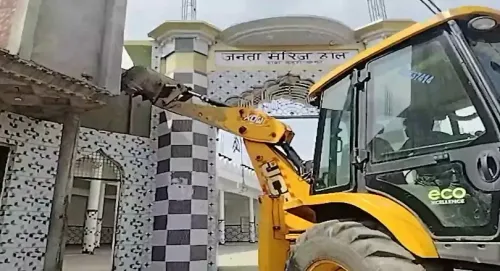
Illegal mosque razed in UP's Sambhal for lacking Waqf Board nod

Synopsis
Sambhal's district administration razed an unauthorised mosque on Waqf land in Qutubpur Sakta on 12 November, after the caretaker could not produce a Waqf Board construction permit. The structure — spread over 130 square metres — had also begun hosting prayers, drawing local opposition. Officials warned that any unauthorised construction on Waqf property across the district faces the same fate.
Key Takeaways
Sambhal district administration demolished an unauthorised mosque in Qutubpur Sakta on 12 November 2026 .
The structure was being built on approximately 130 square metres of Waqf-designated land without Waqf Board approval.
The mosque caretaker reportedly failed to produce valid construction permission when asked by authorities.
Tehsildar Dhirendra Kumar Singh confirmed the Waqf Board told the District Minority Welfare Office that no permission had been sought.
Villagers had flagged the unauthorised construction to police and revenue officials roughly a month before the demolition.
Large security forces were deployed; officials confirmed the demolition was carried out peacefully.
The district administration in Sambhal, Uttar Pradesh, on Thursday, 12 November 2026, demolished a mosque that was under construction on Waqf-owned land in the Qutubpur Sakta area, citing the absence of mandatory permission from the Waqf Board. Officials confirmed that the structure was being raised on approximately 130 square metres of land without any authorisation, prompting authorities to order its removal after the mosque caretaker reportedly failed to produce valid construction documents.
What Led to the Demolition
According to officials, local villagers had alerted police and revenue teams roughly a month ago that unauthorised construction of a mosque was underway on what they described as residential land. Asmoli Circle Officer Aman Singh said a joint team from the police and revenue department was subsequently dispatched to verify the complaint, and the investigation confirmed the construction was illegal.
'Upon receiving the information, a joint team of the police and revenue department reached the spot and conducted an investigation, during which this construction was found to be illegal,' Singh said. He added that the Sambhal Sub-Divisional Magistrate (SDM) subsequently issued directives to initiate demolition action against any illegal construction on the land.
What the Waqf Board Said
Sambhal Tehsildar Dhirendra Kumar Singh told reporters that the land in question had been formally declared Waqf property by the Waqf Board. He emphasised that any new construction on Waqf land requires the Board's prior approval — a condition that was not fulfilled here.
'Any new construction cannot take place on a Waqf property without the permission of the Waqf Board. Here, people had not only carried out construction work but they had also started offering namaz, which was opposed by locals in the area,' the Tehsildar said. He further noted that the District Minority Welfare Office in Sambhal had separately confirmed with the Waqf Board that no permission had ever been sought for any construction on the plot.
'That is why this illegal structure is being removed today…only those structures which have been permitted by the Waqf Board will be allowed, the rest will be demolished,' he added.
Security Deployment and Peaceful Execution
A large contingent of security personnel was deployed at the demolition site to ensure the process was carried out without incident. Officials said both police and administrative teams remained on the ground throughout the operation. The Circle Officer confirmed that the demolition was completed peacefully.
Broader Context
This comes amid a wider pattern of Uttar Pradesh authorities cracking down on structures alleged to be in violation of property and construction laws. The state has seen multiple demolition drives targeting structures deemed illegal, drawing both support and criticism across political lines. Notably, Waqf-related land disputes have been a recurring flashpoint in UP, with questions around proper documentation and Board oversight frequently at the centre of such controversies. The case in Qutubpur Sakta underscores the tension between community religious practice and regulatory compliance on protected land categories.
It remains to be seen whether the mosque's caretakers or the local community will seek legal recourse, or whether the Waqf Board will initiate any formal inquiry into how the construction began in the first place.
Point of View
No legal standing to build — but it arrives in a charged political climate where such actions are rarely read as routine enforcement. The more pointed question is institutional: how did construction on formally designated Waqf land reach the stage of active namaz before local authorities intervened? If the answer is administrative neglect for weeks, that is a failure the administration has yet to account for. The broader pattern of demolition drives in UP also demands scrutiny — consistent application of the law across all communities is the only standard that holds up to accountability.
NationPress
12 Nov 2026
Frequently Asked Questions
Why was the mosque in Sambhal's Qutubpur Sakta demolished?
The mosque was demolished on 12 November 2026 because it was being constructed on Waqf-designated land without the mandatory prior permission of the Waqf Board. The mosque caretaker reportedly could not produce any valid construction authorisation when asked by district officials.
What is Waqf land, and why does construction need Waqf Board permission?
Waqf land is property dedicated under Islamic law for religious or charitable purposes and is administered by the statutory Waqf Board. Under Indian law, any new construction on such land requires prior approval from the relevant Waqf Board; construction without that permission is considered illegal regardless of who initiates it.
Who flagged the unauthorised construction, and when?
Local villagers informed police and revenue teams approximately one month before the demolition that a mosque was being illegally built on residential land. A joint police-revenue team subsequently investigated and confirmed the construction was unauthorised, after which the Sambhal SDM issued demolition orders.
Was the demolition carried out peacefully?
Yes. A large contingent of security personnel was deployed at the Qutubpur Sakta site to ensure a peaceful process. Officials confirmed there were no untoward incidents during the demolition.
What happens to other unauthorised structures on Waqf land in Sambhal?
Sambhal Tehsildar Dhirendra Kumar Singh stated that only structures with valid Waqf Board permission will be allowed to stand, and all other illegal constructions will face demolition. This suggests authorities are taking a broader compliance posture on Waqf land in the district.