Kishan Reddy: IMF projects India GDP growth at 7% for FY27
Synopsis
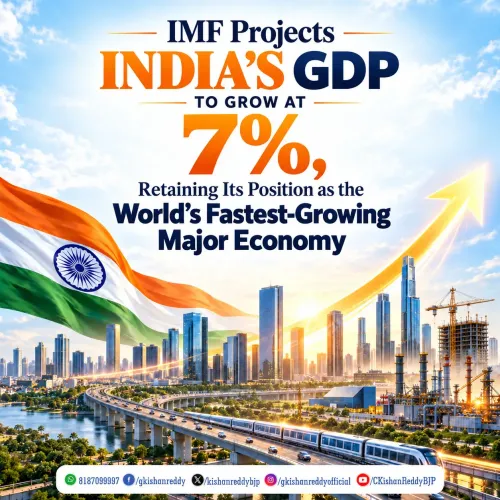
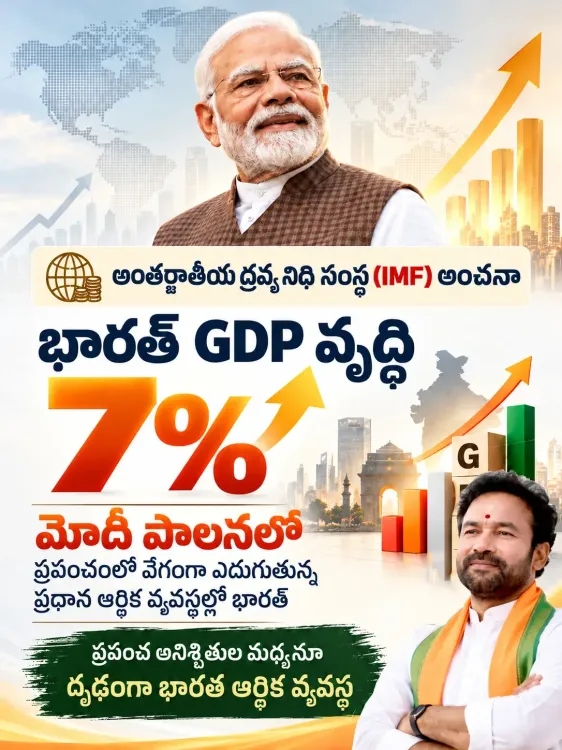
Union Coal and Mines Minister G. Kishan Reddy highlighted an IMF projection of 7% GDP growth for India in FY 2026-27, attributing the forecast to PM Narendra Modi's structural reforms, inflation control, and stable macroeconomic policies amid global uncertainty.
Key Takeaways
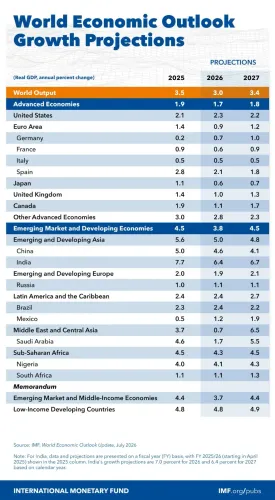
The IMF has projected India's GDP growth at 7% for FY 2026-27 , according to Union Minister G.
Kishan Reddy's post on October 14, 2026.
Kishan Reddy credited PM Narendra Modi's key reforms and stable policy framework for sustaining India's growth momentum.
The minister highlighted effective inflation management and macroeconomic stability as twin pillars of India's resilience.
India's reform scaffold — including the GST (2017) and the Insolvency and Bankruptcy Code (2016) — underpins the structural confidence multilateral agencies place in the economy.
The projection comes despite acknowledged global headwinds: economic uncertainty and geopolitical tensions affecting major economies worldwide.
The next IMF World Economic Outlook release and the Union Budget 2026-27 will be key events to watch for revised growth assumptions.
Even as trade headwinds and geopolitical fault lines rattle economies from Europe to East Asia, India's growth story refuses to blink — and now the International Monetary Fund (IMF) has put a number to that confidence: a 7% GDP growth rate for FY 2026-27. Union Coal and Mines Minister G. Kishan Reddy, also the BJP's Telangana state president, amplified the projection on Wednesday, October 14, crediting Prime Minister Narendra Modi's structural reforms and steady policy framework for keeping India on this trajectory.
What the IMF number actually signals
The IMF has, over successive World Economic Outlook cycles, consistently flagged India as one of the fastest-growing major economies — even when global demand softens. A 7% growth forecast for FY27, if confirmed in the next Outlook release, would reinforce that pattern and place India well ahead of most G20 peers. Kishan Reddy's post, written in Telugu, flags the projection as evidence of 'unmatched momentum' in the Indian economy — తిరుగులేని వేగంతో ముందుకు దూసుకుపోతోంది (surging forward with unstoppable speed).
The minister also pointed to two pillars underpinning investor confidence: effective inflation management and macroeconomic stability. Both have been recurring themes in the Modi government's economic messaging, particularly as central banks globally have struggled to tame price pressures in the post-pandemic cycle.
The reform scaffold behind the forecast
India's current growth architecture rests on a decade-long stack of structural interventions. The Goods and Services Tax (GST), rolled out nationwide in 2017, unified a fragmented indirect-tax regime and dramatically expanded the formal economy's footprint. The Insolvency and Bankruptcy Code (IBC), enacted in 2016, injected credit discipline and gave lenders a credible resolution mechanism — a shift that has steadily improved India's ease-of-doing-business standing with global capital.
Together, these reforms have created the kind of structural predictability that multilateral agencies — and the foreign institutional investors whose flows they track — now treat as a baseline expectation for India, not a bonus.
Global headwinds India is navigating
Kishan Reddy's post does not shy from the external environment. 'Economic uncertainties and political tensions prevailing globally' — his framing — are real: slowing Chinese demand, prolonged Middle East instability, and a high-rate Western monetary environment have all compressed growth outlooks across emerging markets. That India is still projected to clock 7% inside this environment is the political point the minister is making, and it is one the IMF's own comparative data tends to support.
What to watch next: the formal release of the IMF World Economic Outlook and the Union Budget 2026-27 will either lock in or revise these growth assumptions — and both carry significant market-signalling weight for India's fiscal year ahead.
Point of View
Insulating the claim from opposition pushback. The 7% projection, if it clears verification in the next World Economic Outlook, would extend a streak of IMF citations that the Modi government has consistently used to frame India as a 'bright spot' in a turbulent global economy. The deeper strategic message is continuity — that stable policy, not just cyclical luck, is driving growth. As the FY27 budget cycle begins, this kind of multilateral validation shapes both investor sentiment and the domestic political optics around economic management.
NationPress
14 Oct 2026
Frequently Asked Questions
What is the IMF's GDP growth forecast for India in FY 2026-27?
According to Union Minister G. Kishan Reddy's post, the IMF has projected India's GDP growth rate at 7% for the financial year 2026-27, though the precise figure is yet to be confirmed in an official IMF World Economic Outlook release.
Why is G. Kishan Reddy talking about India's GDP growth?
G. Kishan Reddy is Union Minister of Coal and Mines and BJP Telangana state president. He shared the IMF's projected 7% GDP growth figure to highlight the Modi government's economic management and structural reforms as driving India's momentum despite global uncertainty.
What reforms does India credit for its strong GDP growth?
The Modi government has pointed to the nationwide rollout of the Goods and Services Tax in 2017 and the Insolvency and Bankruptcy Code enacted in 2016 as key structural reforms that improved tax compliance, formalisation, and credit discipline — laying the foundation for sustained growth.
How does India's projected 7% GDP growth compare globally?
A 7% GDP growth rate would place India among the fastest-growing major economies in the world, well ahead of most G20 peers. The IMF has repeatedly identified India as a standout performer in its comparative global growth assessments, even during periods of broader economic slowdown.
When will the IMF officially confirm India's FY27 GDP forecast?
The official confirmation is expected with the release of the next IMF World Economic Outlook. The Union Budget 2026-27 is another key event that may carry revised growth assumptions or new policy signals affecting the forecast.