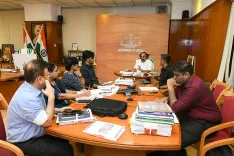
UP launches barcode system at 14 religious sites for instant digital heritage access

Synopsis
Uttar Pradesh is turning temple walls into digital gateways. With barcodes installed at 14 sites — from Ayodhya to Prayagraj — tourists can now scan to unlock centuries of history, skipping the guesswork. With 575 projects approved for the year, this is the state's most ambitious push yet to marry pilgrimage culture with smartphone-era access.
Key Takeaways
Uttar Pradesh has installed barcode-enabled information plaques at 14 religious and historical sites as of 15 September 2026 .
A smartphone scan delivers a 360-degree overview of each site's history, archaeology, and religious significance.
575 projects have been approved under the initiative for the current financial year.
Covered sites span Mainpuri , Firozabad , Prayagraj , Ayodhya , and Ukhrand .
Tourism and Culture Minister Jaiveer Singh said the goal is to provide 'authentic and concise information' and reduce reliance on local guides.
The initiative specifically targets lesser-known sites that carry local significance but lack widespread public awareness.
Uttar Pradesh has rolled out a barcode and plaque system across 14 religious and historical sites, enabling tourists and pilgrims to access detailed information about the heritage, archaeological significance, and religious beliefs of each location — simply by scanning a code on their smartphone. The initiative, announced on 15 September 2026 from Lucknow, is part of a broader 575-project plan approved for the current financial year.
What the System Offers
Each installed plaque carries a scannable barcode that delivers a 360-degree digital overview of the site — covering its historical context, archaeological importance, and associated religious traditions. Uttar Pradesh Tourism and Culture Minister Jaiveer Singh said the system is designed to furnish devotees and tourists with 'authentic and concise information' about sites of religious, ancient, and historical importance. The plaques go beyond mere identification, aiming to transform these locations into interactive hubs of cultural knowledge.
Sites Where Installation Is Complete
The 14 sites where plaques and barcodes have already been installed span several districts. In Mainpuri, the system is live at Nardanand Rishi Ashram and Chyavan Rishi Ashram. In Firozabad, Samaur Babadham and Radhakrishnan Temple are covered. Four sites in Prayagraj — Kalyani Mata Temple, Shri Durvasa Ashram, Shulkanteshwar Mahadev Temple, and Shri Dashashwamedh Temple — are now equipped, along with Paglanand Ashram in the same city. In Ayodhya, installations are complete at Kamanhiya Baba Temple, Prachin Shivala Temple, Prachin Jwaladevi Temple (Suchitaganj-Sohawal), and Gehnag Baba Temple. Vankhandeshwar Temple in Ukhrand is also part of the first phase.
Why This Matters for Heritage Tourism
Uttar Pradesh is home to some of India's most visited pilgrimage circuits, from Varanasi and Ayodhya to Prayagraj and Mathura, drawing millions of domestic and international visitors annually. Critics of heritage sites in the region have long pointed to inadequate signage and the absence of reliable on-site information as barriers for independent travellers. This system directly addresses that gap. Notably, the initiative places particular emphasis on smaller, lesser-known shrines and ashrams that carry local significance but have historically lacked public visibility or institutional documentation.
Digital Heritage and the Younger Generation
Officials have highlighted a secondary goal: reconnecting younger Indians with their local cultural and religious roots through a medium — smartphone scanning — they already use intuitively. The system also marks a step in integrating Uttar Pradesh's heritage infrastructure with digital technology, aligning with broader national efforts to modernise cultural tourism.
What Comes Next
With 575 projects approved for this financial year, the rollout is expected to scale rapidly. As more installations are completed, additional religious and historical sites across Uttar Pradesh will be brought into the network, progressively reducing dependence on local guides and creating a standardised, government-verified information layer for the state's vast heritage landscape.
Point of View
But its real test lies in content quality, not code deployment. A barcode is only as useful as the information behind it — if the linked pages are poorly maintained, translated inconsistently, or biased toward a single religious reading of contested historical sites, the initiative risks becoming digital wallpaper. With 575 projects on the calendar, the Uttar Pradesh government will also need to establish a content governance framework to keep information current and credible. The focus on smaller, lesser-known shrines is a genuine differentiator — mainstream heritage circuits already have guides and apps — and that's where this scheme could actually move the needle for rural religious tourism.
NationPress
15 Sept 2026
Frequently Asked Questions
What is the barcode initiative launched at UP's religious sites?
It is a state government scheme that installs QR-code-enabled plaques at religious and historical sites across Uttar Pradesh, allowing visitors to scan and instantly access information about each site's history, archaeology, and religious significance. Installation has been completed at 14 sites so far, with 575 projects approved for the current financial year.
Which sites have received barcodes and plaques so far?
The 14 completed sites include locations in Mainpuri, Firozabad, Prayagraj, Ayodhya, and Ukhrand — among them Shri Dashashwamedh Temple and Shri Durvasa Ashram in Prayagraj, and Kamanhiya Baba Temple and Prachin Jwaladevi Temple in Ayodhya.
Why did the Uttar Pradesh government launch this initiative?
The scheme aims to reduce dependence on local guides and provide tourists and pilgrims with standardised, authentic information about heritage sites. It also targets lesser-known sites that carry local significance but have historically lacked documentation or public visibility.
How does the system work for visitors?
A visitor scans the barcode installed at a plaque using any smartphone camera or QR scanner app. The scan opens a digital page offering a 360-degree overview of the site — covering its historical context, archaeological importance, and associated religious traditions — without needing a guide.
When will more sites be covered under the UP barcode scheme?
The state government has approved 575 projects for the current financial year. As installations are completed across the rollout cycle, additional religious and historical sites statewide will be integrated into the barcode network.