India slams USCIRF again as 'biased body with political agenda'
Synopsis
India has now twice in ten days labelled the USCIRF a 'biased organisation with a blatantly political agenda' — and the MEA's latest salvo goes further, spotlighting the commission's silence on an alleged neo-Nazi plot to shoot worshippers at a Hindu temple in Illinois. The juxtaposition is deliberate: New Delhi is turning the religious-freedom lens back on Washington.
Key Takeaways
MEA spokesperson Randhir Jaiswal on 20 November 2026 reiterated that India views the USCIRF as a 'biased organisation with a blatantly political agenda.' India declined to raise the USCIRF's allegations formally with the US government , saying the body does not merit serious engagement.
The USCIRF had recently accused the Indian government of targeting minority citizens by removing them from electoral rolls.
India highlighted the USCIRF's silence on an alleged neo-Nazi plot to attack the Sri Venkateswara Swami (Balaji) Temple in Aurora, Illinois on 11 October 2026 .
105 US lawmakers urged the FBI to treat the alleged temple attack as a federal hate crime.
India has consistently rejected USCIRF designations, calling them politically motivated interference in domestic affairs.
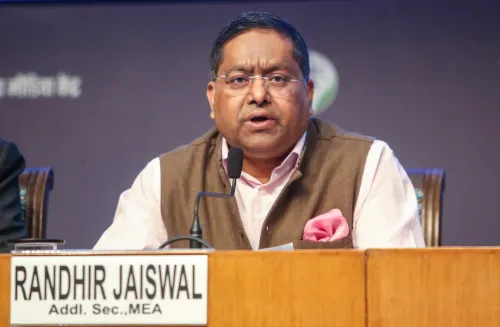
India's Ministry of External Affairs (MEA) on Friday, 20 November 2026, renewed its sharp criticism of the US Commission on International Religious Freedom (USCIRF), calling it a 'biased organisation with a blatantly political agenda' that does not merit serious engagement. The remarks came during a bi-weekly media briefing in New Delhi, where MEA spokesperson Randhir Jaiswal responded to questions about whether India intended to formally raise the USCIRF's latest allegations with the US government.
What Jaiswal Said
Jaiswal was asked whether New Delhi would take up the matter with Washington after the USCIRF recently accused the Indian government of targeting minority citizens by removing them from electoral rolls. His reply was unambiguous: 'On USCIRF, I want to repeat what I have said earlier that we see it as a biased organisation with a blatantly political agenda, and I don't think an organisation which is so prejudiced needs to be taken seriously.'
The response closely echoed language used by the MEA on 10 November, when it had described the USCIRF as a 'biased and ill-informed organisation' with a 'blatantly political agenda.' That earlier rebuke had also pointed to the commission's silence on attacks targeting the Indian community inside the United States.
India's Core Charge: Selective Silence
A central thread in India's criticism is what it frames as a double standard. During the 10 November briefing, Jaiswal highlighted that the USCIRF and its commissioners had 'consistently kept silent on attacks on religious places in the United States, as well as on hate crimes and racial abuse that are targeted at the Indian community in the United States.'
He cited a specific recent example: last month, an alleged plot to attack a Hindu temple in the US state of Illinois was foiled. According to prosecutors, Alexandros Paporakis, 19, of Palatine — described as a self-identified neo-Nazi — allegedly attempted to shoot a man outside the Sri Venkateswara Swami (Balaji) Temple in Aurora on 11 October, the first day of Navaratri, but his rifle jammed. Prosecutors further alleged that Paporakis had written an eight-page white supremacist manifesto describing violence against people of Indian descent at a Hindu place of worship.
US Lawmakers' Response to the Temple Attack
The alleged attack drew a significant bipartisan response on Capitol Hill. As many as 105 US lawmakers urged the Federal Bureau of Investigation (FBI) to investigate the alleged incident as a possible federal hate crime, warning of growing threats against Indian-Americans and other South Asian communities. India's argument is that the USCIRF, which regularly comments on religious freedom in India, has remained conspicuously quiet on this episode.
Pattern of Friction
This is not the first time India has pushed back against the USCIRF. The commission has repeatedly placed India on its watchlist of countries of concern, drawing consistent denials and rebuttals from New Delhi, which regards such designations as interference in domestic affairs driven by political motivations. The USCIRF's latest allegation — that minority voters are being removed from electoral rolls — represents an escalation in its scrutiny of India's democratic processes, a charge the MEA has dismissed without offering a detailed rebuttal on the specifics.
Notably, the timing of India's renewed pushback comes as India-US diplomatic ties remain broadly stable, suggesting New Delhi is calibrating its criticism to signal displeasure without escalating at the bilateral level. How the new US administration eventually responds — or whether it distances itself from the USCIRF's positions — will be closely watched.
Point of View
New Delhi avoids legitimising the commission's framing while keeping its own counter-narrative — USCIRF's silence on anti-Hindu violence in America — in circulation. The Illinois temple episode is a tactically useful exhibit, and the fact that 105 US lawmakers backed an FBI investigation gives India bipartisan cover. What is missing from the MEA's rebuttal, however, is any direct address of the specific charge about minority voters and electoral rolls — a gap that critics will note. The broader question is whether India's blanket dismissal strategy is sustainable as the USCIRF broadens its scrutiny from religious persecution to electoral processes, a domain far harder to wave away.
NationPress
20 Nov 2026
Frequently Asked Questions
What did India say about the USCIRF on 20 November 2026?
MEA spokesperson Randhir Jaiswal called the USCIRF a 'biased organisation with a blatantly political agenda' and said it does not merit serious engagement. India declined to raise the matter formally with the US government.
What did the USCIRF accuse India of this time?
The USCIRF recently accused the Indian government of targeting minority citizens by removing them from electoral rolls. India has not addressed the specific allegation, dismissing the commission's credibility instead.
Why does India say the USCIRF is biased?
India argues that the USCIRF selectively targets India while staying silent on anti-Indian and anti-Hindu incidents in the United States itself. It has repeatedly cited the commission's failure to condemn hate crimes and attacks on Hindu temples in the US as evidence of double standards.
What was the Illinois Hindu temple incident?
Prosecutors allege that Alexandros Paporakis, 19, a self-identified neo-Nazi from Palatine, Illinois, attempted to shoot a man outside the Sri Venkateswara Swami (Balaji) Temple in Aurora on 11 October 2026 — the first day of Navaratri — but his rifle jammed. He allegedly wrote an eight-page white supremacist manifesto targeting people of Indian descent. Some 105 US lawmakers have urged the FBI to investigate it as a federal hate crime.
Has India previously criticised the USCIRF?
Yes. India has consistently rejected USCIRF designations placing it on a watchlist of countries of concern, calling them politically motivated and an interference in domestic affairs. The 20 November remarks echo a near-identical rebuke issued on 10 November 2026.