Giriraj Singh hails India's first geothermal wells in Ladakh
Synopsis
Union Textiles Minister Giriraj Singh has hailed ONGC's completion of India's first two geothermal wells in Ladakh's Puga Valley, calling it a landmark for clean energy and Atmanirbhar Bharat. The milestone follows decades of surveys at the site and advances India's push for non-fossil baseload power.
Key Takeaways
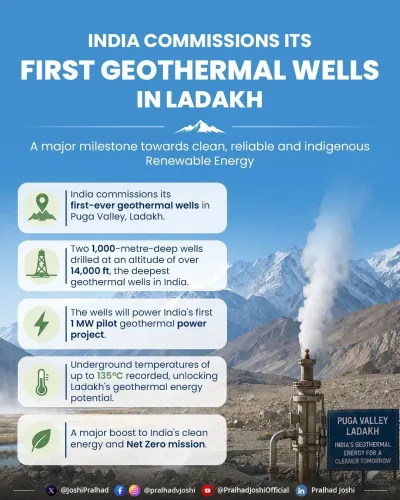
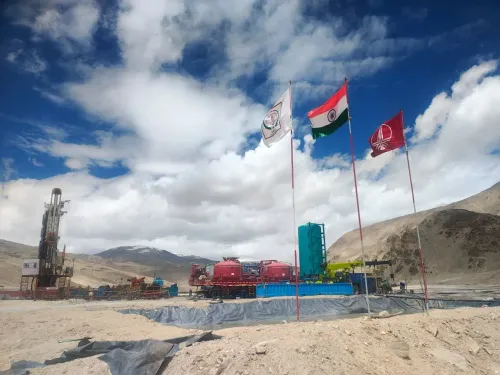
ONGC has drilled India's first two geothermal wells in Puga Valley, Ladakh , according to Union Textiles Minister Giriraj Singh .
Puga Valley has been identified as India's prime geothermal site since surveys conducted in the 1970s and 1980s by ONGC and the Geological Survey of India.
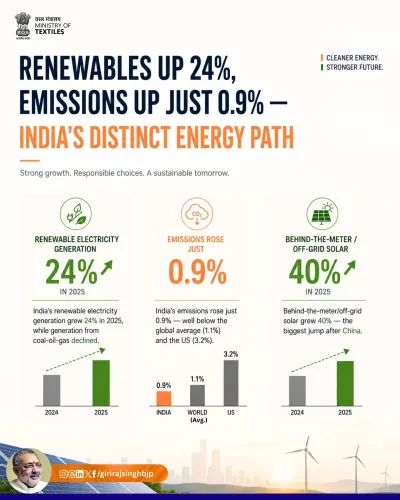
Geothermal energy provides continuous baseload power, addressing the intermittency gap in India's solar and wind-heavy renewable mix.
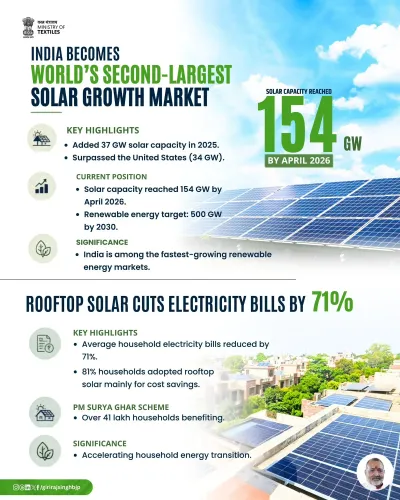
The project aligns with India's target of 500 GW non-fossil energy capacity by 2030 and net-zero emissions by 2070 .
Ladakh's strategic border location makes local energy self-sufficiency a national security priority alongside environmental goals.
Commercial viability, grid integration, and tariff policy remain the key unresolved steps before the Puga pilot can deliver power at scale.
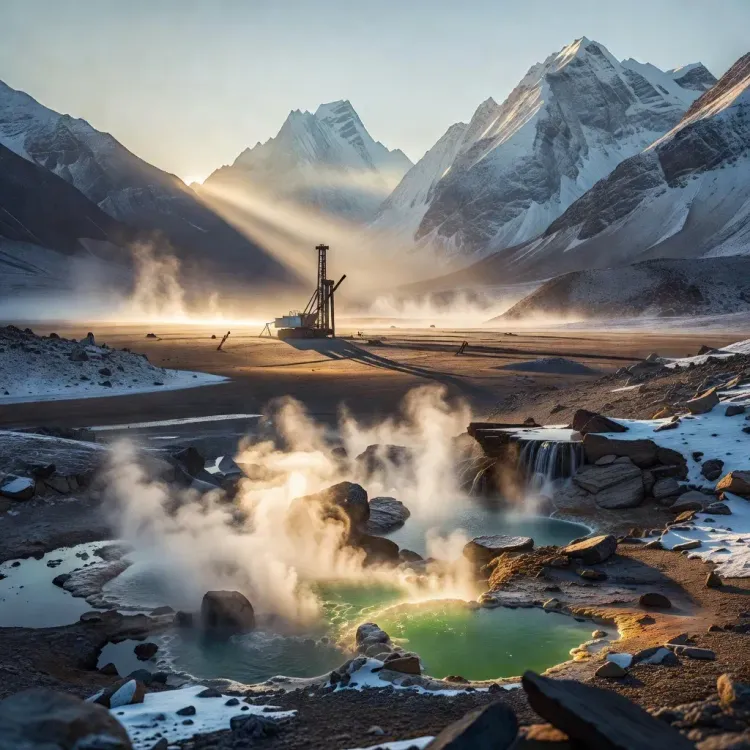
Deep beneath the high-altitude silence of Ladakh's Puga Valley, India has drilled what Union Textiles Minister Giriraj Singh is calling a historic first — the country's inaugural pair of geothermal wells, executed by state-run ONGC, marking a tangible step toward energy sources that run day and night, regardless of sun or wind.
Posting on Wednesday, 29 July 2026, Singh declared in Hindi: 'Bharat ne swachh urja ki disha mein ek aur aitihasik uplabdhi hasil ki hai' — 'India has achieved yet another historic milestone in the direction of clean energy.' He tied the drilling success directly to Prime Minister Narendra Modi's vision and the broader Atmanirbhar Bharat self-reliance push.
Why Puga Valley, and why now
Puga Valley in eastern Ladakh is no random choice. The site has been flagged as India's most promising geothermal zone since reconnaissance surveys carried out by ONGC and the Geological Survey of India in the 1970s and 1980s — hot springs and surface thermal manifestations have long signalled heat reservoirs below. Turning that decades-old survey data into actual drilled wells represents a significant operational leap.
Ladakh's geography makes energy security a strategic imperative, not just an environmental one. The union territory shares sensitive borders, and conventional grid connectivity to the region remains limited. A local geothermal baseload source could change the calculus entirely — power that does not depend on fuel convoys or weather windows.
Geothermal's place in India's 500 GW clean-energy push
India has set an ambitious target of 500 GW of non-fossil energy capacity by 2030, with a net-zero commitment by 2070. Solar and wind dominate the current build-out, but both are intermittent. Geothermal offers something neither can — continuous, round-the-clock generation from the earth's own heat, making it a potential anchor for baseload supply in remote grids.
The National Action Plan on Climate Change (2008) had included geothermal in India's renewable portfolio, but progress on actual drilling remained slow for years. The Puga wells, if the milestone holds, would represent the first time India has moved from surveys and policy to physical infrastructure in the ground.
What comes next for the Puga pilot
The critical questions now shift from drilling to delivery: commercial viability assessments, grid integration planning, and tariff policy will determine whether Puga becomes a template or a one-off. Any follow-up from the Ministry of New and Renewable Energy on scaling geothermal exploration nationally will be the real signal to watch.
For now, India's clean-energy map has a new dot — drilled into the frozen earth of the Himalayas, pointing toward a baseload future the country has been circling for half a century.
Point of View
Acknowledged in policy but starved of capital and execution; actual drilled wells would mark a genuine shift in seriousness. The fact that it is the Textiles Minister, not the Energy or Petroleum Minister, amplifying this milestone underscores how cross-portfolio the Atmanirbhar Bharat narrative has become — every cabinet voice is expected to carry the development story. Commercial viability remains the unresolved test: moving from pilot wells to grid-scale supply in Ladakh's terrain will require policy and tariff commitments that have not yet materialised publicly.
NationPress
28 Oct 2026
Frequently Asked Questions
What are the geothermal wells drilled by ONGC in Ladakh?
ONGC has drilled India's first two geothermal wells in Puga Valley , eastern Ladakh — a site identified since the 1970s as India's most promising geothermal zone due to its hot springs and subsurface heat reservoirs.
Where is Puga Valley and why is it significant for geothermal energy?
Puga Valley is located in eastern Ladakh in the northern Himalayas. It has visible hot springs and thermal surface activity, making it the site most consistently identified by geologists as India's best candidate for geothermal power generation.
What is India's geothermal energy potential?
India has several geothermal provinces, with Puga Valley in Ladakh being the most developed. Geothermal energy offers round-the-clock baseload generation, complementing India's solar and wind capacity as the country targets 500 GW of non-fossil power by 2030 .
Why did Giriraj Singh comment on an energy project if he is the Textiles Minister?
Cabinet ministers across portfolios routinely amplify major national milestones on social media under the Atmanirbhar Bharat and Viksit Bharat 2047 communication frameworks, regardless of their specific ministry.
What happens after India's first geothermal wells are drilled in Puga?
The next steps involve commercial viability assessments, grid integration planning, and tariff policy decisions by the Ministry of New and Renewable Energy to determine whether the Puga pilot can be scaled into a functioning power source for Ladakh.