Giriraj Singh flags India's push into 1150 kV UHV power transmission
Synopsis
Union Textiles Minister Giriraj Singh amplified India's plans to advance into 1150 kV Ultra High Voltage power transmission, building on the country's 2012 UHVAC test station legacy at Bina, Madhya Pradesh, and aligned with renewable energy grid modernisation goals.
Key Takeaways
Union Textiles Minister Giriraj Singh shared India's UHV power transmission push on 23 May 2026 via the NaMo App.
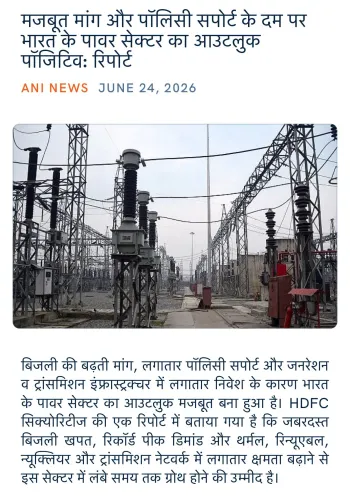
India is preparing to advance into 1150 kV Ultra High Voltage (UHV) integration for long-distance power transmission.
India commissioned a 1200 kV UHVAC test station at Bina, Madhya Pradesh in 2012 , establishing early UHV research credentials.
UHV corridors are critical to evacuating power from renewable energy sites in Rajasthan and Gujarat to distant load centres.
Key watchers will track tenders from the Ministry of Power and Power Grid Corporation for commercial UHV line deployment.
Successful commercial deployment would place India alongside China as one of the very few countries operating UHV lines at scale.
Union Textiles Minister Giriraj Singh on Saturday, 23 May 2026, shared a report highlighting India's preparations to write a new chapter in power transmission through 1150 kV Ultra High Voltage (UHV) integration, signalling the government's intent to advance the country's long-distance electricity grid infrastructure.
Context
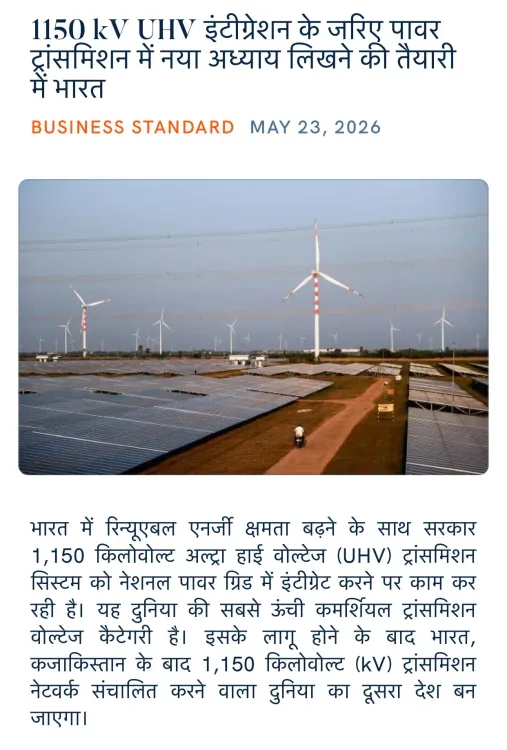
Singh shared the post via the NaMo App, amplifying coverage of India's emerging push into UHV transmission technology. The Hindi caption reads: '1150 kV UHV integration ke zariye power transmission mein naya adhyay likhne ki taiyari mein Bharat' — translated as 'India is preparing to write a new chapter in power transmission through 1150 kV UHV integration.' The post reflects the ruling dispensation's emphasis on infrastructure modernisation as a political and economic priority.
Policy Backdrop
India has a history of pioneering high-voltage transmission research. In 2012, the country commissioned a 1200 kV UHVAC national test station at Bina, Madhya Pradesh, making it one of the few nations to develop and test such technology at scale. That facility laid the groundwork for eventual commercial deployment of ultra high voltage lines capable of transmitting bulk power over thousands of kilometres with significantly lower losses.
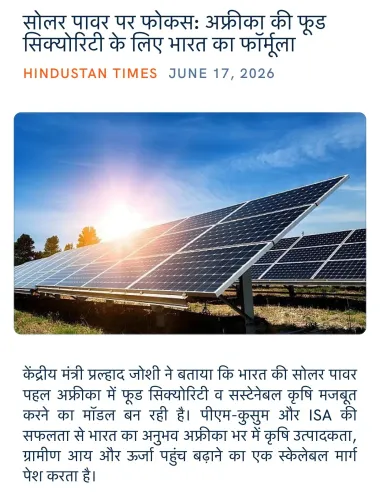
The broader grid modernisation drive is closely linked to India's renewable energy capacity addition targets. As solar and wind generation sites are often located far from consumption centres — in Rajasthan, Gujarat, and the Himalayan foothills — UHV corridors are seen as essential infrastructure to wheel that power efficiently to load centres in the north, west, and south.
Stakeholders and Impact
Power Grid Corporation of India, the central transmission utility, along with state power utilities and private renewable energy developers, stand to be the primary stakeholders in any 1150 kV rollout. Higher voltage transmission reduces resistive losses per unit of power carried, which can translate into lower per-unit transmission costs and improved grid reliability for end consumers.
Renewable energy developers, who often face evacuation bottlenecks at project sites, would benefit from dedicated UHV corridors that can absorb large quantum of generation. Industrial consumers and distribution companies in power-deficit regions could see more stable supply if inter-regional transfer capacity expands substantially.
What's Next
Watchers of India's power sector will track whether the Ministry of Power or Power Grid Corporation issues formal tenders or feasibility notifications for 1150 kV or 1200 kV transmission lines in the near term. The transition from test-station validation to commercial deployment involves regulatory clearances, right-of-way acquisition, and equipment indigenisation — each carrying its own timeline.
If India successfully operationalises UHV lines at commercial scale, it would join a very small group of countries — led by China — that have deployed such technology in live grid conditions, marking a significant leap in the country's energy infrastructure capability.
Point of View
Where ministers across portfolios reinforce the infrastructure narrative via the NaMo App ecosystem. The 1150 kV UHV push, if it moves from aspiration to tender, would represent a generational upgrade to India's transmission backbone, directly enabling the renewable energy transition. It also signals competitive awareness of China's lead in commercial UHV deployment, positioning India's grid modernisation as a matter of strategic as well as economic urgency. The timing, ahead of peak summer demand stress on the grid, lends the messaging additional political salience.
NationPress
19 Sept 2026
Frequently Asked Questions
What is 1150 kV UHV power transmission and why does it matter for India?
1150 kV Ultra High Voltage (UHV) transmission refers to electricity lines operating at extremely high voltages, enabling bulk power to be carried over very long distances with lower energy losses. For India, it matters because renewable energy generation sites are often far from demand centres, and UHV corridors can efficiently wheel that power across the country.
Has India worked on UHV transmission before?
Yes. India commissioned a 1200 kV UHVAC national test station at Bina in Madhya Pradesh in 2012, making it one of the few countries to develop and test such technology. That facility has been the foundation for India's UHV research and development efforts.
Why did Giriraj Singh, a Textiles Minister, post about power transmission?
Giriraj Singh shared the post via the NaMo App, a platform used by BJP leaders to amplify government achievements across sectors. Senior ministers routinely share infrastructure and development stories beyond their own portfolios as part of the party's broader communication strategy.
Which agencies would implement a 1150 kV UHV transmission network in India?
Power Grid Corporation of India, the central transmission utility, would be the primary implementing agency, working alongside the Ministry of Power. State power utilities and private developers could also participate depending on the project structure.
How does UHV transmission help India's renewable energy goals?
Large solar and wind projects are concentrated in states like Rajasthan and Gujarat, far from major load centres. UHV transmission lines can carry bulk renewable power over thousands of kilometres efficiently, reducing bottlenecks in power evacuation and supporting India's clean energy capacity targets.