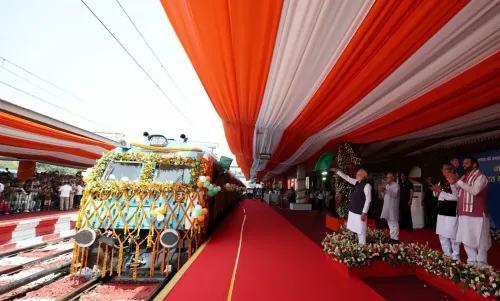
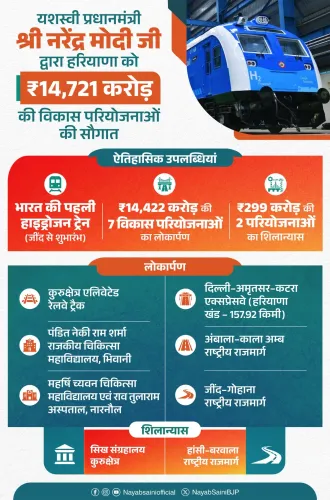
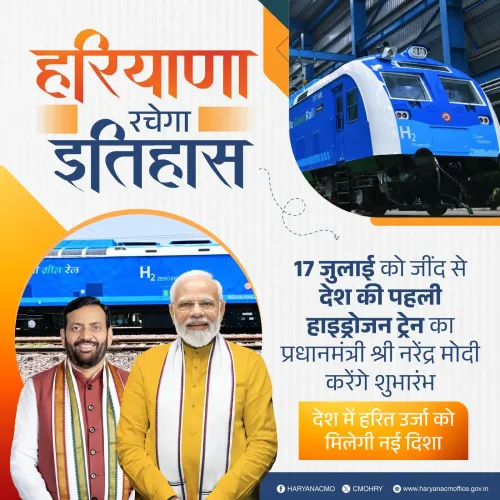
Piyush Goyal flags India's first hydrogen train launch from Jind
Synopsis
Union Minister Piyush Goyal declared on 17 July 2026 that India received its first hydrogen train, launched from Jind in Haryana — a milestone he said has written the district's name into history and advances India's rail decarbonisation agenda.
Key Takeaways
Union Minister Piyush Goyal announced on 17 July 2026 that India's first hydrogen train was launched from Jind, Haryana .
The minister described the event as historic for both Jind and the state of Haryana .
Hydrogen fuel-cell trains emit only water vapour, offering a zero-direct-emission alternative to diesel traction.
Indian Railways has been developing hydrogen train technology since at least 2022 as part of its decarbonisation drive.
The launch aligns with the National Green Hydrogen Mission approved by the Union Cabinet in 2023 .
Operational data from the Jind pilot will shape decisions on further hydrogen rake procurement.
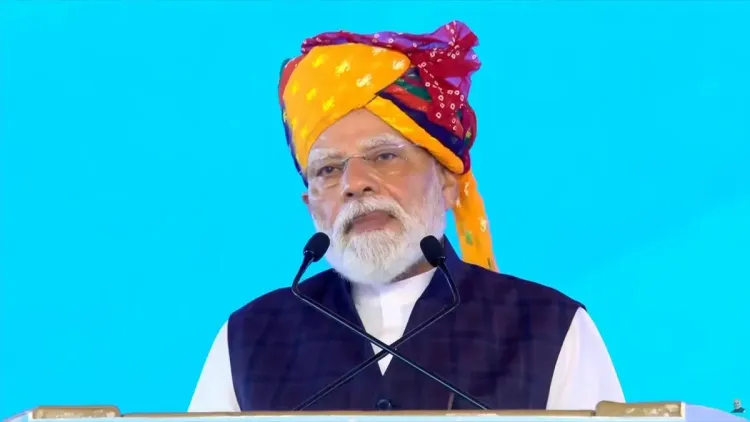
Union Commerce and Industry Minister Piyush Goyal on Friday, 17 July 2026, marked what he described as a historic moment for Jind and the state of Haryana, declaring that India had received its first hydrogen train from the district.
Posting on X in Hindi, Goyal wrote: 'Aaj Jind aur Haryana ka naam itihas ke panon mein darj ho gaya hai. Aaj yahan se desh ko pehli hydrogen train mili hai' — 'Today the name of Jind and Haryana has been written into the pages of history. Today, from here, the country has received its first hydrogen train.'
Context
The launch event at Jind, a district headquarters in northern Haryana, marks a significant symbolic milestone in India's push to decarbonise its vast rail network. The minister's post underscores the political salience of the development for the state, which borders Delhi and hosts a dense web of rail connectivity.
Hydrogen fuel-cell trains produce zero direct emissions, emitting only water vapour, making them a sought-after technology for rail corridors where overhead electrification is difficult or costly to deploy.
Policy Backdrop
Indian Railways flagged the development of hydrogen fuel-cell trains in successive budgets and rail conventions from 2022 onward as a core plank of its decarbonisation agenda. The technology aligns with India's broader 2070 net-zero commitment and the push to reduce diesel dependency across non-electrified routes.
The National Green Hydrogen Mission, approved by the Union Cabinet in 2023, provides the overarching policy framework for scaling green hydrogen production and deployment across sectors, including transport. Hydrogen trains represent one of the most visible end-use applications under that mission.
The Jind launch continues a pattern of state-level rollouts for landmark rail technologies — a model previously seen with the introduction of Vande Bharat express services and semi-high-speed corridor trials in different parts of the country.
Stakeholders and Impact
Passengers on the Haryana rail network stand to be the immediate beneficiaries if the hydrogen train enters regular service, offering a cleaner alternative to diesel-hauled trains on routes not yet covered by overhead electrification. Indian Railways, as the operating entity, will gather critical operational data on range, refuelling logistics, and maintenance costs from this pilot.
The launch also carries economic significance for Jind district, elevating its profile as the origin point of a nationally significant technology deployment. State officials and local representatives are expected to leverage the milestone in ongoing infrastructure-investment discussions with the Centre.
What's Next
Attention will now turn to operational performance data from the Jind service — including reliability metrics and refuelling turnaround times — which will determine whether Indian Railways places follow-on orders for additional hydrogen rakes. Policymakers will also watch how this pilot integrates with procurement and production targets under the National Green Hydrogen Mission.
If the Jind pilot proves commercially viable, it could accelerate the rollout of hydrogen traction across other non-electrified corridors, potentially reshaping India's green mobility roadmap well before the 2070 net-zero deadline.
Point of View
High-visibility output of India's green hydrogen policy architecture — translating Cabinet-level mission approvals into an on-the-ground rail deployment. For the BJP, anchoring the milestone in Haryana carries clear electoral optics in a state that has been a political battleground. The broader significance lies in whether this pilot can generate the operational evidence needed to justify network-scale procurement, or whether it remains a symbolic first mover. The minister's framing of the event as 'written into the pages of history' signals that the government intends to treat hydrogen rail as a flagship decarbonisation narrative alongside electrification.
NationPress
16 Oct 2026
Frequently Asked Questions
What is India's first hydrogen train and where was it launched?
India's first hydrogen train was launched from Jind in Haryana on 17 July 2026 , as announced by Union Minister Piyush Goyal on X.
How does a hydrogen train work?
A hydrogen fuel-cell train uses hydrogen gas to generate electricity through a chemical reaction with oxygen, powering electric traction motors and emitting only water vapour — producing zero direct exhaust emissions.
What is the National Green Hydrogen Mission?
The National Green Hydrogen Mission was approved by the Union Cabinet in 2023 to scale up green hydrogen production and deployment across sectors including transport, energy, and industry in India.
Why is the Jind hydrogen train launch significant for Indian Railways?
It marks the first operational deployment of hydrogen traction technology on the Indian rail network, providing real-world data that could inform decisions on expanding the technology to other non-electrified corridors.
What happens next after the hydrogen train launch in Jind?
Authorities will monitor operational performance, refuelling logistics, and costs from the Jind pilot before deciding on follow-on orders for additional hydrogen rakes and broader integration with the National Green Hydrogen Mission .