India's national highway deaths fall 4.1% post-Covid, first drop since pandemic
Synopsis
For the first time since the pandemic, India's national highway death toll has actually fallen — by 4.1%, from 64,772 to 62,122. The drop is real but uneven: UP, MP, and Punjab drove the gains while fifteen states, including Tamil Nadu and Maharashtra, recorded higher tolls. The government's 4E strategy is showing early results, but the harder test is whether state roads — where the bulk of fatalities occur — can follow.
Key Takeaways
National highway deaths in India fell 4.1% — from 64,772 to 62,122 — the first decline since the Covid-19 pandemic.
Data was tabled in the Lok Sabha by the Ministry of Road Transport and Highways (MoRTH) and compiled via the e-DAR portal.
Uttar Pradesh led improvements, with highway deaths falling from 9,560 to 7,573 ; Madhya Pradesh and Punjab also recorded significant drops.
Fifteen states and Union Territories — including Tamil Nadu , Maharashtra , Karnataka , and Bihar — reported higher fatalities.
Overspeeding remains the leading cause of fatal crashes, followed by wrong-side driving, driver fatigue, and mobile phone distraction.
Overall road accidents across India, including on state highways and city roads, continued to rise despite the national highway improvement.
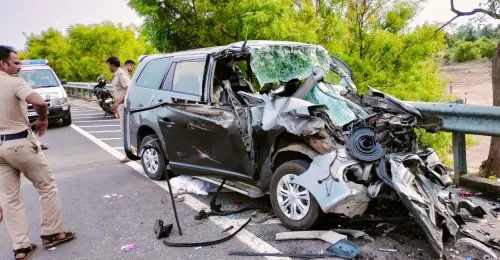
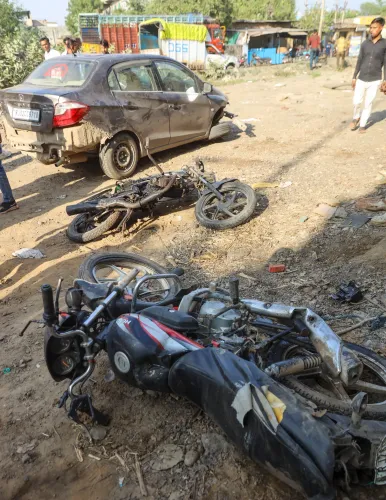
India has recorded a fall in national highway fatalities for the first time since the Covid-19 pandemic, with deaths on the national highway network dropping 4.1% — from 64,772 to 62,122 — according to figures tabled in the Lok Sabha by the Ministry of Road Transport and Highways (MoRTH). The data, compiled through the government's electronic Detailed Accident Report (e-DAR) portal, marks a rare reversal after years of steadily rising fatalities as traffic volumes rebounded to pre-pandemic levels.
What Drove the Decline
The government attributes the improvement to its '4E strategy' — Education, Engineering, Enforcement, and Emergency Care. Officials point to large-scale rectification of accident-prone blackspots, redesigned road geometry, improved signage, tighter access control, and an expanded network of speed cameras and electronic monitoring systems.
Emergency response initiatives were also cited as a contributing factor, particularly cashless treatment schemes designed to save lives during the critical 'golden hour' immediately following a crash. Taken together, these interventions appear to have begun translating into measurable outcomes on the national highway network.
State-by-State Picture
Uttar Pradesh led the improvement among states, recording a sharp fall in highway deaths from 9,560 to 7,573. Madhya Pradesh followed with a reduction from 4,644 to 3,610, while Punjab saw fatalities decline from 1,562 to 1,022.
The picture was not uniformly positive, however. Fifteen states and Union Territories reported increases, with Tamil Nadu, Maharashtra, Karnataka, and Bihar among those registering higher death tolls. The divergence underscores how unevenly safety interventions have been implemented across the country.
Where the Challenge Remains
Despite the encouraging trend on national highways, overall road accidents across India — including those on state highways and city roads — continued to climb. Experts caution that the country's road safety challenge remains formidable. Overspeeding continues to be the leading cause of fatal crashes, followed by wrong-side driving, driver fatigue, and mobile phone distraction.
Notably, the improvement is confined to the centrally managed highway network, where enforcement and infrastructure upgrades are more consistently applied. State roads, which carry a significant share of traffic, have yet to show comparable gains.
What the Data Signals
India has long recorded one of the world's highest road fatality rates, making even a modest percentage decline statistically significant. The e-DAR portal's role in systematically capturing accident data has itself been flagged as a structural improvement, enabling better identification of high-risk stretches for targeted intervention.
Whether this marks the beginning of a sustained downward trend will depend on how consistently the Centre and state governments build on these early gains — particularly in the fifteen states where fatalities are still rising.
Point of View
But it should not be mistaken for a road safety turnaround. The improvement is essentially a story about centrally controlled infrastructure — where enforcement and blackspot rectification are tractable — while state roads, which carry the majority of India's traffic and casualties, continue to worsen. The 4E strategy is the right framework, but its application remains patchy. More troubling is the divergence between states: UP's sharp decline and Tamil Nadu's simultaneous rise suggest that political will and administrative capacity, not just policy design, are the decisive variables. India's road fatality rate per lakh population remains among the highest globally, and a single year's dip on one category of roads is a data point, not a trend.
NationPress
18 Sept 2026
Frequently Asked Questions
Why have India's national highway deaths fallen for the first time since Covid-19?
National highway fatalities dropped 4.1% — from 64,772 to 62,122 — primarily due to the government's 4E strategy covering Education, Engineering, Enforcement, and Emergency Care. Key measures included blackspot rectification, improved road design, speed cameras, and cashless emergency treatment schemes targeting the critical golden hour after crashes.
Which states recorded the biggest improvements in highway safety?
Uttar Pradesh led the decline, with highway deaths falling from 9,560 to 7,573. Madhya Pradesh saw a reduction from 4,644 to 3,610, and Punjab recorded a drop from 1,562 to 1,022. These three states accounted for a significant share of the overall national improvement.
Which states saw highway fatalities increase despite the national trend?
Fifteen states and Union Territories reported higher fatalities, including Tamil Nadu, Maharashtra, Karnataka, and Bihar. The uneven picture highlights disparities in enforcement capacity and infrastructure investment across states.
Does the decline mean India's overall road accident problem is improving?
Not entirely. While national highway deaths fell, overall road accidents across India — including on state highways and city roads — continued to rise. The improvement is concentrated on the centrally managed highway network, where interventions are more consistently applied.
What is the e-DAR portal and why does it matter for road safety?
The electronic Detailed Accident Report (e-DAR) portal is the government's digital system for systematically recording road accident data. It enables authorities to identify high-risk stretches and target interventions more precisely, and the figures tabled in the Lok Sabha were compiled through this platform.