India's renewable energy hits 300 GW milestone, outpacing Western expectations
Synopsis
India crossed 300 GW of non-fossil fuel capacity in July 2026 and hit its 50% renewables target five years early — yet Western climate discourse keeps fixating on coal. The Diplomat analysis lays out why that framing misses the scale and speed of one of the fastest energy build-outs in history, while also flagging the real barriers: storage gaps, carbon border tariffs, and a $1 trillion-plus shortfall in global climate finance.
Key Takeaways
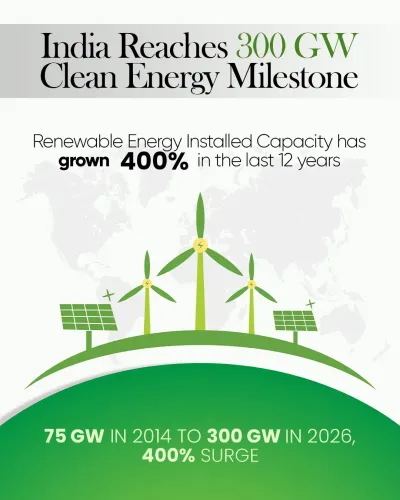
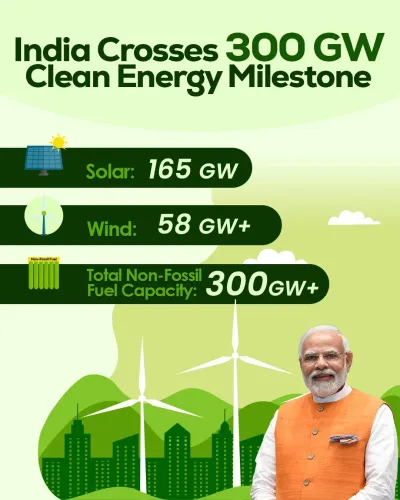
India's non-fossil fuel capacity surpassed 300 GW in July 2026 , exceeding half of total installed power capacity.
India crossed its 50% renewables target in June 2025 , five years ahead of schedule; the earlier 40% target was met nearly a decade early in November 2021 .
The country added a record 55 GW of clean capacity in 2025–26 and now ranks third globally for installed renewable energy.
Despite the capacity milestone, renewables supply under a third of India's actual electricity consumption due to storage and grid gaps.
Indian steel and aluminium exporters may need to cut prices by 15–22% to comply with European carbon border rules, per the Global Trade Research Initiative .
India objected at COP29 to a $300 billion annual climate finance goal, calling it less than a quarter of the $1.3 trillion developing nations had sought.
India's non-fossil fuel energy capacity surpassed 300 gigawatts in July 2026, crossing the halfway mark of total installed capacity — a milestone that analysts say Western commentary on India's climate commitments has largely failed to acknowledge, according to an analysis published in The Diplomat. The country added a record 55 gigawatts of clean energy capacity in the 2025–26 financial year alone, cementing its position as the third-largest installed renewable energy market in the world.
Targets Met Years Ahead of Schedule
At the 2015 Paris climate conference, India pledged that 40 per cent of its installed power capacity would come from non-fossil fuel sources by 2030. The country reached that threshold in November 2021 — nearly a decade early. After raising the bar to 50 per cent, India crossed that revised target in June 2025, again five years ahead of its own deadline. On 29 July 2025, renewables met more than half of India's total electricity demand in a single day, underscoring the pace of the transition.
The Structural Challenge Western Critics Miss
Despite the headline numbers, the transition is not without friction. Although over half of India's installed capacity is now non-fossil, these sources supply under a third of the electricity the country actually consumes. Solar generation peaks in the afternoon, while demand typically spikes in the evening — a mismatch that storage and transmission infrastructure, still under construction, is yet to bridge. Until that gap is closed, coal will remain the backbone of reliable baseload supply. Clean capacity is being added rapidly, but electricity demand is rising almost as fast, the analysis noted.
This comes amid a broader context that Western critics rarely factor in: many of today's high-income economies industrialised on coal for over a century before shifting to cleaner energy. India is attempting to do both simultaneously — expanding electricity access and industrial output for 1.4 billion people while building one of the largest clean-energy systems ever assembled.
Trade Pressure and the Carbon Border Problem
India's industrial exporters face a separate, compounding pressure. Steel and aluminium are among the hardest sectors to decarbonise, and Indian firms now face carbon border adjustment rules in key European markets. The Global Trade Research Initiative estimates that Indian steel and aluminium exporters may need to cut prices by 15 to 22 per cent to remain competitive in Europe. Smaller firms bear a disproportionate burden, struggling with the cost of measuring and reporting emissions at the scale that European compliance requires.
Finance Remains the Binding Constraint
'Finance is the final, perhaps most binding, constraint. A transition of this scale requires enormous investment, much of it in grids and storage with long payback periods,' the article noted. At COP29, India formally objected to the new climate finance goal of $300 billion a year, which was less than one-fourth of the $1.3 trillion that developing countries had collectively demanded — a gap that critics argue renders the target structurally inadequate for economies at India's stage of development.
Carbon Markets and the Road Ahead
India's national carbon market became operational in January 2025, providing industry with a price signal to reduce emissions. Growth in India's fossil fuel emissions is projected to have slowed sharply in 2025. Energy transitions are rarely linear, as recent Western experience confirms — and India's trajectory, while imperfect, is one of the fastest clean-energy build-outs in history. How quickly storage and grid infrastructure can close the reliability gap will determine whether the country can reduce its coal dependence as decisively as it has expanded its renewable base.
Point of View
Then a revised target in 2025 five years early, is not incremental progress — it is among the fastest sovereign energy pivots on record. The real story is structural, not political: storage and grid investment still lag capacity addition, meaning coal cannot exit on political will alone. The COP29 finance standoff is also under-reported; a $300 billion offer against a $1.3 trillion ask is not a compromise, it is a signal that the global financing architecture is not calibrated for transitions at India's scale.
NationPress
12 Oct 2026
Frequently Asked Questions
How much renewable energy capacity does India have in 2026?
India's non-fossil fuel energy capacity crossed 300 gigawatts in July 2026, accounting for more than half of the country's total installed power capacity. The country also added a record 55 GW of clean energy in the 2025–26 financial year.
Did India meet its Paris Agreement renewable energy targets?
Yes, and ahead of schedule on both counts. India pledged 40% non-fossil capacity by 2030 and hit it in November 2021, nearly a decade early. It then raised the target to 50% and crossed that in June 2025, five years before the deadline.
Why does India still rely on coal if renewables exceed half its capacity?
Although non-fossil sources make up over half of installed capacity, they generate under a third of actual electricity consumed. Solar peaks in the afternoon while demand peaks in the evening, and storage and transmission infrastructure to bridge this gap is still being built, making coal the current backbone of reliable baseload supply.
What is the carbon border adjustment challenge for Indian exporters?
Indian steel and aluminium exporters face new carbon border rules in European markets. The Global Trade Research Initiative estimates they may need to cut prices by 15 to 22 per cent to remain competitive, with smaller firms hit hardest by the cost of emissions measurement and reporting compliance.
What was India's position on climate finance at COP29?
India objected to the new climate finance goal of $300 billion a year agreed at COP29, noting it was less than one-fourth of the $1.3 trillion that developing countries had collectively demanded. India argues the shortfall leaves economies like its own without adequate resources to fund grid, storage, and industrial decarbonisation at the required scale.