Jitendra Singh Launches BRCP Phase-III With ₹1,500 Cr Outlay
Synopsis
Union Science and Technology Minister Dr. Jitendra Singh launched BRCP Phase-III on 15 July 2026, backed by a ₹1,500 crore joint outlay from DBT and Wellcome Trust UK and approved by PM Modi's Cabinet, targeting a globally competitive biomedical research workforce as India eyes a USD 300 billion bioeconomy by 2030.
Key Takeaways
₹1,500 crore total outlay for BRCP Phase-III: ₹1,000 crore from the Department of Biotechnology and ₹500 crore from Wellcome Trust UK.
The funding was approved at a Cabinet meeting chaired by Prime Minister Narendra Modi .
The DBT–Wellcome Trust India Alliance partnership dates to 2008 and has grown into one of India's most prominent biomedical career platforms.
Singh projected India's Bioeconomy to reach USD 300 Billion by 2030 , with biotechnology as a key driver.
Phase-III will fund fellowships and research grants to enhance researchers' credentials, international visibility, and professional opportunities.
The Minister called for greater industry and philanthropic participation to translate research into diagnostics and affordable healthcare solutions.
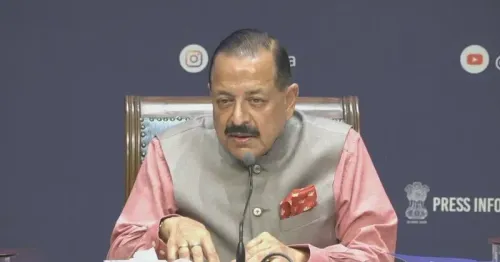
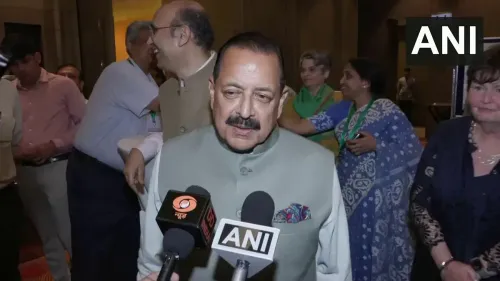
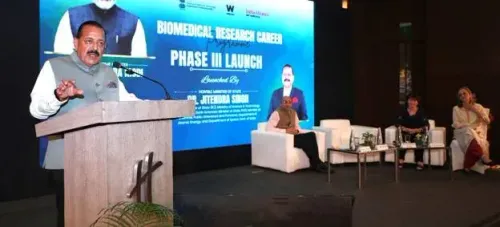
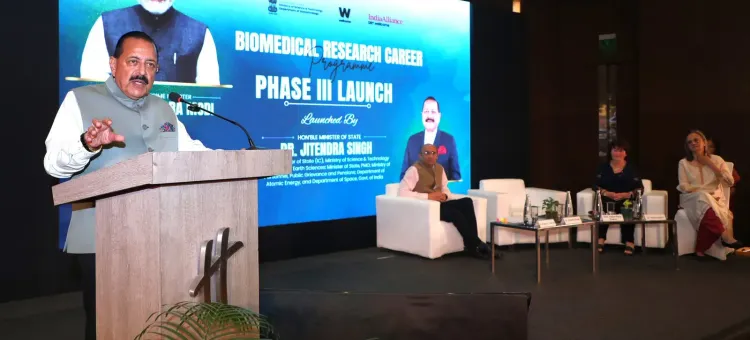
Union Science and Technology Minister Dr. Jitendra Singh on Wednesday, 15 July 2026 addressed the launch of Phase-III of the Biomedical Research Career Programme (BRCP), a flagship initiative jointly funded by the Department of Biotechnology (DBT) and the London-based Wellcome Trust, UK, marking a significant step in India's ambition to build a globally competitive biomedical research workforce.
Context
The Phase-III launch carries a total outlay of ₹1,500 crore, with ₹1,000 crore committed by the Department of Biotechnology and ₹500 crore contributed by Wellcome Trust UK. The funding package was cleared at a Cabinet meeting chaired by Prime Minister Shri Narendra Modi, underlining the government's institutional backing for the programme. The BRCP will continue to support fellowships and research grants aimed at nurturing biomedical researchers with international-grade credentials and visibility.
Speaking at the event, Dr. Singh stated: 'The next industrial revolution will be driven by biotechnology, and India is prepared to lead it.' He added that India's Bioeconomy is set to reach USD 300 Billion by 2030, framing the BRCP as a foundational investment in that trajectory.
Policy Backdrop
The DBT–Wellcome Trust India Alliance was formally established in 2008 as a competitive fellowship platform for early-career biomedical researchers in India, filling a structural gap in domestic research funding and international exposure. Over successive phases, the BRCP has evolved from a narrowly defined fellowship scheme into what Dr. Singh described as 'one of the most respected career platforms' in the biomedical sciences.
The programme's design — blending government budget support with foreign philanthropic capital — mirrors the approach outlined in India's National Biotechnology Development Strategy, which targeted expanded bioeconomy scale and stronger international research linkages. The DBT, established in 1986, remains the nodal body coordinating these efforts under the Ministry of Science and Technology.
Stakeholders and Impact
The primary beneficiaries are biomedical researchers, early-career scientists, and research institutions across India. Dr. Singh noted that the initiative has strengthened researchers 'not only through financial support but also by enhancing their credentials, international visibility and professional opportunities.' This positions BRCP fellows competitively in both domestic academia and global research ecosystems.
The Minister also highlighted the broader partnership model, calling the Government of India–Wellcome Trust UK collaboration 'a model of sustained international scientific collaboration and philanthropy.' He expressed hope for greater participation by philanthropic institutions and industry to translate research outputs into technologies, diagnostics, and affordable healthcare solutions — signalling an intent to expand the programme's translational scope beyond basic research.
What's Next
With Cabinet approval secured, attention now shifts to the rollout of Phase-III fellowship calls and grant cycles under the expanded ₹1,500 crore envelope. Dr. Singh's explicit call for industry and philanthropy to join the initiative suggests that new memoranda of understanding (MoUs) and co-funding arrangements could follow in the near term.
As India positions biotechnology as a pillar of its next phase of economic growth, the BRCP's Phase-III expansion represents a bet that sustained investment in research careers — backed by both state resources and international foundations — can accelerate the country's transition from a consumer to a producer of biomedical innovation.
Point of View
Multi-year strategy to close India's biomedical talent gap by anchoring domestic funding to foreign philanthropic capital — a model that reduces dependency on either source alone. The Cabinet imprimatur signals that biotechnology has moved from a sectoral priority to a national economic agenda item, consistent with the government's bioeconomy growth narrative. Dr. Singh's call for industry co-investment suggests the programme is being repositioned from a purely academic fellowship platform toward a translational pipeline — a shift that, if operationalised, could meaningfully accelerate the path from laboratory research to market-ready diagnostics and therapeutics. Whether new industry MoUs materialise will be the real test of that ambition.
NationPress
14 Oct 2026
Frequently Asked Questions
What is the Biomedical Research Career Programme (BRCP)?
The BRCP is a joint initiative of India's Department of Biotechnology and the UK-based Wellcome Trust, launched in 2008, that provides fellowships and research grants to build a globally competitive biomedical research workforce in India.
How much funding has been allocated for BRCP Phase-III?
BRCP Phase-III has a total outlay of ₹1,500 crore — ₹1,000 crore from the Department of Biotechnology and ₹500 crore from Wellcome Trust UK — approved by the Union Cabinet chaired by PM Narendra Modi.
Who approved the BRCP Phase-III funding?
The funding was approved at a Cabinet meeting chaired by Prime Minister Narendra Modi, giving the programme the highest level of government sanction.
What is India's bioeconomy target by 2030?
Union Minister Dr. Jitendra Singh stated that India's Bioeconomy is set to reach USD 300 Billion by 2030, with biotechnology identified as a primary driver of the next industrial revolution.
What is the role of Wellcome Trust in Indian biomedical research?
Wellcome Trust is a London-based global charitable foundation that has partnered with India's Department of Biotechnology since 2008 through the DBT–Wellcome Trust India Alliance, co-funding fellowships and grants for early-career biomedical researchers in India.