India Unveils Carbon Market Portal at Prakriti 2026 Summit
Synopsis
The Prakriti 2026 Summit, hosted by the Union government, has launched a pivotal carbon market portal, fostering discussions among leaders and experts about sustainable growth and climate action. This initiative marks a significant step towards enhancing India's position in global carbon markets.
Key Takeaways
Prakriti 2026 Summit focuses on carbon markets and climate action.
The Indian Carbon Market portal was launched to manage carbon trading.
Collaboration among multiple ministries highlights India's commitment to sustainability.
Discussion topics include compliance frameworks and innovative technologies.
Businesses are encouraged to view carbon markets as opportunities for growth.
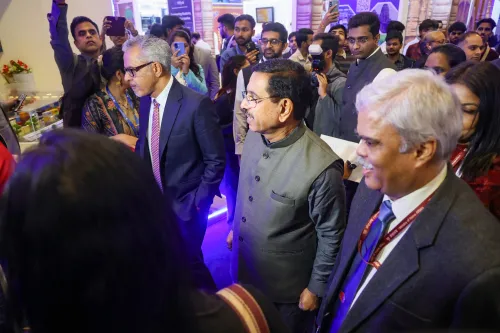
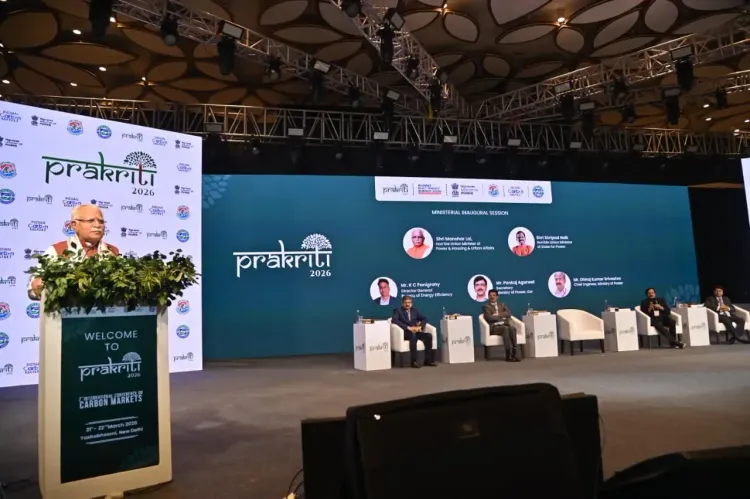
New Delhi, March 21 (NationPress) On Saturday, the Union government inaugurated the International Conference on Carbon Markets, dubbed Prakriti 2026, which brings together policymakers, industry leaders, and global experts to discuss the future of carbon markets and strategies for climate action.
This initiative was organized by the Bureau of Energy Efficiency, operating under the Ministry of Power and the Ministry of Environment, Forest and Climate Change.
The conference is part of the Bharat Electricity Summit 2026, aiming to provide a significant platform for stakeholders, both national and international, to engage in discussions about the evolving landscape of carbon markets, their impact on climate mitigation, and the potential for India’s sustainable growth.
Additionally, the Union government introduced the Indian Carbon Market portal during the event, which was attended by Union Minister for Power and Housing and Urban Affairs Manohar Lal Khattar, Minister of State for Power Shripad Naik, and other prominent figures.
This newly launched portal will act as a centralized platform for the management and execution of the Indian carbon market.
While inaugurating the portal, Minister Khattar emphasized India's pivotal role in advancing climate commitments.
He mentioned that initiatives like the Carbon Credit Trading Scheme, the expansion of renewable energy, and energy efficiency programs are integral to establishing a transparent and credible carbon market framework that will serve as a long-term national resource.
"India has successfully set up a carbon credit trading framework featuring nine recognized methodologies and over 40 registered entities engaged in projects related to biogas, hydrogen, and forestry," stated Union Minister Khattar.
He also encouraged businesses to perceive carbon markets not only as compliance obligations but as opportunities for innovation, investment, and sustainable development.
The two-day conference will include discussions on global carbon markets under the Paris Agreement Crediting Mechanism, compliance frameworks, digital monitoring, reporting, and verification technologies, carbon border policies, and the integration of new sectors such as buildings and cooling into India's carbon trading system.
Point of View
The launch of the Indian Carbon Market portal at the Prakriti 2026 Summit signifies a strategic move towards reinforcing India's commitment to climate action. The collaboration between various ministries and stakeholders illustrates a united approach to tackling environmental challenges and fostering economic growth through sustainability.
NationPress
22 Sept 2026
Frequently Asked Questions
What is the purpose of the Prakriti 2026 Summit?
The Prakriti 2026 Summit aims to bring together policymakers, industry leaders, and global experts to discuss carbon markets and climate action strategies.
Who organized the Prakriti 2026 Summit?
The summit was organized by the Bureau of Energy Efficiency under the Ministry of Power and the Ministry of Environment, Forest and Climate Change.
What is the Indian Carbon Market portal?
The Indian Carbon Market portal is a centralized platform designed for implementing and managing India's carbon market.
What initiatives are part of India's carbon market framework?
Initiatives include the Carbon Credit Trading Scheme, expansion of renewable energy, and energy efficiency programs.
What topics will be discussed during the conference?
The conference will cover global carbon markets, compliance frameworks, digital monitoring technologies, and integration of new sectors into India's carbon trading system.