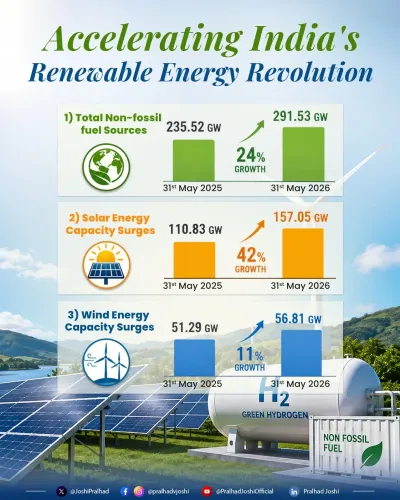
Pralhad Joshi Highlights India's Clean Energy Rise in BloombergNEF 2026 Report
Synopsis
Union Minister Pralhad Joshi cited the BloombergNEF India Transition Factbook 2026 to highlight India's growing stature in renewable energy deployment and clean hydrogen investment, linking the milestones to PM Modi's leadership and the government's Panchamrit climate commitments.
Key Takeaways
Union Minister Pralhad Joshi cited the BloombergNEF India Transition Factbook 2026 on 16 October 2026 to highlight India's clean energy progress.
India committed at COP26 (2021) to achieve 500 GW of non-fossil fuel capacity by 2030 under its Panchamrit strategy.
The National Green Hydrogen Mission was approved by the Union Cabinet in 2023 to scale domestic hydrogen production.
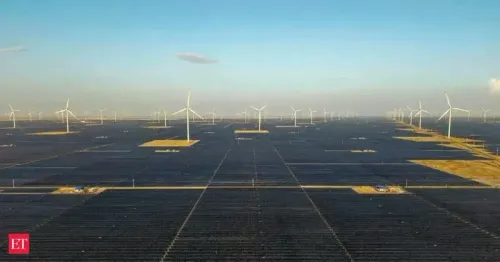
India ranks among the top five countries globally in installed solar and wind capacity.
Specific data points from the BloombergNEF 2026 factbook have not been independently verified from public record.
Next key signals include quarterly capacity data from the Ministry of New and Renewable Energy and Union Budget allocations for green hydrogen.
India's clean energy story is no longer a promise — it is a data point on a global benchmark. Union Minister of Consumer Affairs, Food and Public Distribution, and New and Renewable Energy Pralhad Joshi on Friday, 16 October 2026 cited the BloombergNEF India Transition Factbook 2026 to declare that India has emerged as a key player in renewable energy deployment, clean hydrogen, and energy-transition investment.
Joshi's post credits the momentum to the leadership of Prime Minister Narendra Modi, framing India's milestones as evidence of a 'sustainable, energy-secure future' being actively built — not merely planned.
From Panchamrit to the Factbook: the policy arc behind the claim
The reference to a third-party global research benchmark is deliberate. At COP26 in 2021, India announced its Panchamrit strategy — a five-point climate commitment that includes achieving 500 GW of non-fossil fuel capacity by 2030. That target, ambitious when announced, has since become the anchor of India's international climate identity.
In 2023, the Union Cabinet approved the National Green Hydrogen Mission, signalling that the next frontier would not just be solar panels and wind turbines but a domestic clean hydrogen economy with both industrial and export ambitions. Joshi now oversees both of these thrusts from a single ministry.
Why India ranks among the world's top solar and wind deployers
Since 2014, India has steadily scaled its installed renewable capacity, joining the top five countries globally in both solar and wind deployment. The policy engine behind this has been a layered mix — production-linked incentives for domestic manufacturing, viability gap funding for remote renewable projects, and international climate commitments that create reputational pressure to deliver.
Citing BloombergNEF, a globally respected research provider focused on energy-transition data, gives the government's narrative an independent data anchor. It is a move that signals confidence: when your progress is being validated externally, you quote the validator.
Clean hydrogen: the next bet India is placing
Clean hydrogen is the detail in Joshi's post that carries the most forward weight. Unlike solar and wind — where India's scale is already visible — the hydrogen economy is still being built. The National Green Hydrogen Mission set the framework; the investment flows and electrolyser capacity additions in the quarters ahead will determine whether the ambition translates into industry.
Watchers of India's energy portfolio will next track quarterly capacity addition data from the Ministry of New and Renewable Energy and any fresh green hydrogen allocations in the upcoming Union Budget — the two numbers most likely to either validate or complicate the factbook's findings.
India is no longer merely setting targets. The question is whether the installation curve stays steep enough to meet the 2030 deadline — and whether clean hydrogen goes from mission document to measurable megawatts.
Point of View
A tactic that carries weight with foreign investors and climate negotiators alike. The dual mention of renewable deployment and clean hydrogen in a single post signals that the ministry is actively trying to shift India's clean energy story from 'solar scale' to 'full energy-transition economy.' Anchoring it to PM Modi's leadership also keeps the political dividend firmly at the Centre ahead of any major climate forum. The real test, however, will come when quarterly installation data and Budget allocations are measured against the 500 GW milestone that is now less than four years away.
NationPress
16 Oct 2026
Frequently Asked Questions
What is the BloombergNEF India Transition Factbook 2026?
The BloombergNEF India Transition Factbook 2026 is a research publication by BloombergNEF, a global clean-energy research provider, that benchmarks India's progress in renewable energy deployment, clean hydrogen, and energy-transition investment against global peers.
What is India's 500 GW renewable energy target?
India announced at COP26 in 2021 its Panchamrit strategy, which includes a target of achieving 500 GW of non-fossil fuel electricity capacity by 2030 — a central plank of the country's climate commitments.
What is the National Green Hydrogen Mission?
The National Green Hydrogen Mission was approved by India's Union Cabinet in 2023. It aims to scale domestic production and use of clean hydrogen, positioning India as a potential green hydrogen exporter and reducing dependence on fossil-fuel-based industrial feedstocks.
What is Pralhad Joshi's role in India's energy sector?
Pralhad Joshi is India's Union Minister of New and Renewable Energy (as well as Consumer Affairs, Food and Public Distribution), making him the cabinet minister directly responsible for India's solar, wind, and green hydrogen policy.
How does India rank globally in renewable energy?
India ranks among the top five countries in the world in installed solar and wind capacity, a position built through successive policy frameworks that link domestic manufacturing incentives with international climate targets since 2014.