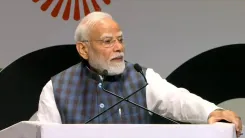
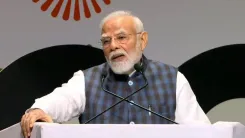
India manufacturing sector driving new growth phase: DIPAM Secretary
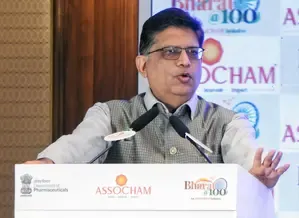
Synopsis
DIPAM Secretary Arunish Chawla says India's manufacturing growth is consistently outpacing overall GDP expansion, with non-oil exports back in double digits, demat accounts up six-fold since 2019, and UPI transactions matching the size of the entire economy — painting a picture of structural transformation, not just a cyclical upturn.
Key Takeaways
DIPAM Secretary Arunish Chawla said India is entering a new phase of broad-based, manufacturing-led growth on 19 November 2026 in Mumbai.
Non-oil, non-petrochemical, and non-jewellery exports have returned to high double-digit growth on the back of the 'Make in India' campaign.
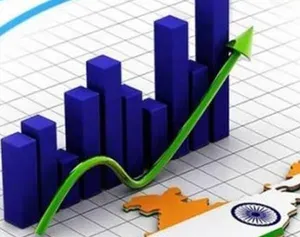
India has sustained real GDP growth of over 7% since the COVID-19 recovery, making it the fastest-growing major economy globally.
50 crore people were lifted out of poverty between 2011 and 2023 — the fastest poverty decline on record for any country.
Demat accounts rose from 3.6 crore (2019) to 25 crore recently; mutual fund AUM grew from ₹15 lakh crore (2016) to ₹84 lakh crore in October 2026.
UPI and digital payments recorded 25,000 crore transactions worth ₹314 lakh crore in FY 2025–26, roughly equal to India's GDP.
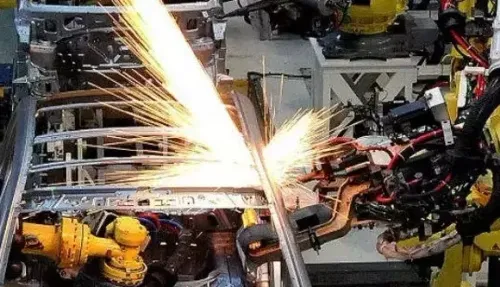
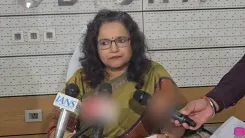
Arunish Chawla, Secretary of the Department of Investment and Public Asset Management (DIPAM), on Thursday, 19 November 2026, said India is poised to enter a new phase of strong and sustained economic growth, driven by a manufacturing sector that is consistently outpacing overall GDP expansion. Speaking in Mumbai, Chawla pointed to recent data showing that growth is becoming increasingly broad-based, with the 'Make in India' campaign producing tangible results in export diversification and industrial output.
Manufacturing and Export Momentum
Chawla highlighted that non-oil, non-petrochemical, and non-jewellery exports have returned to high double-digit growth — a development he described as 'a matter of considerable reassurance and satisfaction.' He noted, however, that sustaining this momentum over the next 20 years remains the central challenge for policymakers and industry alike. The export diversification signals a structural shift away from commodity-dependent outbound trade, analysts have observed.
From 'Garibi Hatao' to 'Viksit Bharat'
Referencing the recent World Bank report and the Consumption Expenditure Surveys, Chawla said: 'As India moves from 'Garibi Hatao' to 'Viksit Bharat', financing this vision becomes increasingly important and requires careful consideration and strategic planning.' He noted that India has sustained real GDP growth of over 7 per cent since recovering from the COVID-19 pandemic, making it the fastest-growing major economy in the world. According to Chawla, India has lifted 50 crore people out of poverty between 2011 and 2023 — described as the fastest poverty decline ever recorded in the history of any country.
Capital Markets and Financial Democratisation
Chawla underlined a dramatic deepening of India's capital markets. Demat accounts surged from approximately 3.6 crore in 2019 to 25 crore last month — an increase of more than six times. Assets under management in the mutual fund industry grew from ₹15 lakh crore in 2016 to ₹84 lakh crore in October 2026, roughly a five-to-six-fold rise. Average monthly SIP inflows stood at ₹32,000 crore in September. 'This represents the true democratisation of capital markets, a watershed moment that must be built upon to finance Viksit Bharat,' Chawla noted.
Digital Infrastructure and Financial Inclusion
The DIPAM Secretary also pointed to India's digital infrastructure as a foundational enabler of this growth story. Mobile, smartphone, and internet connectivity now reach approximately 90 per cent of the country, including rural areas. In FY 2025–26, UPI and other digital payment systems recorded 25,000 crore transactions worth ₹314 lakh crore — a figure broadly equivalent to the size of India's entire economy. India now counts 55 crore UPI users, 60 crore Jan Dhan accounts with deposits exceeding ₹3 lakh crore, and 134 crore active Aadhaar numbers. Chawla described this as 'an enormous financial ecosystem in which every Indian is a participant.'
What Lies Ahead
With the government's Viksit Bharat 2047 vision anchoring long-term planning, Chawla's remarks signal that DIPAM views financial deepening and manufacturing-led export growth as complementary engines for the next phase of development. The convergence of robust capital market participation, digital infrastructure, and diversified exports positions India as a potentially outsized contributor to global economic growth through the coming decades — provided, as Chawla cautioned, the current momentum is strategically maintained.
Point of View
But the figures deserve scrutiny alongside the optimism. The poverty-reduction claim — 50 crore people between 2011 and 2023 — rests on methodologies that have been debated by independent economists, and comparing multidimensional poverty indices across survey cycles is notoriously imprecise. The capital market democratisation narrative is real but partial: 25 crore demat accounts in a country of 140 crore adults still represents shallow retail participation, and SIP inflows, while impressive, are concentrated in urban households. Most importantly, Chawla's own caveat — sustaining manufacturing momentum for 20 years — is the hardest part of the story, requiring policy consistency that India's industrial history has rarely delivered across political cycles.
NationPress
19 Nov 2026
Frequently Asked Questions
What did DIPAM Secretary Arunish Chawla say about India's manufacturing sector?
Arunish Chawla said India's manufacturing sector is consistently outperforming overall GDP growth, putting the country on the threshold of a new phase of strong and sustained expansion. He pointed to broad-based data, including double-digit growth in non-oil and non-jewellery exports, as evidence that the 'Make in India' campaign is delivering structural results.
How fast have India's capital markets grown in recent years?
Demat accounts increased more than six-fold, from approximately 3.6 crore in 2019 to 25 crore recently, while mutual fund AUM rose from ₹15 lakh crore in 2016 to ₹84 lakh crore in October 2026. Average monthly SIP inflows stood at ₹32,000 crore in September, which Chawla described as the 'democratisation of capital markets.'
What is India's poverty reduction record according to Chawla?
According to Chawla, India lifted 50 crore people out of poverty between 2011 and 2023 — a pace he described as the fastest poverty decline ever recorded in any country's history. He cited the World Bank report and Consumption Expenditure Surveys to support the claim.
How significant is India's digital payments ecosystem?
In FY 2025–26, UPI and digital payment systems recorded 25,000 crore transactions worth ₹314 lakh crore — broadly equal to the size of India's economy. India now has 55 crore UPI users, 60 crore Jan Dhan accounts, and 134 crore active Aadhaar numbers, forming what Chawla called 'an enormous financial ecosystem in which every Indian is a participant.'
What is the 'Viksit Bharat' vision Chawla referenced?
'Viksit Bharat' — meaning Developed India — is the government's long-term development framework targeting a fully developed economy by 2047. Chawla said financing this vision requires careful strategic planning, and that capital market deepening and manufacturing-led growth are central to achieving it.