Puri at FICCI AGM: India's decade-long economic leap
Synopsis
At the FICCI Annual General Meeting, Union Petroleum Minister Hardeep Singh Puri invoked India's 'Fragile Five' stigma and the Licence-Quota Raj to argue that a decade of Modi-era reforms has fundamentally rewritten India's economic story — crediting youth, farmers, workers, and industry as the true drivers.
Key Takeaways
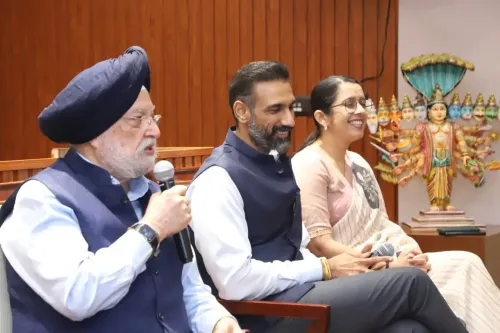
Union Petroleum Minister Hardeep Singh Puri posted on the occasion of the FICCI Annual General Meeting , drawing a sharp contrast between India's past economic vulnerabilities and its current growth momentum.
Morgan Stanley labelled India part of the 'Fragile Five' in 2013 , grouping it with Brazil, Indonesia, Turkey, and South Africa as capital-flow-vulnerable emerging markets.
India's Licence-Quota Raj , dismantled by the landmark 1991 liberalisation , remains a byword for the statist era that suppressed private enterprise for decades.
Puri attributed India's economic progress and large-scale poverty reduction to India's youth, farmers, workers, and industry — framing PM Modi's role as one of guidance and direction.
The post was tagged to @PMOIndia and @ficci_india , indicating deliberate institutional signalling ahead of a key industry-government policy forum.
From the stifling days of the Licence-Quota Raj to the ignominy of being branded part of the 'Fragile Five' in 2013, India's economic story has known its share of low points — and Union Petroleum Minister Hardeep Singh Puri wants every Indian to register just how far the country has travelled since.
Posting on the sidelines of the FICCI Annual General Meeting, Puri invoked two of modern India's sharpest economic embarrassments to frame the scale of the turnaround. 'Licence-koTA raj se lekar Fragile Five ki pehchaan tak' — from the licence-quota regime to the 'Fragile Five' label — he wrote, before arguing that the decade under PM Narendra Modi has set the economy on a fundamentally different trajectory.From 'Fragile Five' to fastest-growing large economy
The 'Fragile Five' tag was coined by Morgan Stanley in 2013, grouping India alongside Brazil, Indonesia, Turkey, and South Africa as emerging markets dangerously dependent on foreign capital and vulnerable to global capital outflows. It was a moment of real institutional embarrassment — the rupee was in freefall, the current-account deficit was ballooning, and investor confidence had cratered. The contrast with where India now stands as one of the world's fastest-growing major economies is the core of Puri's argument.
The other reference point — the Licence-Quota Raj — goes back further still. India's pre-1991 economic architecture was built around centralised permits and import restrictions that throttled private enterprise for decades. The liberalisation reforms of 1991 dismantled much of that scaffolding, but the shadow of that era remains a powerful shorthand for state-induced economic stagnation.
A collective achievement, Puri argues — not a government one
Notably, Puri's post is careful to distribute credit broadly. He names India's youth, farmers, workers, and industry as the real engines of the country's rapid economic progress and the lifting of crores of people out of poverty — framing PM Modi's role as that of a guide, not a sole architect. It is a rhetorical move calibrated for a business audience at a FICCI AGM: acknowledge the private sector, honour the labour force, and position government as an enabler.
The Federation of Indian Chambers of Commerce and Industry (FICCI), India's apex business body, holds its Annual General Meeting as one of the country's most watched forums for industry-government signalling. A senior Cabinet minister invoking the country's sharpest economic low points at such a platform carries deliberate weight — it sets a 'before and after' frame that the government wants anchored in the business community's institutional memory.
What the FICCI forum means for the reform conversation
The timing of Puri's remarks matters. With the next Union Budget on the horizon, the FICCI AGM is precisely the arena where industry lobbies sharpen its asks and ministers trial-balloon their narratives. By opening with the 'Fragile Five' and 'Licence Raj' invocations, Puri signals that the government intends to continue anchoring its economic identity around structural departure — from both pre-liberalisation statism and the mid-2010s vulnerability era.
The road from the Fragile Five to a $3-plus trillion economy was neither straight nor government-made alone — but at a gathering of India's industrial captains, that is precisely the story Puri chose to tell.
Point of View
Farmers, workers, and industry rather than the state alone, the message also hedges against the 'government-takes-all-credit' critique that has dogged the ruling party. With the Union Budget cycle approaching and FICCI positioned as a key lobbying theatre, the speech is as much a pre-Budget mood-setter as it is retrospective celebration. The deliberate silence on specific growth numbers, however, leaves the narrative open to scrutiny from opposition economists who contest the poverty-reduction and inequality data.
NationPress
19 Nov 2026
Frequently Asked Questions
What is the 'Fragile Five' and was India part of it?
The 'Fragile Five' was a grouping coined by Morgan Stanley in 2013 identifying India, Brazil, Indonesia, Turkey, and South Africa as emerging markets highly vulnerable to capital outflows due to large current-account deficits and dependence on foreign investment. India was included at a time when the rupee was under severe pressure.
What was India's Licence-Quota Raj?
The Licence-Quota Raj refers to India's pre-1991 economic regime in which businesses required government licences and permits to operate, expand, or import, creating bottlenecks and stifling private enterprise. It was largely dismantled by the landmark liberalisation reforms of 1991.
What is FICCI and why does its AGM matter?
FICCI, the Federation of Indian Chambers of Commerce and Industry, is India's oldest and largest apex business body. Its Annual General Meeting is one of the country's most significant industry-government forums, where policy signals are exchanged and business priorities are formally presented to senior ministers.
What did Hardeep Singh Puri say at the FICCI AGM?
Puri posted on X invoking India's journey from the Licence-Quota Raj and the 'Fragile Five' label to its current economic progress, attributing the turnaround to PM Modi's guidance and to the collective efforts of India's youth, farmers, workers, and industry.
How has India's economy changed over the past decade?
India moved from being tagged a vulnerable emerging market in 2013 to becoming one of the world's fastest-growing major economies, with significant policy shifts in areas including direct-benefit transfers, infrastructure investment, and trade integration, though debates continue over inequality and the quality of job creation.