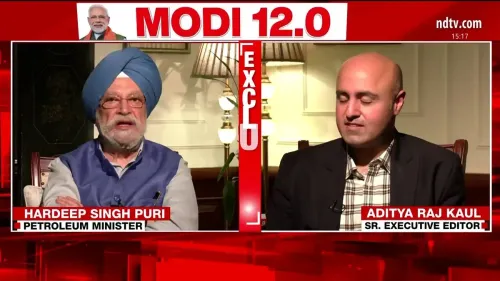
Puri Lists 12-Year Modi Govt Gains on Independence Day
Synopsis
On Independence Day 2026, Union Petroleum Minister Hardeep Singh Puri posted a 12-year governance scorecard under PM Modi, citing multipliers from 6x LPG connections to 33x mobile phone production, spanning welfare schemes and manufacturing growth.
Key Takeaways
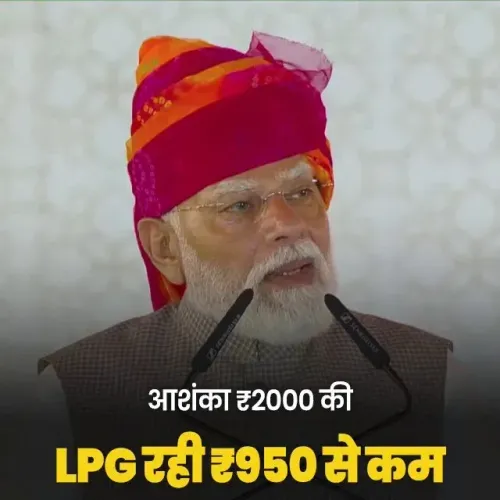
Puri claims LPG gas connections were delivered at 6 times the previous annual pace under the Pradhan Mantri Ujjwala Yojana .
Toilet construction under Swachh Bharat Mission ran at 4 times the earlier rate; housing under PMAY at 3 times .
Defence production reportedly rose 4 times ; Khadi and village-industry output 5 times ; electronics manufacturing 7 times .
Modern railway coach production is claimed to have increased 21 times over the 12-year period.
Mobile phone production is cited as rising 33 times , reflecting the PLI-driven domestic manufacturing surge.
The post was shared on Independence Day, 15 August 2026 , framing party governance achievements within national celebration.
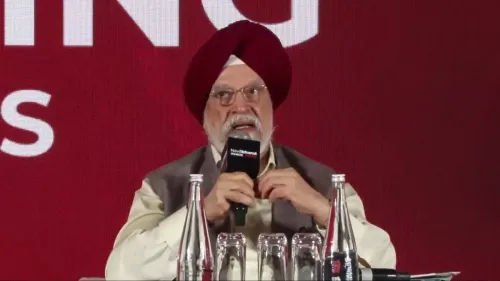
On Independence Day, 15 August 2026, Union Petroleum Minister Hardeep Singh Puri posted a sweeping scorecard of what he called the transformation of 'Naya Bharat' under Prime Minister Narendra Modi — rattling off multipliers across welfare delivery, manufacturing, and digital growth that together sketch a portrait of scale the ruling BJP wants voters to carry into the next political cycle.
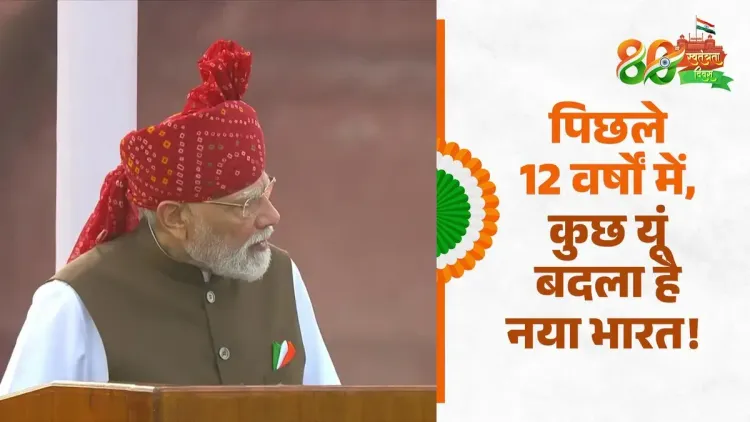
Puri's post, written in Hindi, declares: 'PM Narendra Modi ji ke netritva mein pichle 12 varshon mein kuch yun badla hai naya Bharat' — 'This is how the new India has changed in the last 12 years under PM Narendra Modi's leadership.' What follows is a rapid-fire list of sectoral claims, each anchored to a multiplier.
From Gas Cylinders to Railway Coaches: The Numbers Puri Cited
The minister claims LPG gas connections were distributed at 6 times the earlier annual pace — a direct reference to the reach of the Pradhan Mantri Ujjwala Yojana, launched in May 2016 to put subsidised cooking-gas cylinders in the hands of women from below-poverty-line households. Toilet construction under the Swachh Bharat Mission — the sanitation drive that began in October 2014 — ran at 4 times the previous rate, he says, while housing delivery under the Pradhan Mantri Awas Yojana moved at 3 times the old speed.
On the production side, the claims grow sharper. Defence manufacturing is said to have risen nearly 4 times. Khadi and village-industry output climbed 5 times. Electronics manufacturing expanded 7 times. Modern railway coach production — a visible symbol of the Indian Railways modernisation push — is pegged at a 21-fold increase. And at the top of the list: mobile phone production up 33 times, a figure that tracks broadly with the surge in domestic handset assembly driven by the Production Linked Incentive scheme rolled out from 2020.
Welfare Schemes Meet Make-in-India: The Narrative Architecture
The structure of Puri's list is deliberate. It opens with welfare — gas, toilets, homes — then pivots to manufacturing and innovation. That sequence mirrors the BJP's twin-track pitch since 2014: direct delivery to the poor on one hand, and industrial self-reliance under the Atmanirbhar Bharat banner on the other. Khadi's 5x growth sits alongside defence indigenisation and PLI-backed electronics as proof points for that argument.
The Make in India and Defence Procurement Policy reforms, initiated between 2014 and 2016, set the foundation for the domestic-production surge Puri now cites. The mobile manufacturing number is the headline figure — India went from assembling a handful of handsets domestically a decade ago to becoming one of the world's largest smartphone producers, a shift that reshaped supply chains and created millions of assembly-line jobs.
Independence Day as a Political Stage
15 August is the BJP's preferred canvas for this kind of stocktaking. Posting a governance scorecard on Independence Day is not incidental — it fuses national pride with party achievement, a framing the opposition contests but cannot easily avoid engaging with. Puri, a former career diplomat who has served in senior cabinet roles, brings a policy-fluency to the messaging that goes beyond routine cheerleading.
The multipliers Puri cites are drawn from official programme reviews and government data; the specific figures have not been independently cross-verified. What is verifiable from the policy record is the trajectory: all the schemes he references — Ujjwala, Swachh Bharat, PMAY, PLI, Make in India — were launched, funded, and scaled under the Modi governments of 2014 and 2019, and each has official completion or output data attached to it.
Twelve years in, the BJP's bet is that a 33-fold jump in mobile phones and a 6-fold acceleration in gas connections are numbers that cut through. Whether the opposition can offer a competing arithmetic before the next electoral test is the real question Independence Day 2026 leaves open.
Point of View
A strategy the party has refined across successive Independence Days. The unanswered challenge for the opposition remains constructing a counter-narrative that is equally concrete and emotionally resonant.
NationPress
29 Sept 2026
Frequently Asked Questions
What did Hardeep Singh Puri post on Independence Day 2026?
Puri posted a Hindi-language scorecard on X listing multipliers of growth across welfare and manufacturing sectors under PM Modi's 12-year government, including claims of 6x LPG connections, 33x mobile production, and 21x railway coach output.
What is the Pradhan Mantri Ujjwala Yojana that Puri referenced?
Ujjwala Yojana is an LPG connection scheme launched in May 2016 to provide subsidised cooking-gas cylinders to women from below-poverty-line households across India.
How much has India's mobile phone production grown under Modi?
Puri claims mobile phone production grew 33 times over 12 years, a figure linked to the Production Linked Incentive scheme that drew global handset makers to assemble phones domestically from 2020 onwards.
What schemes did Puri's Independence Day post refer to?
The post implicitly references Pradhan Mantri Ujjwala Yojana (LPG), Swachh Bharat Mission (toilets), Pradhan Mantri Awas Yojana (housing), Make in India and PLI (electronics and defence), and Indian Railways modernisation.
Why do BJP leaders post governance scorecards on Independence Day?
Independence Day offers a nationally watched platform to frame party achievements within the language of patriotism, allowing the ruling party to associate its governance record with the emotional weight of national celebration.