India's Asia power gap with China narrows: Lowy expert

Synopsis
India's gap with China in the Asia Power Index is the narrowest since the index began in 2018. Lowy Institute's Shruti Pandalai says the change reflects India's greater effectiveness at converting its capabilities into influence, rather than a dramatic increase in overall power.
Key Takeaways
India ranks as Asia's third-most powerful country in the 2026 Asia Power Index .
The gap between India and China is at its lowest since the index began in 2018 , according to Shruti Pandalai .
Pandalai said India's overall score rose modestly while China's was largely unchanged, qualifying her recollection of the movements.
India has strengthened partnerships with the United States , Japan and Australia over the past decade.
Pandalai attributed India's regional profile in part to wider diplomatic engagement and visibility in multilateral forums.
India's gap with China in the 2026 Asia Power Index has narrowed to its lowest level since the index began in 2018, according to Shruti Pandalai, India Chair at the Lowy Institute. Speaking on 23 November, she said the finding reflected India's growing effectiveness in turning its capabilities into regional influence, rather than a dramatic increase in its overall power.
India is ranked the third-most powerful country in Asia in the index. Pandalai described it as an increasingly consequential player in the Indo-Pacific, pointing to diplomatic and strategic engagement across the region.
India's score and the gap with China
Pandalai said India's overall score had risen modestly while China's remained largely unchanged, helping bring the two countries closer together in the index. She qualified her recollection of the score movements, saying, “if I am right”.
She cautioned against interpreting the result as evidence of a sudden expansion in India's power. “What this report really finds is that India is becoming a more influential and effective power,” she said.
In Pandalai's assessment, the distinction lies in how effectively India uses the economic, diplomatic and strategic strengths it already possesses. The source did not provide the countries' numerical scores or the precise size of the gap.
Diplomacy across the Indo-Pacific
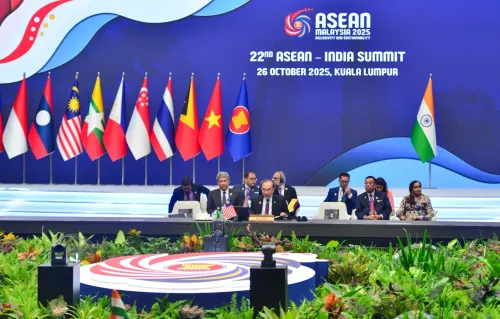
Pandalai linked India's regional profile to a more active role in the Indo-Pacific and wider diplomatic engagement. Over the past decade, India has strengthened partnerships with the United States, Japan and Australia, while broadening engagement with Europe, West Asia, Oceania and Southeast Asia.
She also pointed to India's greater visibility in regional institutions, strategic dialogues and multilateral platforms. In her assessment, that presence has contributed to perceptions of stronger Indian leadership and influence.
The index finding therefore concerns more than the country's position in a ranking: Pandalai's explanation draws a distinction between possessing capabilities and using them to exert influence. Her account does not suggest that every aspect of India's power has risen at the same pace.
Strategic choices and major-power ties
Pandalai said India has maintained its relationships with major powers with its core national interests in view. She argued that images of Prime Minister Narendra Modi alongside Xi Jinping or President Vladimir Putin should not automatically be read as India moving towards another camp.
“India has made very clear strategic choices in terms of what its capacity and capability-building priorities are and how it maps its place in the world,” she said.
Her interpretation places India's ties with different major powers alongside its broader regional diplomacy, rather than treating a meeting with any one leader as a complete account of its strategic position.
What the assessment leaves open
The reported narrowing of the gap reflects a modest increase in India's score as well as a largely unchanged Chinese score, according to Pandalai. It does not, on the details provided, establish that India has overtaken China or experienced a dramatic surge in overall power.
The source did not set out future index projections or announce a policy change following the findings. The question ahead is whether India can continue to translate its capabilities and diplomatic engagement into influence across the region.
Point of View
But it should not be mistaken for evidence that India has overtaken China or that its capabilities have suddenly expanded. Pandalai's distinction between power and influence matters: diplomacy can make existing strengths more consequential without eliminating differences in underlying capacity. India's strategic autonomy will be judged by its ability to sustain partnerships across competing powers while advancing clearly defined national interests.
NationPress
23 Nov 2026
Frequently Asked Questions
What does the 2026 Asia Power Index say about India?
India ranks as Asia's third-most powerful country in the 2026 Asia Power Index. Its gap with China is the narrowest since the index began in 2018, according to Lowy Institute's Shruti Pandalai.
Why has India's power gap with China narrowed?
Pandalai said India's overall score rose modestly while China's remained largely unchanged. She qualified her recollection of the score movements.
Does the index show a dramatic increase in India's power?
Pandalai said the report does not indicate a dramatic increase in India's power. She argued instead that India has become more effective at translating its capabilities into influence.
How has India expanded its regional influence?
Pandalai pointed to India's active Indo-Pacific role, wider diplomatic engagement and greater visibility in regional and multilateral forums. She also cited stronger partnerships with the United States, Japan and Australia.
What happens next after the Asia Power Index findings?
The source does not identify a policy change or future index projection following the findings. Pandalai's assessment focuses on how India has used its capabilities and diplomatic relationships to build influence.