India-China power calculus: Experts warn of strategic risk in trade ties
Synopsis
A new CRF volume on India-China relations lands a blunt warning: economic interdependence with Beijing is not a cushion — it is a potential chokehold. With India's electronics and manufacturing sectors deeply reliant on Chinese imports, experts say the real strategic contest isn't just on the border — it's in the supply chain.
Key Takeaways
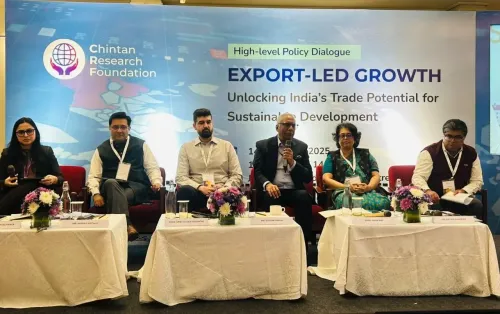
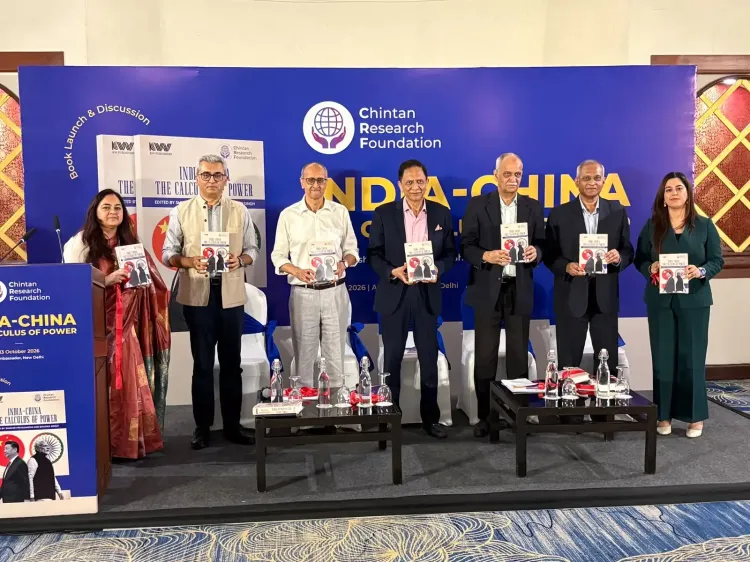
The Chintan Research Foundation (CRF) released a multi-essay volume in New Delhi on 15 October 2026 mapping the India–China power equation.
Former Ambassador Ashok Kantha argues the two nations' parallel ambitions are structurally incompatible , impeding trust-building.
China's push for a multi-polar order conflicts with India's demand to be treated as a genuine peer , not a secondary power.
Analyst Deep Pal warns India's dependence on Chinese imports in electronics and critical technologies risks becoming a strategic vulnerability.
Professor Kanti Bajpai identifies 2035 , 2050 and 2060 as key years for watching shifts in the regional military and economic balance.
Scholars called for stronger Chinese-language training, research funding and field exposure for Indian journalists and academics.
As India and China negotiate a relationship where technological and economic competition coexists with the imperatives of regional stability, a new collection of essays published by the Chintan Research Foundation (CRF) in New Delhi has mapped the evolving power equation between the two Asian giants — cautioning that economic interdependence could quietly morph into a strategic vulnerability.
Key Developments
The CRF, in a bid to deepen India's scholarship on China, brought together a series of essays examining the dominant strands of discourse shaping the bilateral relationship over the coming decade. An accompanying discussion probed the norms and values likely to define engagement between the world's two most populous nations in the years ahead.
Shishir Priyadarshi, President of the CRF, called for a balanced assessment of both countries' perspectives — one that moves beyond conventional narratives to encompass the full spectrum of engagement, competition and cooperation.
Structural Incompatibility and Strategic Recalibration
In his foreword to the volume, former Ambassador Ashok Kantha argues that the two countries' parallel national ambitions are structurally incompatible, complicating any sustained effort to build mutual trust. China's emphasis on multi-polarity, he notes, has tilted the emerging world order toward a 'first among equals' framework — a framing that sits uneasily with India's demand to be treated as a genuine peer.
Notably, the strategic calculus is described as still in flux. According to the book, India's choices on economic and technological development will prove decisive in shaping the future balance of power. The volume frames India–China relations not as a binary choice between engagement and confrontation, but as a continuous negotiation between economic coexistence and strategic competition.
Scholars Identify Leverage Points and Fault Lines
Professor Srikanth Kondapalli drew on historical context, recalling the three conditions China reportedly raised with then President K. R. Narayanan in the 1990s — including an insistence on the non-negotiable 'One-China principle'. He stressed the urgent need to strengthen India's scholarship on China through greater research funding, Chinese-language training and academic exchanges. Limited diplomatic reciprocity and differing strategic perceptions, he argued, continue to constrain the relationship. He closed with a call for institutional support for young scholars and field research in China.
Professor Kanti Bajpai offered a comparative power audit: China holds clear advantages in manufacturing, infrastructure, technology and defence production, while India's leverage derives from its demographic strength, geographic position, Indian Ocean presence, diplomatic partnerships and a growing economy. He flagged critical risk vectors — including Tibet, the China–Pakistan axis, technological competition and critical minerals — and identified 2035, 2050 and 2060 as the key horizon years for watching shifts in the regional military and economic balance.
Economic Dependence as Strategic Vulnerability
Deep Pal identified economic and technological cooperation as potential avenues for engagement despite persistent security tensions, but issued a pointed caution: India's dependence on Chinese imports — particularly in electronics, critical technologies and manufacturing components — risks becoming a strategic liability. He called for import diversification, improved market access for Indian businesses in China, and greater cross-border exchanges. He also stressed that bilateral economic ties must be assessed against the wider backdrop of US–China competition, export controls and accelerating global trade fragmentation.
Media, Narratives and the Security Dilemma
Shubhangi Sharma examined how competing historical claims and territorial perceptions reinforce the India–China security dilemma — where steps taken to enhance one country's security routinely deepen the other's anxieties. She argued that Indian journalism remains constrained in its ability to interpret China, citing logistical obstacles and limited opportunities for constructive on-ground engagement. She called for greater field exposure for Indian journalists to foster a more nuanced understanding of China's society, culture and people.
As both nations look ahead to a decade of compounding technological and geopolitical change, the consensus from the CRF gathering was clear: neither full decoupling nor unconditional engagement is viable — the path forward demands a disciplined, eyes-open coexistence.
Point of View
And calling for 'diversification' without naming a timeline or enforcement mechanism is the kind of counsel that sounds strategic but changes nothing. The years flagged — 2035, 2050, 2060 — correspond to China's own declared modernisation milestones, which means India is essentially being warned to prepare on Beijing's timetable. The deeper problem is institutional: India still lacks the depth of China-watchers, Chinese-language scholars and on-ground journalists needed to make sense of a rival that has studied India far more systematically than India has studied it.
NationPress
15 Oct 2026
Frequently Asked Questions
What is the Chintan Research Foundation's new volume on India-China relations about?
It is a collection of essays examining the evolving power equation between India and China, covering border tensions, trade asymmetries, technological competition and the risks of economic interdependence. The volume frames the bilateral relationship as a continuous negotiation between economic coexistence and strategic competition, not a binary choice between engagement and confrontation.
Why do experts warn that India's trade ties with China could become a strategic vulnerability?
Analyst Deep Pal notes that India is heavily dependent on Chinese imports in electronics, critical technologies and manufacturing components. This dependence, he cautions, could give China economic leverage in a crisis, and he has called for import diversification and improved market access for Indian businesses in China.
What did Ambassador Ashok Kantha say about India-China relations in his foreword?
Ambassador Ashok Kantha argues that the two countries' parallel national ambitions are structurally incompatible, making it difficult to build mutual trust. He also notes that China's 'first among equals' multi-polar framing conflicts with India's expectation of being treated as a genuine peer.
Which years are identified as critical for the India-China power balance?
Professor Kanti Bajpai highlighted 2035, 2050 and 2060 as key horizon years for assessing shifts in the regional military and economic balance — dates that align with China's own declared national modernisation milestones.
What institutional improvements did scholars call for at the CRF event?
Scholars called for greater research funding, Chinese-language training, academic exchanges and field research opportunities in China for Indian scholars. They also urged more on-ground exposure for Indian journalists to enable more nuanced reporting on China's society and strategic culture.