Giriraj Singh Flags Rise in India Services PMI for May
Synopsis
Union Textiles Minister Giriraj Singh on June 7, 2026, highlighted a rise in India's Services PMI for May, attributing the uptick to easing cost pressures. The data, shared via the NaMo App, underscores the government's focus on services-led growth as a pillar of India's macroeconomic story.
Key Takeaways
India's Services PMI rose in May 2026 , signalling continued expansion in the sector.
Easing of cost pressures was cited as the primary driver of accelerating services activity.
Union Textiles Minister Giriraj Singh shared the data via the NaMo App on June 7, 2026.
India's services sector accounts for over half of national GDP , making the PMI a key economic barometer.
The S&P Global Services PMI has been tracked monthly since 2005 as a leading indicator of private-sector health.
Markets and analysts will watch the next PMI release and RBI monetary-policy minutes for further signals on cost and demand trends.
Union Textiles Minister Giriraj Singh on Sunday, June 7, 2026, shared data indicating that India's Services PMI rose in May 2026, citing easing cost pressures as a key driver of accelerating activity in the sector. The minister shared the update via the NaMo App, reflecting the ruling party's practice of amplifying positive macroeconomic signals through official digital platforms.
Context
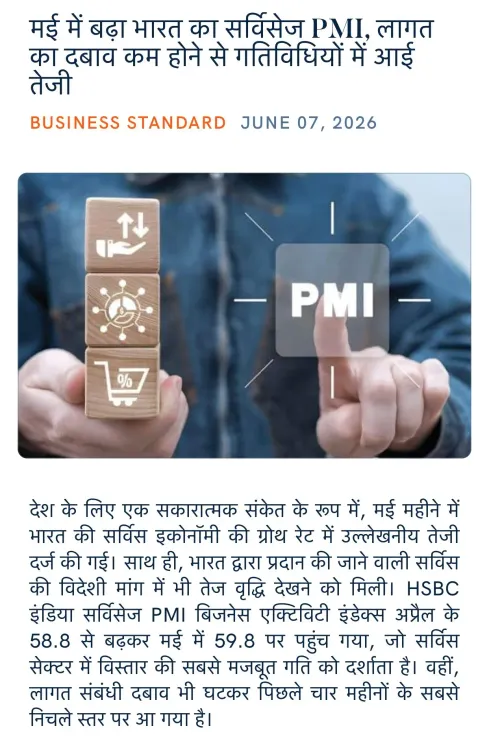
The post, written in Hindi, reads: 'मई में बढ़ा भारत का सर्विसेज PMI, लागत का दबाव कम होने से गतिविधियों में आई तेजी' — ('India's Services PMI rose in May; easing of cost pressures brought acceleration in activities'). The Services Purchasing Managers' Index is a monthly survey-based indicator compiled by S&P Global that measures expansion or contraction in private-sector services activity. A reading above 50 signals expansion; a reading below signals contraction.
India's services sector contributes over half of the country's GDP, making the PMI one of the most closely watched leading indicators of economic momentum. The index has been tracked monthly since 2005 and is regularly cited by policymakers and market participants to gauge domestic demand and employment trends.
Policy Backdrop
The focus on cost pressures is significant in the current macroeconomic context. Input-cost inflation in services — driven by wages, energy, and raw-material prices — had been a persistent concern in prior months, squeezing margins for firms and dampening hiring sentiment. An easing of these pressures, as the May data appears to indicate, would be a constructive signal for both corporate profitability and consumer-facing services.
The broader policy environment has been shaped by the Atmanirbhar Bharat package introduced after the 2020 pandemic disruption and successive monetary-policy decisions by the Reserve Bank of India. Efforts to support services recovery — through credit access, digital infrastructure, and demand-side stimulus — have been a recurring theme in government economic communication. Sharing PMI data via the NaMo App is consistent with this pattern of ministers amplifying macro indicators that align with the government's growth narrative.
Stakeholders and Impact
The immediate beneficiaries of improving services PMI are service-sector firms — spanning IT, hospitality, logistics, financial services, and retail — which collectively employ hundreds of millions of workers across India. Easing cost pressures can translate into better hiring conditions and improved export competitiveness, particularly in sectors like IT and business-process outsourcing where India holds a global competitive position.
For investors and financial markets, a rising PMI alongside lower cost pressures is typically read as a 'goldilocks' signal — growth without overheating. This combination can influence expectations around RBI monetary policy, with markets watching for whether the central bank interprets the data as consistent with its inflation-management objectives.
What's Next
Attention will now turn to the next monthly PMI release and to the RBI's monetary-policy committee minutes, where policymakers may offer explicit commentary on cost dynamics in the services sector. Sustained improvement in the index over consecutive months would strengthen the government's case that India's services-led growth model is on a durable recovery path.
Any reversal — driven by a resurgence in global commodity prices, currency depreciation, or a demand slowdown — could test the narrative. For now, the May data, as shared by Minister Giriraj Singh, adds to a sequence of indicators that the government has pointed to as evidence of macroeconomic resilience heading into the second half of 2026.
Frequently Asked Questions
What is India's Services PMI and why does it matter?
India's Services PMI is a monthly survey by S&P Global measuring whether private-sector services activity is expanding or contracting. A reading above 50 means expansion. It matters because services contribute over half of India's GDP and the index is a leading indicator of employment and demand trends.
What did India's Services PMI show for May 2026?
The May 2026 data indicated a rise in India's Services PMI, with easing cost pressures cited as the key driver of accelerating activity. The exact reading was shared via the NaMo App by Union Textiles Minister Giriraj Singh on June 7, 2026.
Why did Giriraj Singh share Services PMI data when he is the Textiles Minister?
BJP ministers routinely share positive macroeconomic data across portfolios as part of the government's broader economic communication strategy, using platforms like the NaMo App to amplify indicators that support the narrative of India's growth momentum.
What does easing cost pressure mean for India's services sector?
Easing cost pressure means input costs — such as wages, energy, and raw materials — are rising more slowly or declining, which improves profit margins for service firms, supports hiring, and can enhance export competitiveness in sectors like IT and business-process outsourcing.
What should investors watch after India's May 2026 Services PMI data?
Investors should watch the next monthly PMI release and the RBI monetary-policy committee minutes for commentary on whether easing cost pressures are durable and consistent with the central bank's inflation targets.