Edible oil standard pack sizes mandated to ease price comparison

Synopsis
India has standardised edible oil pack sizes — from 200 ml to 20 litres — under the Legal Metrology framework after consulting associations covering 90% of the sector. The move directly targets a market practice of varying package sizes that obscured per-unit costs and made brand-to-brand price comparison nearly impossible for consumers.
Key Takeaways
The Department of Consumer Affairs amended the SoP for edible oil pack sizes under the Legal Metrology framework on 6 June .
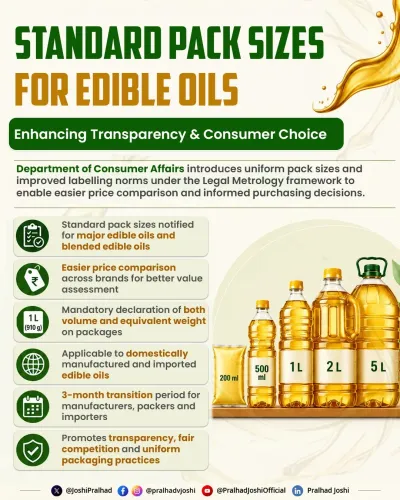
Permitted standard sizes range from 200 ml/gram to 20 litre/kg .
Oils covered include palm, soybean, sunflower, mustard, groundnut, sesame, rice bran, cottonseed , and corn oil .
Packs below 200 ml or 200 grams and minor edible oils are exempt from standardisation.
The decision followed consultations with industry bodies representing nearly 90% of India's edible oil sector.
Packages showing volume must also display the equivalent weight under the Legal Metrology (Packaged Commodities) Rules, 2011 .
The Department of Consumer Affairs on Saturday, 6 June announced an amendment to the standard operating procedure governing net quantity determination and pack sizes for edible oils and fats under the Legal Metrology framework, aimed at boosting consumer transparency and promoting fair trade practices. The revised norms apply to both domestically produced and imported edible oils.
What Prompted the Change
The move comes in response to a growing proliferation of non-uniform package sizes across the edible oils market, which has made it increasingly difficult for consumers to compare prices between brands and assess value for money. The decision followed extensive consultations with major industry associations representing nearly 90 per cent of India's edible oil sector.
Standard Pack Sizes Prescribed
The revised procedure prescribes standard pack sizes for a wide range of edible oils, including palm oil, soybean oil, sunflower oil, mustarapeseed oil, groundnut oil, sesame oil, rice bran oil, cottonseed oil, and corn oil, as well as blended edible oils.
The permitted sizes are: 200 ml/gram, 500 ml/gram, 1 litre/kg, 2 litre/kg, 3 litre/kg, 4 litre/kg, 5 litre/kg, 15 litre/kg, and 20 litre/kg.
Exemptions and Additional Requirements
Packages below 200 ml or 200 grams remain outside the scope of standardisation, ensuring that affordable small packs continue to be available to consumers. Minor edible oils have also been exempted from the standard pack size requirement.
Where quantity is expressed in litres or millilitres, the package must additionally display the equivalent weight. This requirement will be enforced under the Legal Metrology (Packaged Commodities) Rules, 2011.
Impact on Consumers and Industry
The standardisation is expected to make price comparisons across brands straightforward for households, eliminating the confusion caused by odd-sized packaging — a tactic critics argue has historically obscured true per-unit costs. This is a notable regulatory intervention in a sector that directly affects kitchen budgets across income groups.
With industry associations covering the bulk of the sector already part of the consultation process, compliance resistance is expected to be limited. Observers will watch how quickly manufacturers transition existing stock-keeping units to the new standard sizes.
Point of View
Effectively insulating brands from price discipline. The exemption for packs below 200 ml is a sensible carve-out for low-income buyers, but the real test is enforcement: Legal Metrology's track record on packaged commodities compliance at the retail level is patchy. With industry associations already on board, the bottleneck will be the last mile — whether inspectors at mandis and kirana-level supply chains actually verify compliance. If enforcement holds, this could become a template for other commodity categories where packaging fragmentation obscures consumer pricing.
NationPress
21 Oct 2026
Frequently Asked Questions
What are the new standard pack sizes for edible oils in India?
The government has prescribed nine standard pack sizes: 200 ml/gram, 500 ml/gram, 1 litre/kg, 2 litre/kg, 3 litre/kg, 4 litre/kg, 5 litre/kg, 15 litre/kg, and 20 litre/kg. These apply to major edible oils including palm, soybean, sunflower, mustard, groundnut, sesame, rice bran, cottonseed, and corn oil.
Why has the government standardised edible oil pack sizes?
The move addresses the widespread use of varying package sizes by brands, which made direct price comparison difficult for consumers. Standardisation allows shoppers to compare per-unit costs across brands accurately and make more informed purchasing decisions.
Which edible oils are exempt from the new pack size rules?
Packages below 200 ml or 200 grams remain outside the standardisation scope to protect access to affordable small packs. Minor edible oils have also been exempted from the standard pack size requirement.
Under which law do these new edible oil packaging rules apply?
The rules fall under the Legal Metrology framework, specifically the Legal Metrology (Packaged Commodities) Rules, 2011. The amendment was made to the standard operating procedure for determination of net quantity and standard pack sizes of edible oils and fats.
Do the new rules apply to imported edible oils as well?
Yes, the revised provisions apply to both edible oils produced in India and imported edible oils, ensuring a level playing field across domestic and foreign brands in the Indian market.