Joshi introduces standard pack sizes for edible oils
Synopsis
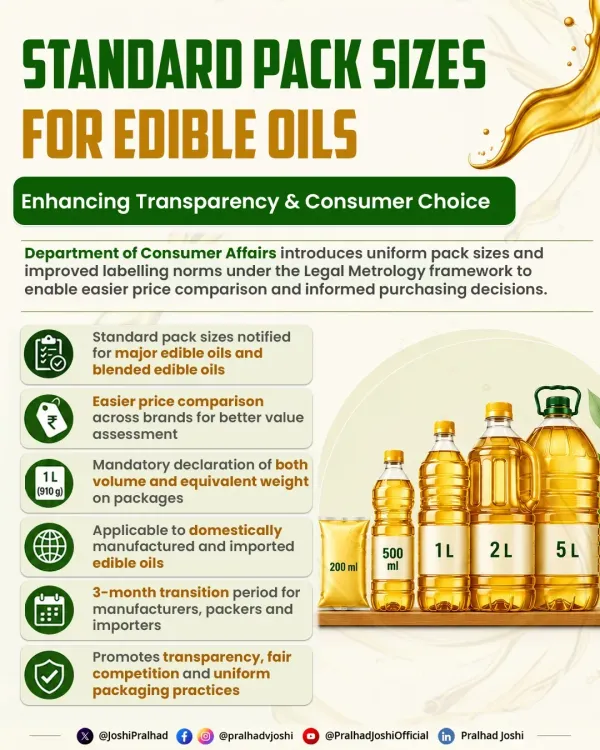
The Department of Consumer Affairs has mandated standard pack sizes for edible oils under Legal Metrology rules, ending the proliferation of non-uniform sizes that made price comparison difficult for Indian consumers. Minister Pralhad Joshi called the move a consumer-centric reform promoting transparency and fair competition.
Key Takeaways
The Department of Consumer Affairs has introduced standard pack sizes for edible oils under the Legal Metrology (Packaged Commodities) Rules .
The reform is designed to end the confusion caused by multiple non-standard pack sizes across brands, making price comparison easier for consumers.
Edible oils join milk powder, biscuits and atta as food categories where standard pack sizes have been mandated since 2011–2017 .
The measure falls under the Legal Metrology Act, 2009 , which provides the statutory basis for packaging and quantity standards.
A gazette notification with exact permitted sizes and a manufacturer compliance timeline is expected but has not yet been confirmed publicly.
The announcement was accompanied by a reference to Jago Grahak Jago , the government's national consumer-awareness campaign running since 2005 .
Union Consumer Affairs Minister Pralhad Joshi announced on Saturday, June 6, 2026, that the Department of Consumer Affairs has introduced standard pack sizes for edible oils under the Legal Metrology framework, a move aimed at bringing greater price transparency and uniformity to retail markets across India.
Context
Posting on X, Minister Joshi said the reform addresses a long-standing consumer grievance: 'Earlier, the availability of multiple non-standard pack sizes across brands often made price comparison difficult for consumers.' He added that uniform pack sizes will 'enable easier comparison of prices and better assessment of value for money.'
Edible oils are among the most widely purchased packaged commodities in Indian households, making pricing transparency in this category a matter of direct relevance to millions of families, particularly those managing tight monthly budgets.
Policy Backdrop
The notification falls under the Legal Metrology (Packaged Commodities) Rules, framed pursuant to the Legal Metrology Act, 2009, which replaced the older Standards of Weights and Measures Act, 1976. The 2009 Act gave regulators an updated toolkit to prescribe packaging, labelling and quantity standards for commodities sold in India.
Standard pack sizes have previously been mandated for categories such as milk powder, biscuits and atta through amendments introduced between 2011 and 2017. The extension of this approach to edible oils continues a pattern of incremental standardisation across high-consumption food categories.
The Jago Grahak Jago campaign, tagged by Minister Joshi in the post, has been the government's primary consumer-awareness vehicle since 2005, reinforcing rights around fair packaging, labelling and pricing.
Stakeholders and Impact
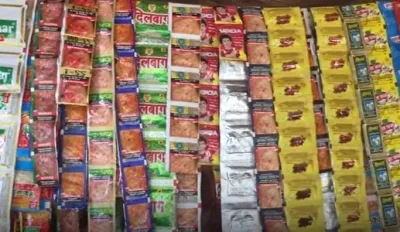
For consumers, the change is designed to remove the confusion caused by, say, a 750 ml bottle from one brand sitting alongside a 800 ml bottle from another — a deliberate or inadvertent pricing fog that made unit-cost comparisons cumbersome. Standardised sizes allow shoppers to compare rupee-per-unit costs at a glance.
For the edible oil industry — which includes large domestic refiners as well as regional brands — the notification will require a transition to permitted pack sizes. A gazette notification detailing the exact sizes and any compliance timeline for manufacturers is expected to follow, though the specific sizes and deadlines have not yet been publicly confirmed.
Fair-competition advocates have long argued that non-standard packaging is a subtle tool that can disadvantage smaller brands and confuse price-sensitive buyers; standardisation levels the playing field to some extent.
What's Next
The official gazette notification specifying the exact permitted pack sizes and the transition period for manufacturers will be the key document to watch. Compliance enforcement would fall to Legal Metrology officers at the state and central levels.
If the edible oils rollout proceeds smoothly, the Department of Consumer Affairs may extend the same standardisation logic to other commodity categories where non-uniform packaging currently complicates consumer decision-making — deepening a regulatory approach that has been building since 2009.
Point of View
Extending a regulatory arc that began with the Legal Metrology Act of 2009. By anchoring the announcement to the Jago Grahak Jago brand, the ministry is also reinforcing institutional continuity and public-awareness infrastructure built over two decades. The real test will be in implementation: how quickly manufacturers transition, how rigorously state Legal Metrology officers enforce compliance, and whether the gazette notification delivers genuinely consumer-friendly size options.
NationPress
21 Oct 2026
Frequently Asked Questions
What are the new standard pack sizes for edible oils in India?
The Department of Consumer Affairs has notified standard pack sizes for edible oils under the Legal Metrology (Packaged Commodities) Rules, but the exact permitted sizes are yet to be confirmed in the official gazette notification.
Why has the government introduced standard pack sizes for edible oils?
The government introduced standard pack sizes because multiple non-standard sizes across brands made it difficult for consumers to compare prices and assess value for money at the point of purchase.
What is the Legal Metrology Act and how does it apply to edible oils?
The Legal Metrology Act, 2009 empowers the government to prescribe packaging, labelling and quantity standards for commodities sold in India. The Packaged Commodities Rules framed under it now extend to edible oils, requiring manufacturers to use only approved pack sizes.
Which other food products have standard pack sizes in India?
Milk powder, biscuits and atta are among the food categories for which standard pack sizes were mandated through Legal Metrology rule amendments between 2011 and 2017, before edible oils were added.
What is Jago Grahak Jago?
Jago Grahak Jago — meaning 'Wake Up, Consumer' — is a national consumer-awareness campaign run by the Department of Consumer Affairs since 2005 to educate citizens about their rights on pricing, packaging and product quality.