Kishan Reddy: India shields households from global LPG price surge
Synopsis
Union Minister G. Kishan Reddy says India has shielded households from a 46% spike in global LPG benchmarks, with Ujjwala beneficiaries paying ₹642 per cylinder against a supply cost exceeding ₹1,600, backed by direct benefit transfers to over 10.58 crore households.
Key Takeaways
International LPG benchmark prices have risen by nearly 46% since February 2026 , compounded by disruptions at the Strait of Hormuz .
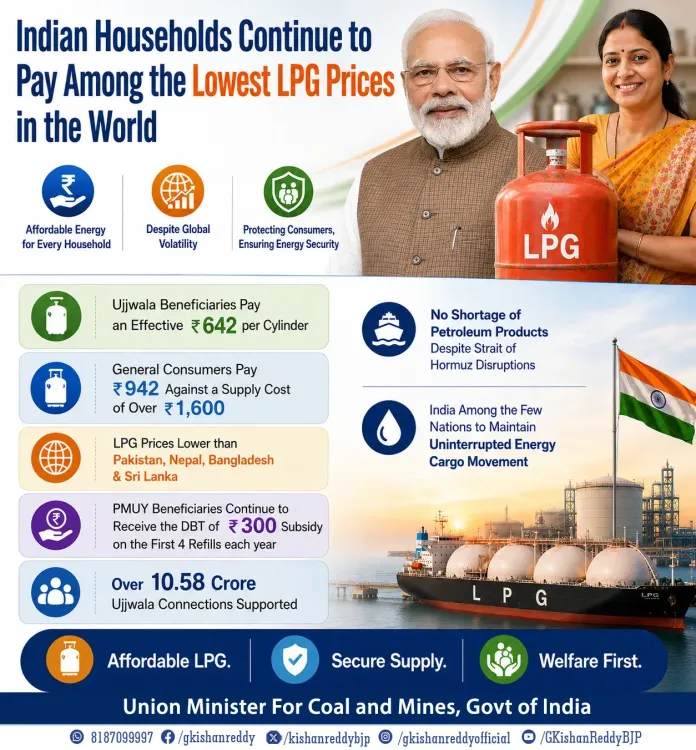
PM Ujjwala Yojana beneficiaries pay an effective ₹642 per cylinder after a ₹300 direct benefit transfer on the first four refills annually.
General consumers pay ₹942 per cylinder even though the supply cost has risen to over ₹1,600 .
More than 10.58 crore households are enrolled as Ujjwala beneficiaries receiving the refill subsidy.
India's domestic LPG prices are described as lower than those in Pakistan , Nepal , Bangladesh , Sri Lanka , the United States , Australia , and Canada .
The government attributes supply continuity to diversified sourcing, increased domestic production, and timely policy interventions.
Union Coal and Mines Minister G. Kishan Reddy on Sunday, June 7, 2026, highlighted that Indian households continue to access cooking gas at prices far below international market levels, even as global LPG benchmark prices have risen sharply and disruptions in the Strait of Hormuz have strained supply chains worldwide.
Context
Reddy's post underscores that despite a nearly 46% rise in international LPG benchmark prices since February 2026, the government has absorbed the bulk of the cost escalation rather than passing it on to consumers. He noted that the actual cost of supplying a domestic LPG cylinder has risen to over ₹1,600, yet general consumers pay only ₹942 per cylinder — a gap that reflects substantial under-recovery borne by oil marketing companies and the exchequer.
Beneficiaries under the Pradhan Mantri Ujjwala Yojana (PMUY) receive an additional ₹300 per cylinder on the first four refills each year through direct benefit transfer, bringing their effective price down to ₹642 per cylinder. More than 10.58 crore Ujjwala beneficiaries are currently covered under this support.
Policy Backdrop
The Pradhan Mantri Ujjwala Yojana was launched in May 2016 to provide LPG connections to women from below-poverty-line households, initially targeting 5 crore connections. The scheme was subsequently expanded in scope and scale, with refill subsidies delivered via the PAHAL Direct Benefit Transfer mechanism — first rolled out in 2013-14 — to reduce leakages and ensure targeted delivery.
Since 2014, successive administrations have maintained large LPG subsidies as a core welfare instrument while gradually moving toward market-linked pricing for general consumers. Global energy price shocks following 2022 prompted repeated absorption of under-recoveries and accelerated efforts to diversify import sources and raise domestic natural gas output. Reddy's statement places the current episode within that continuing policy posture.
The Ministry of Petroleum and Natural Gas coordinates LPG pricing and supply security alongside oil marketing companies, and has pursued diversified sourcing strategies to insulate India from chokepoint-specific risks such as those posed by the Strait of Hormuz, through which a significant share of India's imported crude and LPG transits.
Stakeholders and Impact
The direct beneficiaries of the current pricing shield are 10.58 crore Ujjwala households — predominantly rural women from economically weaker sections — and the broader base of domestic LPG consumers across India. Reddy's post also drew a comparative frame, stating that Indian LPG prices remain 'significantly lower' than those in neighbouring countries including Pakistan, Nepal, Bangladesh, and Sri Lanka, as well as advanced economies such as the United States, Australia, and Canada.
Oil marketing companies and the central exchequer carry the financial burden of the gap between supply cost and consumer price. The scale of under-recovery — with supply costs exceeding ₹1,600 against a consumer price of ₹942 — signals a significant fiscal commitment that will likely feature in discussions around the forthcoming Union Budget or supplementary demands.
What's Next
The immediate policy watch is the next revision of domestic LPG prices by oil marketing companies and whether additional subsidy allocations will be made in upcoming budget exercises to cover widening under-recoveries. Any further escalation in international benchmark prices or continued disruption at the Strait of Hormuz could intensify pressure on the fiscal arithmetic underpinning the current consumer price shield.
The government's stated commitment to 'timely policy interventions, increased domestic production and diversified sourcing' as instruments of energy security suggests that structural supply-side measures, rather than price pass-throughs alone, will remain central to India's response to global energy volatility in the near term.
Point of View
Reinforcing the BJP's long-standing narrative that PMUY and DBT-linked subsidies represent a structural safety net rather than ad hoc relief. The comparison with neighbouring and advanced economies is a deliberate political framing device, positioning India's subsidy architecture as both fiscally responsible and internationally competitive. The implicit fiscal tension — a supply cost of over ₹1,600 against a consumer price of ₹942 — raises questions about the sustainability of under-recovery absorption that will likely resurface during budget deliberations. This statement also signals that the government is unlikely to allow a price pass-through in the near term, prioritising household welfare optics ahead of any fiscal consolidation pressure.
NationPress
23 Oct 2026
Frequently Asked Questions
What is the current LPG cylinder price for Ujjwala Yojana beneficiaries in India?
PM Ujjwala Yojana beneficiaries pay an effective price of ₹642 per cylinder, after receiving a direct benefit transfer of ₹300 per cylinder on the first four refills each year.
What is the LPG cylinder price for general consumers in India in 2026?
General consumers pay ₹942 per cylinder, even though the government has stated that the actual cost of supplying a domestic LPG cylinder has risen to over ₹1,600.
How many beneficiaries are covered under PM Ujjwala Yojana?
More than 10.58 crore households are enrolled as Ujjwala Yojana beneficiaries and continue to receive the ₹300 per cylinder subsidy on the first four refills every year.
Why have global LPG prices risen in 2026?
International LPG benchmark prices have risen by nearly 46% since February 2026, driven by global energy market volatility and supply disruptions linked to the Strait of Hormuz, a critical maritime route for oil and gas imports.
Is LPG cheaper in India than in Pakistan or other neighbouring countries?
According to Union Minister G. Kishan Reddy, LPG prices in India are significantly lower than in neighbouring countries including Pakistan, Nepal, Bangladesh, and Sri Lanka, as well as advanced economies such as the United States, Australia, and Canada.