INS Kolkata-PNS Hunain collision: India rejects Pakistan's claims, calls conduct 'unprofessional'
Synopsis
India has flatly rejected Pakistan's account of the 15 September Arabian Sea collision between INS Kolkata and PNS Hunain, citing a specific 1991 bilateral treaty violation and international maritime law. With both navies having lodged formal protests and Pakistan's envoy summoned in New Delhi, this is the sharpest India-Pakistan naval confrontation in recent years — and it is unresolved.
Key Takeaways
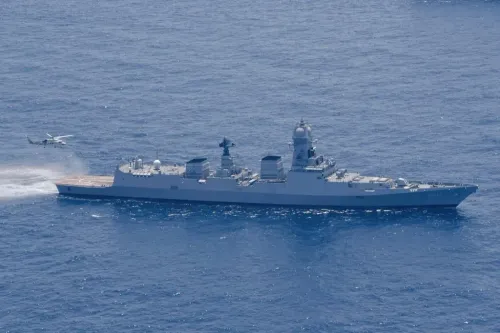
INS Kolkata and PNS Hunain collided in the western Arabian Sea on 15 September 2026 during a routine Indian Navy deployment.
MEA spokesperson Randhir Jaiswal called PNS Hunain's conduct 'unacceptable and unprofessional' and rejected Pakistan's counterclaims as 'usual prevarication.' India says PNS Hunain's overtaking manoeuvre violated Article 10 of the 1991 India-Pakistan agreement , which bars naval units from coming within three nautical miles of each other.
Pakistan's Charge d'Affaires was summoned to the MEA on Wednesday; India's envoy in Islamabad was separately instructed to file a parallel protest.
INS Kolkata sustained no major damage and remains on active deployment in the region.
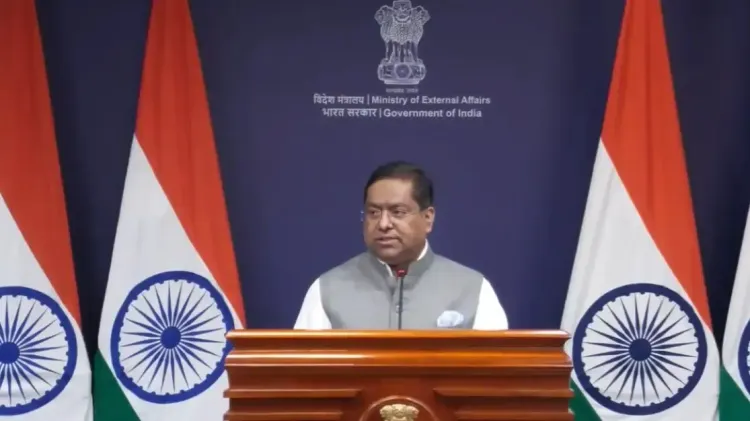
India on Friday, 18 September 2026, firmly rejected Pakistan's allegations over the collision between the Indian Navy's INS Kolkata and the Pakistani naval ship PNS Hunain in the western Arabian Sea on 15 September, dismissing the Pakistani response as 'usual prevarication.' The Ministry of External Affairs (MEA) spokesperson Randhir Jaiswal declared that it was PNS Hunain's 'unacceptable and unprofessional' conduct at sea that directly caused the collision, and confirmed that INS Kolkata suffered no significant damage and remains operational.
What MEA Said at the Briefing
Addressing reporters at a bi-weekly media briefing in New Delhi, Jaiswal stated: 'We have seen Pakistan's response to the protest we have lodged. It is the usual prevarication that we expected. We reject the allegations and insinuations contained therein.'
He elaborated that INS Kolkata was on a routine deployment in the western Arabian Sea when PNS Hunain executed a dangerous overtaking manoeuvre that triggered the incident. 'The dangerous overtaking manoeuvre by PNS Hunain was in gross violation of Article 10 of the Agreement Between India and Pakistan on Advance Notice on Military Exercises, Maneuvers and Troop Movements of 1991, which clearly specifies that naval units at sea are not to be within three nautical miles of each other,' Jaiswal said.
The MEA spokesperson also noted that the Pakistani ship infringed the International Regulations for Preventing Collisions at Sea. He confirmed that the Pakistani side has once again been advised to ensure all military units observe due care and respect the provisions of the relevant bilateral agreements.
Diplomatic Escalation: Pakistan's Envoy Summoned
The incident had already triggered a sharp diplomatic response on Wednesday, when India summoned the Charge d'Affaires of the Pakistan High Commission in New Delhi and lodged a strong protest. Separately, India's Charge d'Affaires in Islamabad was instructed to file a parallel protest with Pakistan's Ministry of Foreign Affairs — a dual-channel démarche signalling the seriousness with which New Delhi views the episode.
The collision occurred in international waters, a detail the MEA has underscored to pre-empt any territorial framing by the Pakistani side.
Pakistan's Counterclaim
Pakistan had previously accused an Indian naval vessel of conducting a 'provocative manoeuvre' that caused the collision, framing its own ship as the aggrieved party. India's point-by-point rebuttal — citing a specific treaty article and international maritime law — represents a deliberate effort to move the dispute onto a legal and procedural footing, rather than allowing it to remain a competing narrative battle.
Context: The 1991 Agreement and Maritime Norms
The 1991 bilateral agreement on advance notice for military exercises and troop movements was designed specifically to reduce the risk of accidental confrontation between the two navies. Article 10's three-nautical-mile separation rule for naval units is one of its core operational safeguards. This is not the first time India has cited treaty violations in maritime incidents involving the two navies, and critics argue that the agreement's enforcement mechanisms remain weak in practice.
Notably, the Arabian Sea has seen heightened naval activity from both sides in recent years, and this incident underscores the fragility of at-sea protocols in a bilateral relationship with limited direct communication channels between military commanders.
What Happens Next
With both sides having lodged formal protests and publicly staked out opposing accounts of the incident, the episode is unlikely to de-escalate quickly. Analysts say the focus will now shift to whether either government seeks a fact-finding exchange or pursues the matter through diplomatic back-channels. INS Kolkata, confirmed to be undamaged, remains on deployment — a signal that India does not intend to alter its operational posture in the region.
Point of View
Where India holds the stronger procedural hand. Yet the 1991 agreement lacks binding enforcement mechanisms, and Pakistan's willingness to publicly invert the blame sequence suggests neither side expects a quiet resolution. The Arabian Sea is becoming a secondary theatre of India-Pakistan friction, and the absence of direct naval communication protocols between the two sides remains a structural risk that this incident has exposed sharply.
NationPress
18 Sept 2026
Frequently Asked Questions
What happened between INS Kolkata and PNS Hunain in the Arabian Sea?
The Indian Navy's INS Kolkata and Pakistan's PNS Hunain collided in the western Arabian Sea on 15 September 2026 while INS Kolkata was on a routine deployment. India says PNS Hunain executed a dangerous overtaking manoeuvre in violation of a 1991 bilateral agreement and international maritime law, causing the collision. INS Kolkata sustained no major damage.
What did India's MEA say about the incident on 18 September?
MEA spokesperson Randhir Jaiswal rejected Pakistan's account as 'usual prevarication' and stated that PNS Hunain's conduct was 'unacceptable and unprofessional.' He cited a violation of Article 10 of the 1991 India-Pakistan agreement, which mandates a minimum three-nautical-mile separation between naval units at sea.
What treaty did Pakistan allegedly violate during the collision?
India says PNS Hunain violated Article 10 of the Agreement Between India and Pakistan on Advance Notice on Military Exercises, Maneuvers and Troop Movements, signed in 1991. That article specifically prohibits naval units from coming within three nautical miles of each other. India also says the Pakistani ship breached International Regulations for Preventing Collisions at Sea.
What diplomatic steps has India taken after the naval collision?
India summoned Pakistan's Charge d'Affaires at the MEA in New Delhi and lodged a formal protest on Wednesday, 17 September. Simultaneously, India's Charge d'Affaires in Islamabad was instructed to file a parallel protest with Pakistan's Ministry of Foreign Affairs — a dual-channel diplomatic response reflecting the gravity New Delhi attaches to the incident.
What is Pakistan's position on the Arabian Sea collision?
Pakistan has accused the Indian naval vessel of carrying out a 'provocative manoeuvre' that caused the collision, effectively placing responsibility on India's side. India has rejected these allegations in their entirety, calling them insinuations inconsistent with the established facts of the incident.