Jitendra Singh: India's Space Economy to Hit $40-45 Bn
Synopsis
At the Bloomberg New Economy Forum's New Delhi roundtable, Science Minister Dr. Jitendra Singh projected India's space economy would grow from USD 9 billion to USD 40–45 billion within seven to eight years, crediting PM Modi's 2020 private-sector reforms and emphasising Earth-applications as the programme's defining strength.
Key Takeaways
India's space economy is currently valued at approximately USD 9 billion and is projected to reach USD 40–45 billion within seven to eight years .
PM Modi's 2020 reforms unlocked the sector to private participation, creating IN-SPACe and spurring progressively increasing private investment.
NewSpace India Limited (NSIL) , incorporated in 2019 , serves as ISRO's commercial arm to facilitate industry partnerships.
The minister identified the next priority as converting existing capabilities into commercially viable, internationally competitive businesses .
India's space programme is distinguished by its downstream Earth applications — covering agriculture, infrastructure, disaster management, and defence .
Satellite communications, geospatial tools, and Earth observation are being actively deployed as national governance infrastructure .
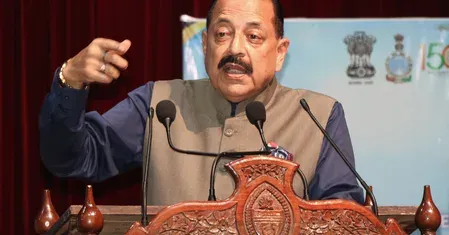
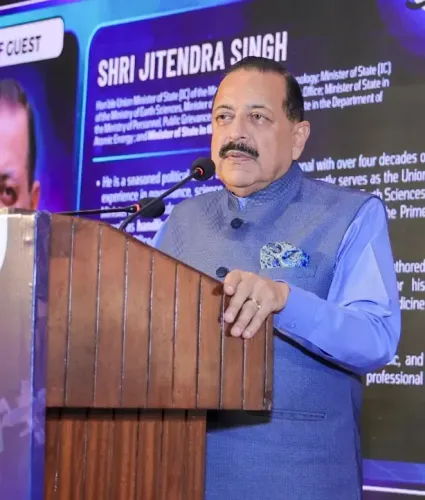
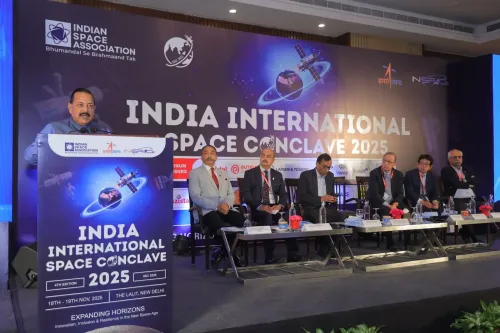
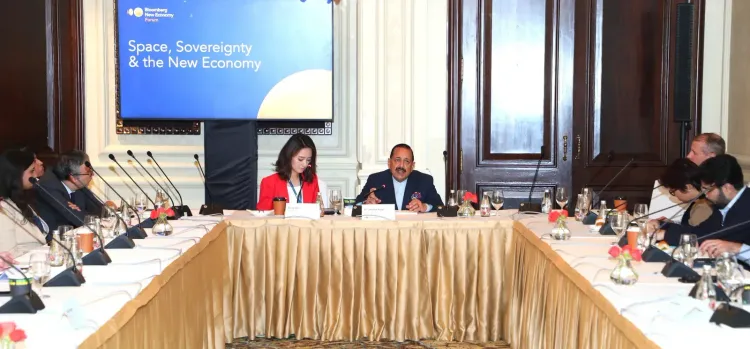
A USD 9 billion industry on its way to USD 40–45 billion — and the clock is ticking at seven to eight years. Union Science and Technology Minister Dr. Jitendra Singh laid out that sweeping trajectory on Saturday, 17 October 2026, speaking at the New Delhi Roundtable on Space organised by the Bloomberg New Economy Forum, making the case that India's space story is no longer just about rockets leaving the atmosphere — it is about money, markets, and a mission to compete globally.
From a closed programme to an open market
The inflection point, as Dr. Singh framed it, was the 2020 decision by Prime Minister Narendra Modi to unlock the space sector to private participation. That reform created IN-SPACe — the Indian National Space Promotion and Authorisation Centre — as the nodal body to greenlight and promote private activity alongside ISRO. A year earlier, in 2019, NewSpace India Limited (NSIL) had been incorporated as ISRO's commercial arm, laying the institutional groundwork for industry partnerships.
The minister described 'progressively increasing private investments' flowing in since that unlocking — a trend now visible in a growing cluster of Indian space startups raising capital for launch vehicles, satellite constellations, and ground-segment services. The model, he argued, demonstrates 'the potential of bringing government institutions and private industry together in a sector that requires substantial technological expertise, investment and long-term commitment.'
The next frontier: commercial scale and global competition
Capability is one thing. Converting it into revenue is another. Dr. Singh was direct: 'The priority now is to convert these capabilities into commercially viable businesses with the scale to compete internationally.' That is a significant shift in official language — from pride in scientific achievement to hard-nosed commercial ambition.
India's hybrid model — strong public institutions paired with private capital — mirrors trends in the United States and Europe, but with a distinctly developmental flavour. The minister pointed to satellite communications, geospatial applications, and Earth observation as tools actively supporting infrastructure development, project monitoring, agriculture, disaster management, and defence. Space, in this telling, is not a prestige project. It is national infrastructure.
Earth observation and geospatial tools as governance backbone
Perhaps the sharpest line from the roundtable was this: India's space programme is 'distinguished not only by its achievements in Space but also by the extensive use of Space technology on Earth.' That downstream emphasis — using satellites to monitor crops, track disasters, and guide construction — sets India apart from programmes that measure success purely by launch cadence or deep-space milestones.
Agriculture, home to hundreds of millions of Indians, and disaster management, critical in a country exposed to cyclones, floods, and earthquakes, are now formally named as beneficiaries of space-derived data. Defence applications round out a picture of a programme deeply embedded in the machinery of the Indian state.
What the $40-billion target demands
Reaching a USD 40–45 billion space economy within the decade will require more than policy intent. Watchers will track the pace of IN-SPACe authorisations, the progress of any new space legislation in Parliament, and whether updated industry valuations from government or sector bodies confirm the growth curve the minister cited. Private startups — from launch-vehicle firms to satellite-imagery providers — will be the ones doing the heavy lifting on the revenue side.
India has built the rocket. Now it has to build the business. That, in a sentence, is the challenge Dr. Jitendra Singh put on the table in New Delhi.
Point of View
More a commercial powerhouse ready for foreign capital and partnerships. The explicit USD 40–45 billion target functions as a diplomatic signal as much as a domestic policy benchmark, framing India as a credible alternative to established space-economy players. The emphasis on downstream Earth applications — agriculture, disaster management, defence — also reinforces the government's broader narrative that frontier technology must serve development goals, not just prestige. Whether the regulatory pipeline through IN-SPACe and potential new space legislation can keep pace with that ambition will be the real test of the next parliamentary session.
NationPress
17 Oct 2026
Frequently Asked Questions
What is India's current space economy value?
According to Union Minister Dr. Jitendra Singh, India's space economy is currently valued at approximately USD 9 billion, with projections to reach USD 40–45 billion over the next seven to eight years.
What is IN-SPACe and what does it do?
IN-SPACe, the Indian National Space Promotion and Authorisation Centre, was established following the 2020 reforms to authorise and promote private-sector participation in India's space activities alongside ISRO.
What is NewSpace India Limited (NSIL)?
NewSpace India Limited is a government-owned company incorporated in 2019 as ISRO's commercial arm, designed to facilitate partnerships between the space agency and private industry.
How is India using space technology on Earth?
India deploys satellite communications, Earth observation, and geospatial applications across sectors including agriculture, infrastructure development, project monitoring, disaster management, and defence.
What did Jitendra Singh say at the Bloomberg New Economy Forum?
At the New Delhi Roundtable on Space organised by the Bloomberg New Economy Forum on 17 October 2026, Dr. Jitendra Singh outlined India's space economy growth projections, credited PM Modi's 2020 reforms for rising private investment, and called for converting India's space capabilities into internationally competitive commercial businesses.