Dr. Jitendra Singh: India's space economy to hit $45 bn in a decade

Synopsis
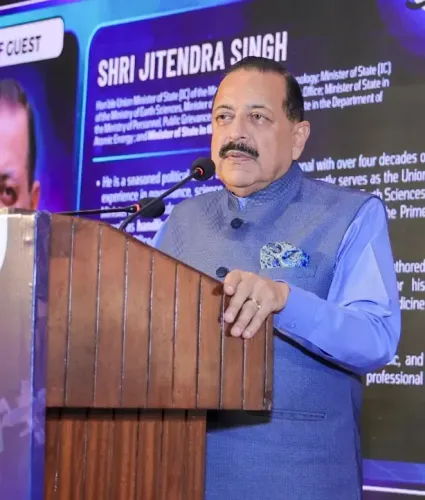
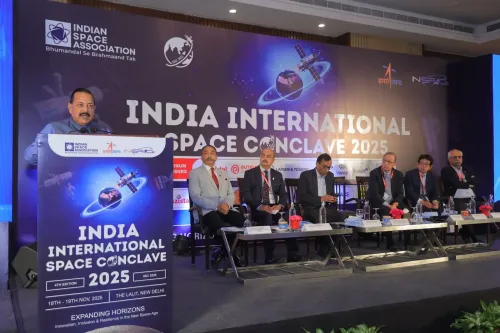
Union Minister Dr. Jitendra Singh at Rise Conclave 2026 in Bengaluru projected India's space economy will hit $45 billion in a decade, underscoring the government's push to expand private participation through IN-SPACe and the 2023 Indian Space Policy.
Key Takeaways
Jitendra Singh projected India's space economy will reach $45 billion within the next decade.
The announcement was made at Rise Conclave 2026 in Bengaluru on June 15, 2026 .
IN-SPACe , established in 2020 , is the nodal body enabling private sector participation in India's space sector.
The 2023 Indian Space Policy formalised roles for government, academia and industry in expanding commercial space activity.
ISRO remains the anchor institution while private startups and aerospace firms are expected to drive commercial growth.
Upcoming IN-SPACe authorisations and 2026-27 budget allocations will be key indicators of execution.
Union Science and Technology Minister Dr. Jitendra Singh on Monday, June 15, 2026, projected that India's space economy is on track to reach $45 billion within the next decade, making the announcement at the #Rise_Conclave2026 in Bengaluru.
Context
Speaking at the Rise Conclave 2026, Dr. Singh placed India's commercial space ambitions in sharp relief, citing a target of $45 billion for the sector over the coming ten years. Bengaluru, home to ISRO's headquarters and a dense cluster of aerospace firms and research institutions, served as a fitting venue for the announcement. The conclave brought together stakeholders from government, industry and academia to deliberate on the trajectory of India's space economy.
India's space sector has undergone significant structural transformation since June 2020, when the government approved landmark reforms opening the sector to private players. Those reforms also established IN-SPACe — the Indian National Space Promotion and Authorisation Centre — as the nodal body to regulate and promote non-government participation in space activities.
Policy Backdrop
The 2023 Indian Space Policy codified the respective roles of government agencies, academia and private industry, providing a formal framework for expanding commercial space activities. The policy explicitly encourages private investment in launch services, satellite manufacturing and downstream applications such as geospatial data and communications.
IN-SPACe has since emerged as the gateway for startups and established aerospace firms seeking authorisation to build and launch satellites or develop launch vehicle technology. Successive Union Budgets have reinforced the thrust toward self-reliance in space technology, mirroring the broader Aatmanirbhar Bharat (self-reliant India) agenda that spans defence, semiconductors and advanced manufacturing.
Stakeholders and Impact
The $45 billion projection, if realised, would represent a transformative leap for an ecosystem that currently holds a modest share of the global commercial space market. Space startups, private aerospace firms and satellite service providers stand to benefit most directly from the policy liberalisation and the investment signals that ministerial projections of this scale send to domestic and foreign capital.
ISRO remains the anchor institution — providing launch infrastructure, technology transfer and mission heritage — while the private sector is expected to drive volume, innovation and downstream commercialisation. Bengaluru in particular, with its concentration of engineering talent and proximity to ISRO facilities, is positioned as the nucleus of this emerging commercial ecosystem.
What's Next
Attention will now turn to the roll-out of IN-SPACe authorisations for private launch vehicles and satellite constellations, which will serve as the near-term litmus test for whether policy intent translates into operational activity. Budget allocations for the space sector in 2026-27 will be closely watched for the fiscal muscle behind the minister's projection.
With global competition in commercial space intensifying, India's ability to attract private investment, scale manufacturing capacity and secure international launch contracts will determine whether the $45 billion milestone becomes a benchmark or a stretch target.
Point of View
India's de facto space capital, amplifies the message to the startup ecosystem clustered around ISRO's campus. The figure sits within the broader arc of reforms since 2020, where each successive policy layer — IN-SPACe, the 2023 Space Policy, budget allocations — has incrementally de-risked private entry. Whether the number holds will depend on how quickly IN-SPACe converts its authorisation pipeline into operational missions and how aggressively the government backs domestic manufacturing of launch vehicles and satellites.
NationPress
13 Sept 2026
Frequently Asked Questions
What is India's space economy target for the next decade?
Union Minister Dr. Jitendra Singh has projected India's space economy will reach $45 billion within the next decade, as stated at Rise Conclave 2026 in Bengaluru.
What is IN-SPACe and what role does it play in India's space sector?
IN-SPACe (Indian National Space Promotion and Authorisation Centre) was established in 2020 to regulate and promote private sector participation in India's space activities, acting as the nodal body for authorising non-government launch vehicles and satellite projects.
What is the 2023 Indian Space Policy?
The 2023 Indian Space Policy is a formal framework that defines the roles of government agencies, academia and private industry in expanding India's commercial space sector, encouraging private investment in launches, satellite manufacturing and downstream applications.
Why is Bengaluru significant for India's space sector?
Bengaluru is the headquarters of ISRO and hosts a dense concentration of aerospace firms, engineering talent and research institutions, making it the nucleus of India's emerging commercial space ecosystem.
What will determine whether India achieves its $45 billion space economy goal?
Key indicators include the pace of IN-SPACe authorisations for private launch vehicles and satellite constellations, budget allocations in 2026-27 , and India's success in attracting private investment and securing international launch contracts.