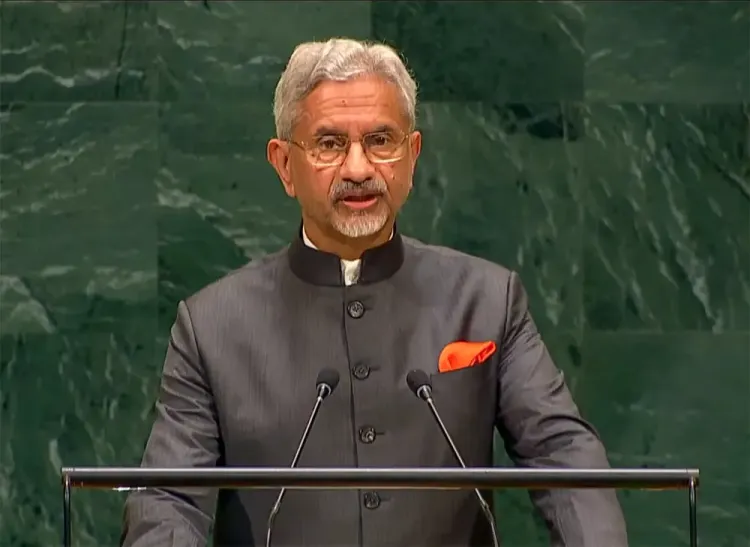
Jaishankar at UN: India will act against terror, slams 'serial practitioner'
Synopsis
At the UN General Assembly, External Affairs Minister Jaishankar did not mince words: India will exercise its right to defend itself against terrorism, and a 'serial practitioner' who misrepresented facts the previous day has been put on notice. The unambiguous warning, set within a sweeping speech on global order and the Global South's vulnerabilities, signals New Delhi's posture is hardening — and the world's largest forum just heard it.
Key Takeaways
External Affairs Minister S.
Jaishankar addressed the UN General Debate on 26 September 2026 , asserting India's right to act against terrorism.
He accused an unnamed country — widely interpreted as Pakistan — of being a 'serial practitioner of terrorism' that misrepresented facts at the assembly a day earlier.
Jaishankar declared that arguments to 'normalise terrorism and claim immunity from its consequences' would 'not stand.' He outlined a '4F crisis' facing the Global South: security of food, fuel, fertiliser and finance .
India cited 600 development projects in 78 countries and joined Liberia and 23 partners in a coalition against maritime attacks.
He renewed India's call for UN Security Council reform and pledged to make artificial intelligence part of its Global South partnership agenda.
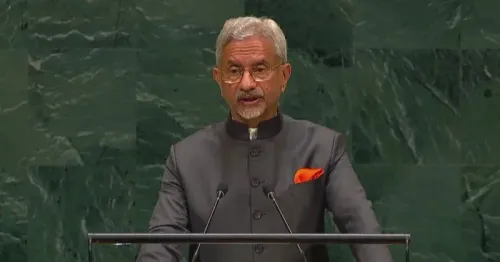
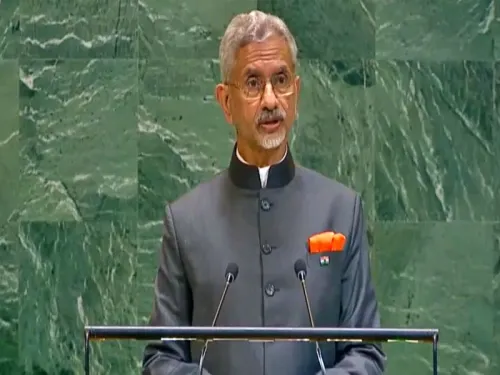
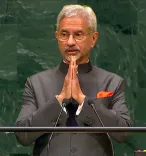
External Affairs Minister S. Jaishankar on Saturday, 26 September issued a pointed warning at the United Nations General Assembly, asserting that India would exercise its sovereign right to defend itself against terrorism and accusing an unnamed country of misrepresenting facts before the world body a day earlier.
'Yesterday, a serial practitioner of terrorism misrepresented facts before this assembly,' Jaishankar told the General Debate. 'Our right to defend ourselves against terrorism will be exercised.'
The Veiled Warning and Its Target
Jaishankar declined to name the country in his remarks, but the reference was widely interpreted in diplomatic circles as directed at Pakistan, given the longstanding Indian position on cross-border terrorism. He accused unnamed actors of making arguments designed to 'normalise terrorism and claim immunity from its consequences,' adding bluntly: 'That will not stand.'
He categorised state-sponsored terrorism with a cross-border dimension as a direct challenge to the global order, calling for governments engaged in such practices to be held accountable and for the financing of terrorism to be exposed and countered. 'Friendship and goodwill cannot coexist with terrorism,' he said, pressing the unnamed perpetrator to change course. He reiterated India's commitment to zero tolerance towards terrorism.
The 4F Crisis and Pressures on the Global South
The anti-terror warning was embedded in a wider address covering peace, development and the structural vulnerabilities of poorer nations. Jaishankar described a '4F crisis' confronting the Global South — encompassing the security of food, fuel, fertiliser and finance. A super El Nino, fertiliser shortages, and disruptions to grain trade were highlighted as causes for alarm.
He also cautioned that the world was witnessing 'a weaponisation of everything' — from financial access and market entry to supply chains and technology. Countries were responding by de-risking and diversifying partnerships, he noted, but the broader global atmosphere was haemorrhaging trust.
India's Development Footprint and Maritime Concerns
Jaishankar pointed to 600 major Indian development projects across 78 countries, spanning infrastructure, manufacturing, agriculture, information technology, and capacity building, with African nations and small island developing states identified as preferred partners. He also cited India's emergency response to the Nepal flash floods and the Venezuela earthquake as examples of its first-responder role.
On maritime security, the minister described attacks on commercial vessels and seafarers — stretching from the Gulf to the Red Sea and the Black Sea — as unacceptable, noting that Indian seafarers had lost their lives. India had joined Liberia and 23 other partners in a coalition to resist such attacks, he said.
Calls for AI Equity and UN Reform
Jaishankar urged that every country should retain the ability to develop its own artificial intelligence models and deployment frameworks in line with national priorities. India, he said, would make AI a core plank of its partnership agenda with the Global South.
He also renewed India's push for reform of international institutions, arguing that a more multipolar world demanded more representative governance. 'Large sections of humanity cannot be excluded from that process,' he said. India has long sought a permanent seat on the UN Security Council, whose composition still reflects the post-World War II settlement. Jaishankar closed the address by invoking Mahatma Gandhi's words: 'There is no way to peace. Peace is the way.'
Point of View
Ensuring maximum interpretive impact while preserving deniability in formal text. The speech's architecture is deliberate: by nesting the terror warning inside a broader development address, New Delhi frames itself simultaneously as a wronged sovereign and a responsible global actor, contrasting sharply with whoever it is accusing. What mainstream coverage may miss is the multilateral dimension — the maritime coalition with Liberia and 23 partners, and the AI equity push, signal that India is actively building coalitions beyond the usual bilateral frames. The question is whether this rhetorical escalation at the UN translates into coordinated diplomatic pressure, or remains a powerful annual ritual.
NationPress
27 Sept 2026
Frequently Asked Questions
What did Jaishankar say about terrorism at the UN General Assembly?
Jaishankar asserted on 26 September 2026 that India would exercise its right to defend itself against terrorism, accusing an unnamed country of being a 'serial practitioner of terrorism' that misrepresented facts before the UN General Assembly. He stated that efforts to normalise terrorism or claim immunity from its consequences 'will not stand.'
Which country was Jaishankar referring to in his UN speech?
Jaishankar did not name the country in his remarks. However, the reference was widely interpreted in diplomatic circles as directed at Pakistan, given India's longstanding position on cross-border terrorism emanating from Pakistani territory.
What is the '4F crisis' Jaishankar mentioned?
The '4F crisis' refers to the simultaneous threats to food, fuel, fertiliser, and finance security facing the Global South. Jaishankar cited a super El Nino, fertiliser shortages, and grain supply disruptions as among the most pressing concerns.
What did Jaishankar say about India's global development role?
Jaishankar highlighted 600 major Indian development projects across 78 countries, covering infrastructure, manufacturing, agriculture, IT, and capacity building. He noted that African nations and small island developing states had been priority partners, and cited India's early disaster response in Nepal and Venezuela.
What did Jaishankar say about UN Security Council reform?
Jaishankar renewed India's call for reformed multilateralism, arguing that large sections of humanity could not be excluded from a restructured global order. India has long advocated for a permanent seat on the UN Security Council, whose current structure reflects post-World War II geopolitics.