Anurag Thakur Hails India's Gold at 56th Physics Olympiad
Synopsis
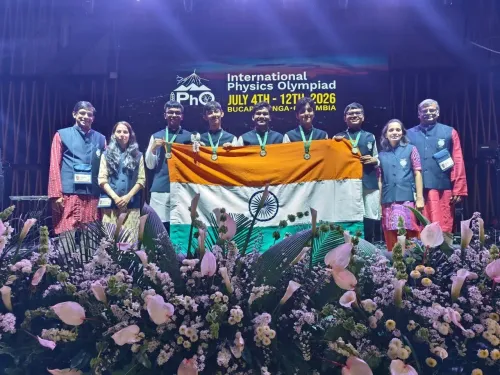
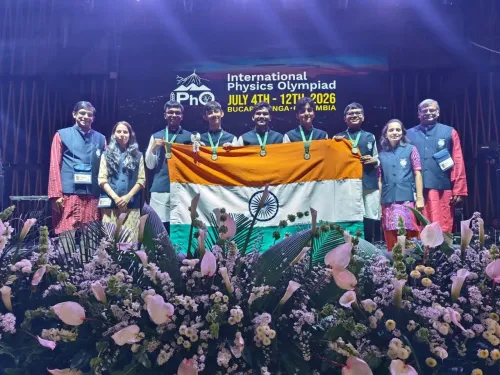
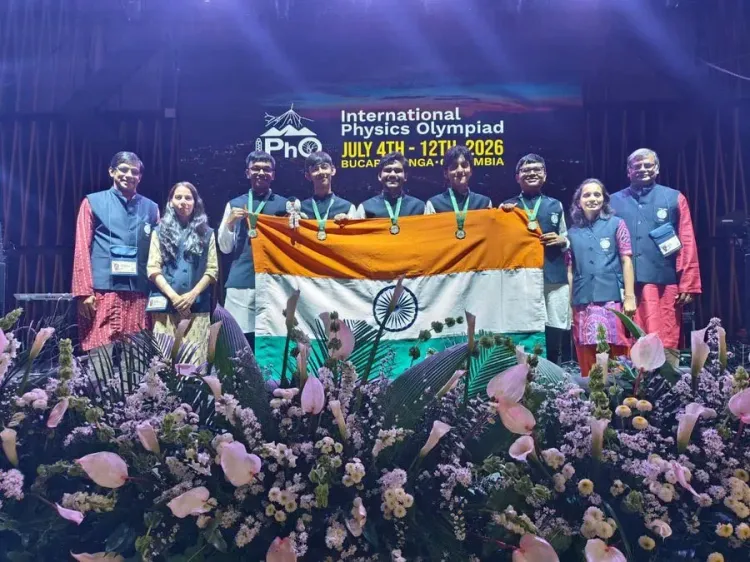
BJP MP Anurag Thakur praised five Indian students — Kanishk Jain, Riddhesh Anant Bendale, Rishit Garg, Shresth Suraiya, and Svarit Joshi — for winning Gold at the 56th International Physics Olympiad 2026 in Colombia, calling them future leaders of India's scientific and technological rise.
Key Takeaways
Five Indian students — Kanishk Jain, Riddhesh Anant Bendale, Rishit Garg, Shresth Suraiya, and Svarit Joshi — won Gold at the 56th International Physics Olympiad 2026 in Colombia .
BJP MP Anurag Thakur , former Union Minister for Youth Affairs & Sports, publicly congratulated the winners on 13 July 2026 .
India has participated in the IPhO since 1998 , with selection and training managed by the Homi Bhabha Centre for Science Education (HBCSE) under the Department of Atomic Energy.
The INSPIRE scheme (2008) and National Education Policy 2020 both emphasise supporting olympiad talent to build India's long-term research workforce.
International olympiad results are routinely cited in parliamentary debates as indicators of India's progress toward becoming a global knowledge economy .
BJP MP Anurag Thakur on Monday, 13 July 2026 congratulated five Indian students — Kanishk Jain, Riddhesh Anant Bendale, Rishit Garg, Shresth Suraiya, and Svarit Joshi — on winning Gold at the 56th International Physics Olympiad (IPhO) 2026, held in Colombia. The former Union Minister of Information & Broadcasting and Youth Affairs & Sports called the achievement a reflection of 'exceptional talent and mettle' of India's young prodigies.
Context
Posting on X, Thakur wrote that he was 'extremely proud' of the five winners and described the Gold medal as 'not merely a medal but the reflection of the exceptional talent and mettle of our young prodigies.' He added that 'today's Physics Olympiad champions are tomorrow's physicists, researchers and scientific leaders who will shape India's scientific future and strengthen its position as a global technology powerhouse.'
The International Physics Olympiad is an annual global competition for high-school students, testing both theoretical and experimental physics. First held in 1967, it draws teams from across the world and is widely regarded as one of the most prestigious pre-university science contests globally.
Policy Backdrop
India began formally participating in the IPhO in 1998, with student selection and training managed by the Homi Bhabha Centre for Science Education (HBCSE), a unit of the Tata Institute of Fundamental Research in Mumbai operating under the Department of Atomic Energy. HBCSE runs a multi-stage national selection process that culminates in an intensive residential training camp before the international competition.
The INSPIRE scheme, launched in 2008 by the Department of Science & Technology, provides scholarships and recognition to top olympiad performers to encourage them to pursue research careers within India. The National Education Policy 2020 further reinforced this direction by explicitly calling for strengthened talent identification and olympiad-style training within the school system.
Stakeholders and Impact
Successive Indian governments have treated international olympiad results as a visible metric of the country's STEM talent pipeline. Performance at events such as the IPhO is regularly cited in parliamentary debates and science ministry reports as an indicator of progress toward a knowledge economy.
For the five medal-winners, the achievement opens pathways to premier undergraduate institutions, research fellowships, and international collaborations. The broader student community — particularly the lakhs of aspirants who participate in HBCSE's national olympiad stages each year — also benefits from the heightened institutional attention that strong results typically generate.
Thakur's post reflects a wider pattern among political leaders of publicly amplifying youth achievements in science and technology, reinforcing the government's narrative around India's ambition to become a global knowledge and innovation hub.
What's Next
With the 56th IPhO concluded, attention will turn to HBCSE's selection and training cycle for the 2027 edition. Strong performances at Colombia may also prompt parliamentary or ministerial statements on additional funding for olympiad training programmes or potential linkages with undergraduate admissions at institutions such as the IITs and IISc. India's broader R&D expansion agenda, including increased science funding and international scientific collaborations, is likely to be cited as the enabling environment for such talent to flourish in the years ahead.
Point of View
Reinforcing the 'Viksit Bharat' narrative ahead of continued policy debates on R&D spending. The shout-out to five named students — rather than a generic team reference — gives the message unusual specificity and human interest, amplifying its reach among parents, educators, and aspirants. It also implicitly underscores the institutional pipeline built over decades through HBCSE and INSPIRE, lending the achievement a policy dimension beyond individual merit. Whether this translates into concrete budget or admissions-policy announcements will be the real test of political intent.
NationPress
12 Oct 2026
Frequently Asked Questions
Who won Gold for India at the International Physics Olympiad 2026?
Five Indian students — Kanishk Jain, Riddhesh Anant Bendale, Rishit Garg, Shresth Suraiya, and Svarit Joshi — won Gold at the 56th International Physics Olympiad 2026 held in Colombia.
Where was the 56th International Physics Olympiad held?
The 56th International Physics Olympiad 2026 was held in Colombia.
What is the International Physics Olympiad?
The International Physics Olympiad (IPhO) is an annual global competition for high-school students in theoretical and experimental physics, first held in 1967. India has participated since 1998.
Which organisation trains India's team for the Physics Olympiad?
The Homi Bhabha Centre for Science Education (HBCSE), a unit of TIFR in Mumbai under the Department of Atomic Energy, selects and trains India's squad for international science olympiads including the IPhO.
What government schemes support Indian physics olympiad winners?
The INSPIRE scheme, launched in 2008 by the Department of Science & Technology, provides scholarships and recognition to top olympiad performers. The National Education Policy 2020 also calls for strengthening olympiad-style talent identification within schools.