India's first free-space QKD link spans 5.56 km in Gandhinagar trial
Synopsis
India has crossed a critical quantum communications milestone: a domestic team successfully transmitted quantum-secured keys across 5.56 km of open air in Gandhinagar — entirely with indigenous technology. The trial's hybrid architecture, combining hardware QKD with post-quantum software encryption, is designed to survive even when the quantum channel goes down, pointing directly toward satellite-based quantum links.
Key Takeaways
India demonstrated its first free-space Quantum Key Distribution (QKD) link over 5.56 km on the night of 27–28 September 2026 .
The trial was conducted by QNu Labs in collaboration with BISAG-N and IIT Gandhinagar in Gandhinagar, Gujarat .
The system maintained a Quantum Bit Error Rate (QBER) below 5% and generated secure keys at 230–260 bits per second .
Keys were integrated with BISAG-N's Vedic Kavach platform, enabling end-to-end encryption using post-quantum cryptography.
The hybrid architecture remains resilient even when the physical quantum channel is temporarily unavailable.
The demonstration lays the groundwork for longer-distance quantum networks and satellite-based quantum communication in India.
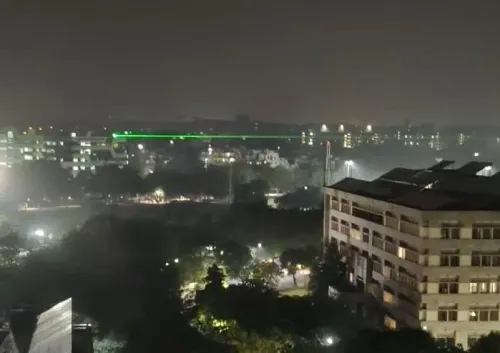
India has successfully demonstrated its first free-space Quantum Key Distribution (QKD) link, establishing a secure quantum communication channel over 5.56 kilometres between the Bhaskaracharya National Institute for Space Applications and Geo-informatics (BISAG-N) and IIT Gandhinagar. The milestone field trial, conducted on the night of 27–28 September 2026, marks a significant advance in India's pursuit of quantum-resilient secure communications.
How the Trial Was Conducted
The demonstration was carried out by QNu Labs in collaboration with BISAG-N and IIT Gandhinagar. The team deployed QNu Labs' proprietary Pointing, Acquisition and Tracking (PAT) system to maintain a stable free-space optical link across the 5.56-km corridor. The trial achieved a Quantum Bit Error Rate (QBER) consistently below five per cent — a critical threshold for reliable quantum key generation — and produced secure keys at a rate of 230–260 bits per second.
Unlike fibre-based QKD systems, free-space QKD transmits quantum signals through open air via optical channels, making it applicable in scenarios where laying fibre infrastructure is impractical or impossible. This characteristic also opens a direct pathway to satellite-based quantum communication.
The Integrated Architecture
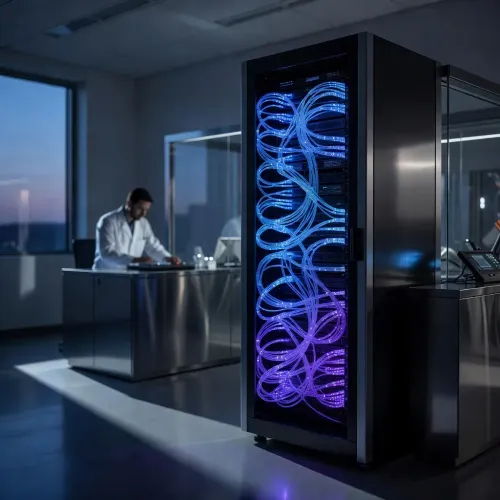
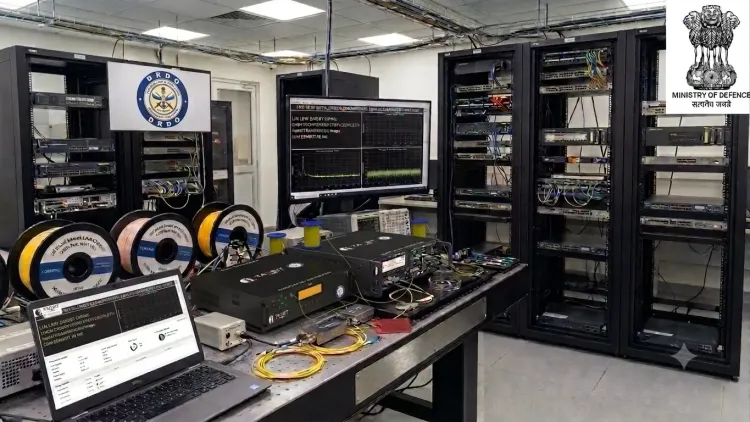
The demonstration brought together two complementary approaches to quantum security. QNu Labs' hardware-based Armos QKD device handled the free-space optical channel, while BISAG-N's Vedic Kavach platform — equipped with post-quantum cryptography and quantum random number generation — provided the software layer. The generated keys were integrated with Vedic Kavach, enabling successful end-to-end encryption and decryption of test messages.
Notably, the integrated architecture is designed to remain operational even when the physical quantum channel is temporarily disrupted — a resilience feature that sets it apart from single-layer quantum security approaches.
What the Stakeholders Said
Dr Vinay Thakur, Director General of BISAG-N, described the integration of Vedic Kavach with QNu Labs' QKD technology as 'a significant step towards practical quantum-resilient communication systems.' Sunil Gupta, Co-founder and CEO of QNu Labs, said the successful demonstration 'paved the way for longer-distance quantum-secure networks and satellite-based quantum communication.' Cmde Manish Tripathi (Retd), In-charge of ISTF at IIT Gandhinagar, said the trial 'showed how academia, indigenous technology and real-world experimentation could be integrated to address emerging secure communication requirements.'
Why This Matters for India
The trial comes as nations race to build quantum-secure communications infrastructure ahead of the anticipated arrival of cryptographically relevant quantum computers — machines capable of breaking widely used encryption standards such as RSA. India's demonstration of a domestically developed, field-tested QKD system reinforces its sovereign quantum security ambitions and reduces dependence on foreign cryptographic technology.
BISAG-N, an autonomous scientific society under the Ministry of Electronics and Information Technology, specialises in space technology applications, satellite communication, and geo-informatics. QNu Labs, founded in 2016, focuses on quantum-secure digital infrastructure and positions itself as a developer of sovereign quantum security products. IIT Gandhinagar, established in 2008, contributes interdisciplinary research across engineering, science, and technology.
With this foundation in place, India's research community and industry partners are now positioned to extend free-space QKD to greater distances and, ultimately, to space-based relay nodes.
Point of View
Vedic Kavach software, and a domestic startup leading the charge. But the real test is scalability: 5.56 km in controlled night-time conditions is a proof of concept, not a deployable network. The hard engineering work — atmospheric turbulence at longer ranges, daytime operation, and satellite relay integration — lies ahead. India has a narrow window to build sovereign quantum infrastructure before foreign-developed quantum networks set interoperability standards it will have to adopt on others' terms.
NationPress
5 Oct 2026
Frequently Asked Questions
What is free-space Quantum Key Distribution (QKD)?
Free-space QKD is a method of transmitting cryptographic keys encoded in quantum states — such as individual photons — through open air rather than through fibre-optic cables. This makes it suitable for communication links where laying fibre is not feasible, and it is a key enabling technology for satellite-based quantum communication.
Who conducted India's first free-space QKD trial?
The trial was conducted by QNu Labs in collaboration with BISAG-N and IIT Gandhinagar on the night of 27–28 September 2026, over a 5.56-km free-space optical link in Gandhinagar, Gujarat.
What is the Vedic Kavach platform used in the demonstration?
Vedic Kavach is a post-quantum cryptography-enabled platform developed by BISAG-N that also incorporates quantum random number generation. In the trial, it was used to receive and apply the quantum-generated keys for end-to-end encryption and decryption of test messages, providing a software-layer complement to QNu Labs' hardware QKD device.
Why does India's QKD milestone matter for national security?
Quantum computers, when they become cryptographically powerful, could break widely used encryption standards such as RSA. A domestically developed, field-tested QKD system gives India a sovereign pathway to quantum-secure communications that does not depend on foreign technology, reducing vulnerability in critical government and defence networks.
What comes next after this demonstration?
According to QNu Labs CEO Sunil Gupta, the 5.56-km demonstration is intended to pave the way for longer-distance quantum-secure networks and satellite-based quantum communication. The trial's hybrid architecture — designed to remain resilient when the quantum channel is unavailable — is expected to serve as a foundation for scaling India's secure communications infrastructure.