Does India Present a $300 Billion Opportunity in Clean Energy?
Synopsis
Union Minister Pralhad Joshi reveals that India is set to attract a whopping $300 billion investment in clean energy by 2030. Discover how this initiative aims to not only transform India's energy landscape but also to empower communities and support global sustainability efforts.
Key Takeaways
$300 billion investment opportunity in clean energy by 2030 .
Focus on renewable energy generation, storage, and green hydrogen.
Commitment to 500 GW of non-fossil fuel power capacity by 2030.
Over 2.5 million households benefitting from rooftop solar.
International cooperation emphasized for technology transfer and financing.
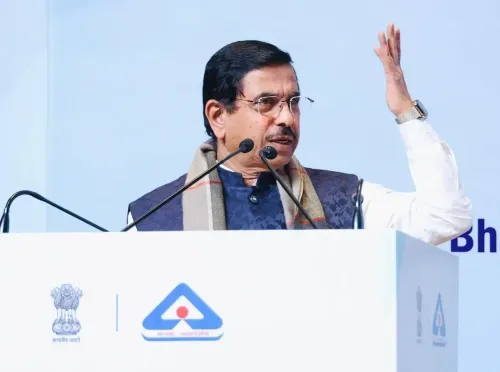
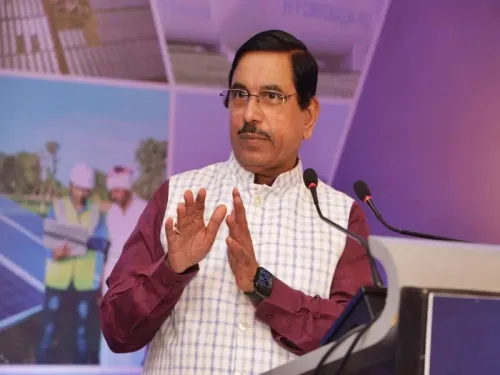
New Delhi, Jan 11 (NationPress) Union Minister for Renewable Energy Pralhad Joshi announced on Sunday that India is poised to offer a staggering $300 billion investment opportunity in areas such as renewable energy generation, storage, green hydrogen, grid development, and manufacturing by 2030.
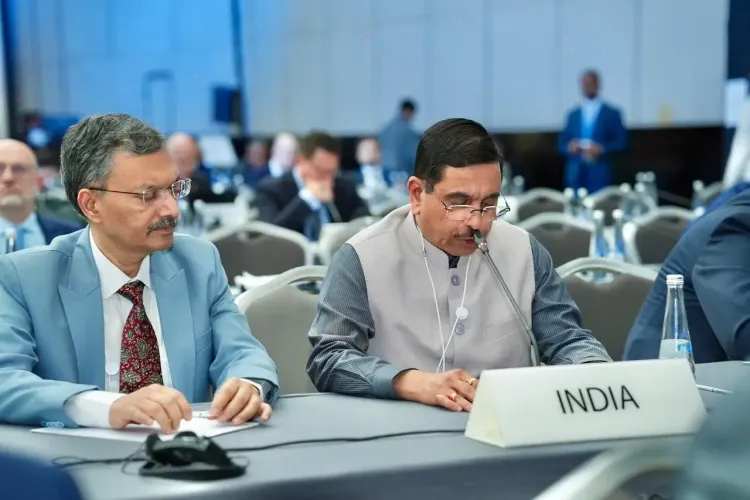
Speaking at the 16th Assembly of the International Renewable Energy Agency (IRENA) in Abu Dhabi, UAE, the Union Minister emphasized that with consistent policies and transparent markets, India remains one of the most appealing destinations for clean energy investments.
Promoting international collaboration, Union Minister Joshi highlighted the necessity for technology transfer, affordable financing, capacity building, and standard harmonization, especially to assist developing nations in expanding renewable energy while fulfilling developmental goals.
Reiterating India's firm backing for IRENA, he stated that India is eager to share its insights, institutional knowledge, and technical skills, collaborating closely with all member nations, particularly Least Developed Countries and Small Island Developing States, to expedite the global shift toward renewable energy.
The Union Minister stressed that India's energy transition focuses not just on capacity growth, but also on enhancing people's lives, creating opportunities, and securing a sustainable future for all.
In his address, Union Minister Joshi conveyed that India's strategy for energy transition is guided by the philosophy of 'Vasudhaiva Kutumbakam' — One Earth, One Family, One Future — underpinned by a long-term vision rooted in equity, inclusivity, and policy consistency.
He reaffirmed India's commitment to achieving 500 GW of non-fossil fuel installed power capacity by 2030 and reaching Net Zero emissions by 2070.
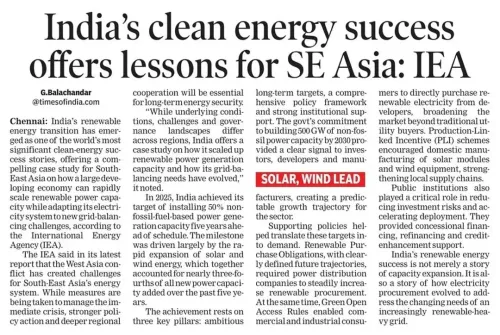
Highlighting a significant achievement, Union Minister Joshi stated that India has already surpassed 50% of its installed electricity capacity from non-fossil fuel sources by 2025, five years ahead of its Nationally Determined Contribution (NDC) target set in the Paris Agreement.
“India's renewable energy capacity has exceeded 266 GW, positioning the country among the global leaders in renewable energy implementation,” he declared.
The Union Minister also pointed out that as one of the fastest-growing major energy markets, India is prioritizing robust and dependable power systems through the rapid deployment of energy storage solutions, grid modernization, and the development of Green Energy Corridors, along with innovative bidding mechanisms like hybrid and round-the-clock renewable energy projects.
He further emphasized India's initiatives to bolster clean energy supply chains and expand domestic manufacturing in sectors such as solar, wind, batteries, and electrolysers, which contribute to national self-reliance and diversified global supply chains.
Focusing on the people-centered aspect of India's energy transition, the Union Minister showcased flagship programs aimed at empowering households and farmers.
“Under the PM Surya Ghar: Muft Bijli Yojana, approximately 2.5 million households have benefited from rooftop solar installations in under two years, with a target to reach 10 million households by March 2027.”
“Through the Pradhan Mantri Kisan Urja Suraksha evam Utthan Mahabhiyan (PM-KUSUM) scheme, about 2.17 million farmers have benefited from replacing diesel pumps and solarizing agricultural feeders.”
Earlier, Union Minister Joshi took part in the high-level dialogue on “Reimagining Energy Futures: Bold Visions for Shared Prosperity” on the sidelines of the Assembly.
He underscored India's dedication to a people-centric energy transition, propelled by enhanced international cooperation on finance, technology, and governance, with the aim of fostering shared prosperity for all.
Stressing that the energy transition must transform into a mass movement driven by equity and inclusion, the Union Minister noted that India added nearly 50 GW of renewable energy capacity in 2025.
He congratulated the Dominican Republic on assuming the presidency of IRENA and extended best wishes to the Vice-Presidents, including Kenya, Solomon Islands, Spain, and Antigua and Barbuda, expressing confidence that their leadership will enhance multilateral cooperation and promote a sustainable and inclusive global energy transition.
Furthermore, the Union Minister met with Amna bint Abdullah Al Dahak, the Minister of Climate Change and Environment of the UAE, to strengthen India-UAE partnerships in climate action, clean energy, and food security.
During their discussion, both parties reviewed the growing partnership in renewable energy, investment, and innovation, underpinned by multiple Memoranda of Understanding signed from 2014 to 2024, aligned with the UAE’s Net Zero 2050 objective.
The dialogue concentrated on enhancing cooperation in renewables, decentralized energy solutions, manufacturing, energy storage, technology collaboration, and blended finance, emphasizing people-centric, scalable initiatives to boost energy security, resilience, and long-term sustainability.
Point of View
Making this initiative essential for both economic growth and environmental sustainability.
NationPress
24 Sept 2026
Frequently Asked Questions
What is the investment opportunity offered by India in clean energy?
India is offering a $300 billion investment opportunity across various sectors such as renewable energy generation, storage, green hydrogen, grids, and manufacturing by 2030.
What are the key components of India's clean energy strategy?
India's clean energy strategy includes renewable energy generation, energy storage, green hydrogen production, grid modernization, and domestic manufacturing.
How is India planning to achieve its clean energy goals?
India aims to achieve its clean energy goals through stable policies, international cooperation, and significant investments in technology and infrastructure.
What milestones has India already achieved in renewable energy?
India has already reached 50% of its installed electricity capacity from non-fossil fuel sources by 2025, ahead of its Nationally Determined Contribution target.
How does India's energy transition impact local communities?
India's energy transition is designed to empower households and farmers through initiatives like rooftop solar installations and solarizing agricultural feeders.