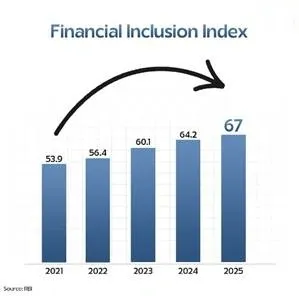
India's Financial Inclusion Index climbs to 67 in 2026, up from 53.9 in 2018
Synopsis
India's Financial Inclusion Index has jumped from 53.9 to 67 in eight years — but the more striking number is the 20-fold surge in PM-JDY deposits to ₹3,16,514 crore, suggesting that millions of newly banked Indians are not just holding accounts but actually saving in them.
Key Takeaways
India's Financial Inclusion Index rose from 53.9 in 2018 to 67 in 2026 , according to an official factsheet dated 27 August 2026 .
PM-JDY accounts have grown four times since 2015, reaching 59.09 crore as of 19 August 2026 .
Total PM-JDY deposits surged nearly 20-fold — from ₹15,670 crore in March 2015 to ₹3,16,514 crore in August 2026.
32.92 crore PM-JDY account holders are women, reflecting steady progress on gender-inclusive banking.
Nearly 41.29 crore RuPay debit cards have been issued, supporting the shift to digital transactions.
An overdraft facility of up to ₹10,000 per household is available after six months of satisfactory account operation.
India's Financial Inclusion Index has risen to 67 in 2026, up from 53.9 in 2018, signalling a measurable expansion in access to credit, insurance, savings, and digital payments across the country, according to an official factsheet released on Thursday, 27 August 2026. The eight-year gain of more than 13 index points reflects the cumulative impact of flagship government programmes, chiefly the Pradhan Mantri Jan Dhan Yojana (PM-JDY).
PM-JDY: Scale and Reach
Accounts under PM-JDY have grown four times since the scheme's launch in 2015, reaching 59.09 crore as of 19 August 2026. Of these, 45.95 crore accounts are held by beneficiaries in rural and semi-urban areas, while 13.14 crore belong to urban and metropolitan residents — underscoring that the scheme's primary reach remains outside major cities.
Female enrolment has been a consistent highlight: 32.92 crore PM-JDY account holders are women, and the share of female beneficiaries has grown steadily over the years, positioning the scheme as a tool for advancing gender equity in financial access.
Deposits Surge Nearly 20-Fold
Total deposits in PM-JDY accounts have risen from ₹15,670 crore in March 2015 to ₹3,16,514 crore as of 19 August 2026 — a nearly 20-fold increase. Officials attribute this growth to rising savings habits among low-income households, greater trust in formal banking institutions, and wider participation in the broader financial system. This is not merely a volume story; the depth of engagement — measured by active deposits rather than dormant accounts — is seen as a more meaningful indicator of genuine inclusion.
Digital Payments and RuPay Adoption
Nearly 41.29 crore RuPay debit cards have been issued to PM-JDY account holders. The domestic card is accepted at all ATMs and most point-of-sale terminals, making it a practical instrument for daily transactions. The scale of RuPay issuance reflects a deliberate policy push to shift low-income households from cash-dependent behaviour toward traceable digital payments — a shift that also improves credit profiling for future lending.
Scheme Benefits and Eligibility
Beyond basic banking, PM-JDY accounts are linked to a suite of government welfare programmes: Direct Benefit Transfer (DBT), Pradhan Mantri Jeevan Jyoti Bima Yojana (PM-JJBY), Pradhan Mantri Suraksha Bima Yojana (PM-SBY), Atal Pension Yojana (APY), and the Micro Units Development and Refinance Agency (MUDRA) scheme. Account holders are also eligible for an overdraft facility of up to ₹10,000 per household, available after six months of satisfactory account operation.
The scheme's mandate has evolved since inception — from ensuring a bank account for every household to guaranteeing access for every unbanked adult, widening the net of financial inclusion considerably. As India targets further improvements in its Financial Inclusion Index, the next challenge lies in converting account ownership into active, sustained financial participation.
Point of View
But index scores can mask uneven depth — having an account is not the same as using it productively. The 20-fold deposit surge is the more persuasive data point, suggesting genuine behavioural change among low-income savers. The real test now is credit uptake: if 59 crore accounts have not translated into proportionate MUDRA disbursements or insurance penetration, the inclusion story remains incomplete. Policymakers should publish active-account ratios and loan-to-account ratios alongside headline figures to give a fuller picture.
NationPress
11 Oct 2026
Frequently Asked Questions
What is India's Financial Inclusion Index and what does the 2026 figure mean?
India's Financial Inclusion Index is a composite measure of access to credit, insurance, savings, and digital payments. A score of 67 in 2026, up from 53.9 in 2018, indicates significantly broader and deeper formal financial access across the population over eight years.
How many PM-JDY accounts are open as of 2026?
As of 19 August 2026, there are 59.09 crore PM-JDY accounts — four times the count at the scheme's launch in 2015. Of these, 45.95 crore are in rural and semi-urban areas.
How much have deposits in PM-JDY accounts grown?
PM-JDY deposits have risen nearly 20-fold, from ₹15,670 crore in March 2015 to ₹3,16,514 crore as of 19 August 2026. The surge reflects growing savings habits and greater trust in formal banking among low-income households.
What benefits do PM-JDY account holders receive?
PM-JDY account holders are eligible for Direct Benefit Transfer, PM-JJBY life insurance, PM-SBY accident insurance, Atal Pension Yojana, and MUDRA scheme credit. They also receive a RuPay debit card and can access an overdraft of up to ₹10,000 after six months of satisfactory account operation.
How has PM-JDY promoted financial inclusion for women?
As of 19 August 2026, 32.92 crore PM-JDY account holders are women, and female enrolment has grown steadily since the scheme's launch in 2015. This makes PM-JDY one of the largest gender-targeted financial access programmes in the world by account count.