Has Govt Support for Fossil Fuels in India Really Fallen to Five Times That of Clean Energy?
Synopsis
This report highlights a significant shift in India's energy policy with government support for fossil fuels shrinking while clean energy investments surge. The ongoing transition holds promise for the future, but challenges remain in ensuring sustainable growth for renewable sources.
Key Takeaways
Government support for fossil fuels is now five times that of clean energy.
Clean energy subsidies have increased by 31% in FY 2024.
Fossil fuel subsidies fell by 12%, driven by temporary price changes.
India's non-fossil electricity capacity is set to surpass 50% by 2025.
Public sector undertakings must diversify to support sustainable energy transition.
New Delhi, Dec 16 (NationPress) The government's backing for fossil fuels in India has reduced to five times the support for clean energy in the fiscal year (FY) 2024, marking the narrowest gap seen in five years, as clean energy subsidies have surged, according to a report released on Tuesday.
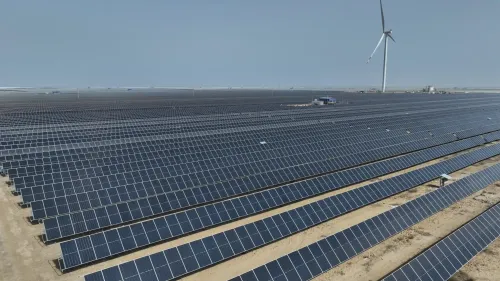
Subsidies for clean energy have risen by 31 percent year-on-year, reaching nearly Rs 32,000 crore ($3.9 billion) in FY 2024, reflecting ongoing policy support for renewable energy, as stated in the report titled Mapping India’s Energy Policy 2025 by the International Institute for Sustainable Development.
In contrast, subsidies for fossil fuels have declined by 12 percent, the most significant drop since the pandemic, driven more by temporary price fluctuations rather than strategic policy changes.
These developments have contributed to India’s non-fossil electricity capacity surpassing 50 percent by 2025, five years ahead of the target, representing a major milestone under India’s updated nationally determined contribution 2.0.
While these trends indicate progress in the energy transition, maintaining this momentum relies on diversifying major energy-related public sector undertakings (PSUs).
Public financial institutions in India, including the Rural Electrification Corporation and Power Finance Corporation, are already increasing their lending for renewable projects and distribution reforms.
However, the capital allocation among PSUs remains heavily biased towards fossil fuels. In FY 2024, a staggering 83 percent of capital expenditure by central energy-related PSUs was directed towards fossil fuel sectors such as coal mining, refinery construction, and oil and gas development.
The clean energy diversification efforts among state-owned enterprises (SOEs) are still limited, raising concerns about locking in energy infrastructure that may not align with India’s long-term climate goals.
“The budget shows promising signs of a gradual shift towards clean energy, yet the broader public financial flows highlight a more profound issue,” remarked Swasti Raizada, senior policy advisor at IISD and a lead author.
“New investments in fossil assets are increasingly appearing on the balance sheets of India’s state-owned enterprises due to weak market signals. As vital state actors in enabling a fair and equitable energy transition, SOEs require robust policy signals and comprehensive diversification plans to engage actively in India’s clean energy shift.”
The report also indicates that electricity subsidies soared to an unprecedented Rs 2.1 lakh crore ($25 billion) in FY 2024, an 18 percent rise, even though electricity demand only grew by seven percent.
This widening gap between the cost of supply and consumer tariffs continues to pressure state finances, suggesting that efficiency improvements and financial reforms in the power distribution sector are failing to manage rising subsidy liabilities.
Point of View
I believe this development reflects a crucial turning point in India's energy strategy. The shift towards renewable energy, while promising, highlights the need for more substantial reforms in public financial flows to ensure that we are not merely reacting to market dynamics but actively steering towards a sustainable future.
NationPress
19 Sept 2026
Frequently Asked Questions
What is the current state of fossil fuel subsidies in India?
Fossil fuel subsidies in India have decreased by 12% in FY 2024, marking the largest decline since the pandemic.
How much have clean energy subsidies increased?
Clean energy subsidies have increased by 31% year-on-year, reaching nearly Rs 32,000 crore ($3.9 billion) in FY 2024.
What does the report suggest about India's energy transition?
The report indicates that India’s non-fossil electricity capacity is expected to exceed 50% by 2025, five years ahead of the initial target.
What challenges remain for India's energy policy?
Despite progress, there is a significant capital allocation skew towards fossil fuels among public sector undertakings, which could hinder long-term climate goals.
What is the impact of electricity subsidies on state finances?
The report indicates that electricity subsidies have reached an all-time high of Rs 2.1 lakh crore ($25 billion), straining state finances amid only a 7% growth in electricity demand.