Rajnath Singh: India's global role hinges on self-reliance and tech
Synopsis
At the VGRC in Vadodara, Rajnath Singh reframed India's Viksit Bharat 2047 goal as a three-legged stool — economic strength, technological capability, and national security — and argued that defence corridors, iDEX, and emerging semiconductor hubs in Sanand and Dholera are not just military assets but the backbone of India's future economic sovereignty.
Key Takeaways
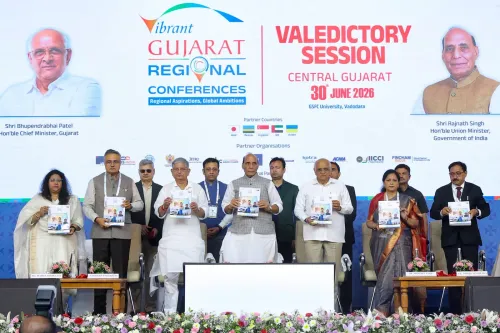
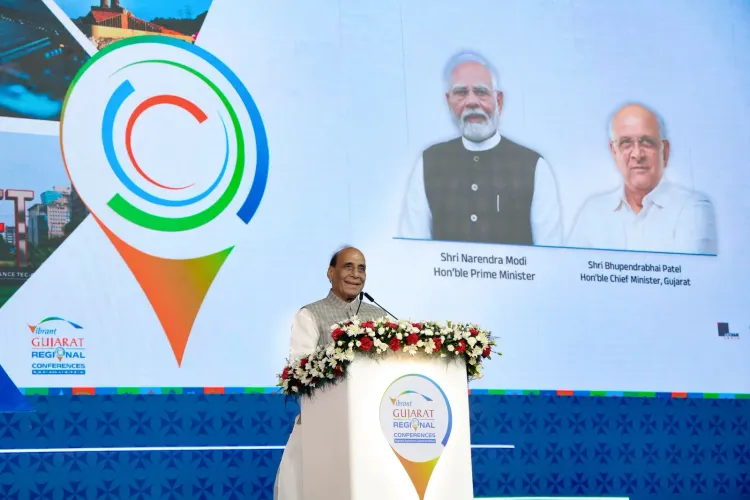
Defence Minister Rajnath Singh addressed the Vibrant Gujarat Regional Conference (VGRC) in Vadodara on 30 June .
He described self-reliance, technological capability and national security as the three pillars determining India's future global role.
Singh linked the Viksit Bharat 2047 goal to advances in technology, industry and strategic capability — not economic growth alone.
Government initiatives cited include Atmanirbhar Bharat , Make in India , iDEX , the Srijan Portal and the Technology Development Fund .
Singh flagged semiconductors , AI , quantum computing , cybersecurity and space technology as critical future domains; pointed to Sanand and Dholera ecosystems as strategic assets.
He stressed that Atmanirbhar Bharat does not mean isolation — India will continue to welcome foreign OEM partnerships, technology transfers and joint ventures.
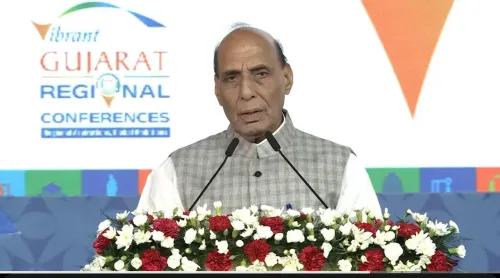
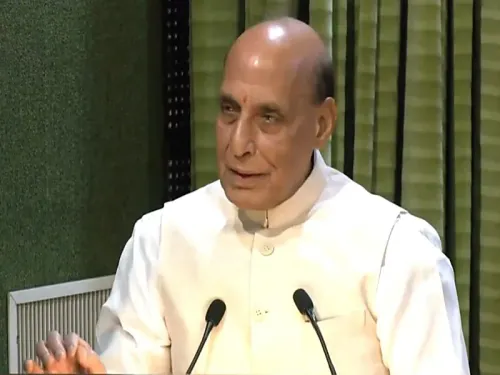
Defence Minister Rajnath Singh on Tuesday, 30 June said that a rapidly shifting geopolitical landscape had made India's self-reliance, technological capability and national security indispensable to shaping the country's future standing on the world stage. He was speaking at the valedictory session of the Vibrant Gujarat Regional Conference (VGRC) in Vadodara.
The Core Argument
Singh framed India's Viksit Bharat 2047 ambition — the national goal of achieving developed-nation status by the centenary of Independence — as something far more layered than an economic target. 'I believe this is not merely a goal of economic development, but a resolve to build an India that is economically prosperous, technologically fully capable and socially fully empowered,' he said.
Drawing on what he described as a historical pattern, Singh argued that every major power rested on three interlocking pillars: economic strength, technological capability and national security. 'Where there is progress in economics, prosperity and technology, that country, that state, will be strong from the perspective of security. And where national security is strong, industry and innovation can function properly and flourish,' he said.
Defence as an Economic Engine
Singh pushed back against a narrow reading of defence as a purely military domain, insisting it underpins a wider economic ecosystem. 'The development of the defence sector is not limited merely to manufacturing weapons. It drives a much broader economic ecosystem. The creation of defence corridors generates new opportunities in infrastructure, logistics, industry and employment,' he said.
He highlighted government-backed programmes — Atmanirbhar Bharat, Make in India, the Defence Acquisition Procedure and the Technology Development Fund — as the primary vehicles for building indigenous capability. Reforms including the Srijan Portal, iDEX, Defence Testing Infrastructure, Green Channel Certification and Self-Certification had, according to Singh, widened the door for MSMEs and start-ups in defence manufacturing.
Self-Reliance Without Isolation
Singh was careful to distinguish India's self-reliance drive from economic nationalism or protectionism. 'For us, Atmanirbhar Bharat means an India that is full of self-confidence, stands firmly on its own feet and works with the world as an equal partner,' he said. India, he added, actively welcomes collaboration with foreign original equipment manufacturers, technology transfers and joint ventures — provided that capabilities and economic benefits are anchored on Indian soil.
Emerging Technologies and Strategic Sovereignty
Looking ahead, Singh identified semiconductors, artificial intelligence, quantum computing, cybersecurity and space technology as sectors that would grow in strategic and economic importance simultaneously. He pointed specifically to emerging ecosystems in Sanand and Dholera in Gujarat as contributors to India's technological sovereignty.
Singh closed by urging industry stakeholders to convert regional industrial strengths into national capabilities and local innovation into global competitiveness — aligning both with India's long-term strategic objectives. The remarks come as India accelerates domestic defence production and deepens technology partnerships ahead of a target to raise defence exports to ₹50,000 crore by 2028-29.
Point of View
Technology and economic growth are a single continuum — but the specificity around Sanand, Dholera, iDEX and MSME certification signals that the Centre is trying to move the narrative from aspiration to infrastructure. The harder question mainstream coverage skips is execution: India's defence export targets have been revised upward repeatedly, and domestic procurement timelines have often slipped. Whether the VGRC platform translates into binding industrial commitments or remains a vision exercise will be the real test of this framing.
NationPress
30 Jun 2026
Frequently Asked Questions
What did Rajnath Singh say at the Vibrant Gujarat Regional Conference?
Defence Minister Rajnath Singh said India's self-reliance, technological capability and national security are the three essential pillars that will determine the country's future global role. He made the remarks at the valedictory session of the VGRC in Vadodara on 30 June, linking them to the Viksit Bharat 2047 goal set by Prime Minister Narendra Modi.
What is the Viksit Bharat 2047 goal Singh referred to?
Viksit Bharat 2047 is the Indian government's national objective of achieving developed-nation status by 2047, the centenary of Independence. Singh described it as encompassing not just economic growth but technological capability and social empowerment.
Which government schemes did Singh highlight for defence self-reliance?
Singh cited Atmanirbhar Bharat, Make in India, the Defence Acquisition Procedure, the Technology Development Fund, iDEX, the Srijan Portal, Defence Testing Infrastructure, Green Channel Certification and Self-Certification as key initiatives expanding MSME and start-up participation in defence manufacturing.
Did Singh say India would stop working with foreign defence companies?
No. Singh explicitly said Atmanirbhar Bharat does not mean isolation. He said India welcomes foreign OEM collaboration, technology transfers and joint ventures, with the condition that capabilities and economic benefits are created within India.
Which future technologies did Singh identify as strategically important?
Singh highlighted semiconductors, artificial intelligence, quantum computing, cybersecurity and space technology as sectors growing in both economic and defence importance. He specifically mentioned emerging ecosystems in Sanand and Dholera in Gujarat as contributors to India's technological sovereignty.