India's GDP hits ₹345 lakh crore in 12 years of Modi govt, economy eyes $5 trillion
Synopsis
India's 'Rashtra Nirman' report puts a number on twelve years of the Modi government: a GDP of ₹345 lakh crore, mobile exports up 163 times, 25 crore lifted from poverty, and UPI processing ₹30 lakh crore in a single month. The data makes the growth case — but also sets the benchmark against which the next phase will be measured.
Key Takeaways
India's GDP reached ₹345 lakh crore in FY 2025–26 , with the country targeting the $5 trillion milestone within two years.
Mobile phone exports surged 163 times — from ₹0.016 lakh crore in 2014 to ₹2.6 lakh crore in 2026 — driven by PLI and ₹1.64 lakh crore in semiconductor investments.
National highway network expanded from 91,000 km to nearly 1.5 lakh km ; metro rail now spans 1,155 km , the third-largest network globally .
UPI recorded nearly 2,300 crore transactions worth ₹30 lakh crore in March 2026 alone; India accounts for 49% of global real-time payments.
Gross NPAs in public sector banks fell from 4.4% in 2014 to 1.93% in 2026; banks posted record profits of nearly ₹2 lakh crore .
More than 25 crore people reportedly lifted out of poverty; direct benefit transfers of ₹51 lakh crore delivered to citizens.
India's economy has reached a GDP of ₹345 lakh crore at current prices in FY 2025–26, according to a government report titled 'Rashtra Nirman' (Nation Building), marking twelve years of the Narendra Modi-led Union government. The country, once labelled part of the 'Fragile Five' economies in 2013, is now the world's fastest-growing major economy and is reportedly on course to cross the $5 trillion mark within two years.
Economic Transformation: From Fragile Five to Top Four
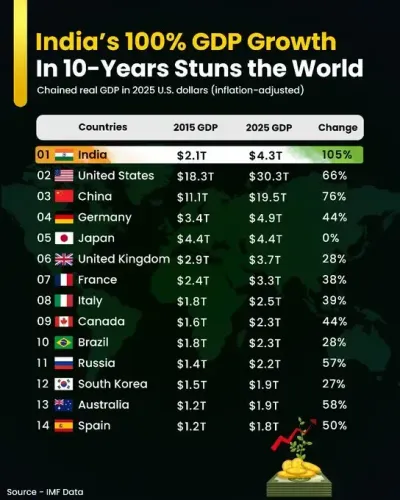
India's GDP, which took six decades post-Independence to cross the $1 trillion mark, accelerated sharply thereafter — reaching $2 trillion by 2014 and surpassing $4 trillion within a decade. According to the World Bank, India has become the second-largest contributor to global GDP growth, driven by structural reforms, digital expansion, and inclusive welfare policies. Inflation, once hovering near 10 per cent in the early 2010s, has been brought below 5 per cent in recent years, easing pressure on household budgets.
Direct benefit transfers worth ₹51 lakh crore have reached citizens directly, eliminating intermediary leakages. More than 25 crore people have reportedly risen out of poverty over this period, expanding the middle class and driving consumption.
Manufacturing and Electronics: A Sectoral Surge
The electronics sector has been among the most dramatic turnaround stories. Electronics exports surged eightfold — from ₹0.38 lakh crore to ₹3.3 lakh crore — while production expanded six times to ₹11.3 lakh crore. Mobile phone exports alone skyrocketed 163 times, from ₹0.016 lakh crore in 2014 to ₹2.6 lakh crore in 2026, according to the report.
The Production Linked Incentive (PLI) scheme and semiconductor investments worth ₹1.64 lakh crore are credited with generating more than 25 lakh jobs. The India Semiconductor Mission 2.0, with 12 approved plants across six states, is aimed at building supply-chain resilience and technological self-reliance.
Public sector banks, which were weighed down by non-performing assets, have staged a recovery — posting record profits of nearly ₹2 lakh crore in 2025–26. Gross NPAs declined from 4.4 per cent in 2014 to 1.93 per cent in 2026.
Infrastructure: Highways, Rail, Power, and Aviation
Physical infrastructure saw a step-change over twelve years. The national highway network expanded from 91,000 km in 2014 to nearly 1.5 lakh km in 2026. Metro rail now spans 1,155 km, placing India as the third-largest metro network globally. The Railways achieved 99.6 per cent electrification of broad-gauge lines, while landmark engineering projects — including the Chenab Bridge, the world's highest railway arch, and the Anji Khad Bridge — were completed. The Mumbai–Ahmedabad bullet train project has recorded significant progress on tunnels and bridges.
Power capacity crossed 530 GW, with renewable energy now accounting for half of installed capacity — reportedly five years ahead of the 2030 target. Loss-making electricity distribution companies (DISCOMs) turned profitable, posting combined earnings of ₹2,700 crore. The number of airports rose from 74 in 2014 to 164 in 2026, with sustainable aviation fuel initiatives marking India's entry into green aviation.
Digital India: UPI, 5G, and the JAM Trinity
Technology has emerged as a key driver of inclusion. The Unified Payments Interface (UPI) recorded nearly 2,300 crore transactions worth ₹30 lakh crore in March 2026 alone. India now accounts for 49 per cent of global real-time payments. Internet connections grew fourfold to 103 crore, and 5G services now cover 99.9 per cent of districts.
Aadhaar coverage expanded to 144 crore, enabling welfare delivery to more than 58 crore beneficiaries through the JAM trinity (Jan Dhan–Aadhaar–Mobile). DigiLocker has issued 950 crore documents, while MyGov counts six crore users.
Trade, Reserves, and the North-East
On the external front, India signed nine major free trade agreements with 38 countries — six of them between 2024 and 2026. Merchandise and services exports touched a record ₹79 lakh crore. Foreign exchange reserves now cover eleven months of imports and 94 per cent of external debt. Remittances stood at ₹13 lakh crore in FY 2025–26, bolstering rural and small-town incomes.
The North-East, historically underserved, has seen accelerated connectivity investment. Prime Minister Modi has made more than 83 visits to the region over twelve years, and road, bridge, and rail projects have deepened its integration with the national economy. Tax reforms, including an exemption for incomes up to ₹12.75 lakh under the new regime, and the introduction of faceless tax assessments, have eased compliance burdens for salaried citizens and small businesses alike.
As India approaches its centenary of Independence in 2047, the 'Rashtra Nirman' report frames the past twelve years as a foundation — not a finish line — for a developed, self-reliant economy.
Point of View
And its framing — from 'Fragile Five' to fastest-growing economy — is a political narrative as much as an economic one. The headline numbers are striking, but several deserve scrutiny: the 25-crore poverty reduction figure draws on multidimensional poverty indices that critics argue undercount income-based deprivation. India's manufacturing share of GDP has not meaningfully crossed 17% despite the PLI push, and the $5 trillion target has been a moving goalpost since 2019. The semiconductor and electronics surge is real and verifiable, but job quality — not just job count — remains the missing metric in every iteration of these reports.
NationPress
27 Sept 2026
Frequently Asked Questions
What is the 'Rashtra Nirman' report released by the Modi government?
'Rashtra Nirman' (Nation Building) is a government report marking twelve years of the Narendra Modi-led Union government, released on 9 June 2025. It compiles economic, infrastructural, and social data to document India's progress from 2014 to 2026, covering GDP growth, manufacturing, digital adoption, and infrastructure expansion.
What is India's GDP as of FY 2025–26?
India's GDP stood at ₹345 lakh crore at current prices in FY 2025–26, according to the Rashtra Nirman report. The country is described as rapidly progressing toward the $5 trillion economy goal, which the report projects could be reached within two years.
How much have mobile phone exports grown under the Modi government?
Mobile phone exports grew 163 times — from ₹0.016 lakh crore in 2014 to ₹2.6 lakh crore in 2026, according to the report. The surge is attributed to the Production Linked Incentive (PLI) scheme and semiconductor investments worth ₹1.64 lakh crore.
What has happened to UPI transactions and digital payments in India?
UPI recorded nearly 2,300 crore transactions worth ₹30 lakh crore in March 2026 alone. India now accounts for 49 per cent of all global real-time payments, with internet connections growing fourfold to 103 crore and 5G covering 99.9 per cent of districts.
How has India's infrastructure changed between 2014 and 2026?
The national highway network expanded from 91,000 km to nearly 1.5 lakh km, metro rail grew to 1,155 km (third-largest globally), airports doubled from 74 to 164, and power capacity crossed 530 GW with renewables comprising half of installed capacity — reportedly five years ahead of the 2030 target.