India flags rough diamond priorities as KP Chair ahead of Delhi Plenary

Synopsis
With the Kimberley Process Plenary coming to New Delhi in December, India is moving fast — signing an MoU with the African Diamond Producers' Association, chairing pre-plenary consultations in Luanda, and pushing to reshape the global rough diamond trade's compliance framework. For an industry that runs India's gem and jewellery export engine, the chairship is as much commerce as diplomacy.
Key Takeaways
India holds the Kimberley Process Chairship for 2026 ; the KP Plenary is set for New Delhi, 30 November – 4 December .
A stakeholder consultation was held in Luanda, Angola , chaired by Additional Secretary Yashvir Singh , with KP working body leaders, the Ghana Vice-Chair, and the UAE's former Chair attending.
The GJEPC and ADPA signed an MoU covering diamond sorting, valuation, manufacturing, and trade and investment linkages.
ADPA member countries produce over 60 per cent of global diamonds; India holds observer status in the grouping.
Key agenda items include reform of the conflict diamond definition , KP Secretariat funding, and digitalisation of certification processes.
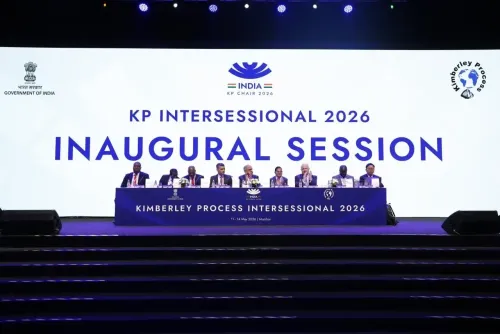
India, holding the Kimberley Process (KP) Chairship for 2026, has outlined its key priorities for the global diamond industry — including responsible rough diamond sourcing — as part of pre-plenary outreach ahead of the KP Plenary scheduled in New Delhi from 30 November to 4 December. The Commerce Ministry disclosed this in a statement on Thursday, 5 November 2026.
Luanda Consultation: Who Was in the Room
The priorities were aired at a stakeholder consultation held in Luanda, Angola, on Tuesday, chaired by Additional Secretary Yashvir Singh on India's behalf. The meeting brought together Chairs and Vice-Chairs of KP Working Groups and Committees, the KP Vice-Chair of Ghana, and the former KP Chair of the United Arab Emirates. Representatives from observer and partner organisations — including the World Diamond Council and the African Diamond Producers' Association (ADPA) — also participated.
India-ADPA MoU: Deepening Ties with African Producers
A key outcome was the approval of a Memorandum of Understanding (MoU) between the Gem and Jewellery Export Promotion Council (GJEPC) of India and the ADPA, ratified at the 13th Extraordinary Meeting of the ADPA Council of Ministers, held alongside the ADPA's 20th anniversary celebrations. The MoU covers capacity building and skills development in diamond sorting, valuation and manufacturing, technical expertise exchange, and the promotion of trade and investment linkages across the diamond value chain. India currently holds observer status in the ADPA — an institutional foothold it is now leveraging for deeper engagement with the continent's diamond sector. ADPA member countries collectively account for over 60 per cent of global diamond production.
What India's Chairship Agenda Covers
Discussions at the Luanda consultation ranged across the sustainability of diamond-producing communities, secure funding and operational continuity of the KP Secretariat, and the digitalisation of certification and statistical processes. Participants also examined reforms to the conflict diamond definition, responsible sourcing standards, artisanal and alluvial diamond production, and strengthening consumer confidence through peer-review mechanisms. This comes amid long-running calls within the KP to modernise its conflict-diamond definition — a debate that has gained urgency with shifting production geographies and supply-chain transparency expectations.
What Singh Said
Additional Secretary Yashvir Singh said: 'India's chairship places emphasis on confidence, compliance and credibility. The consultation in Luanda provided an opportunity to engage directly with the leadership of the KP working bodies, the KP Vice-Chair and observers on issues that are important to the future of the Process and the diamond industry. Our endeavour is to build a shared understanding of the issues before the New Delhi Plenary and to advance practical outcomes through constructive dialogue and consensus-based decision-making.'
ADPA Background and India's Strategic Interest
The ADPA, established in 2006 in Luanda, comprises 15 member countries and 8 observers — including two non-African observers, Russia and India. For India, whose gem and jewellery industry is a significant export earner, securing reliable and ethically sourced rough diamond supply chains from Africa is both a commercial and diplomatic priority. The New Delhi Plenary in December will be a critical test of India's ability to steer consensus on some of the KP's most contested reform questions.
Point of View
But the harder test is whether India can broker consensus on revising the conflict diamond definition — a debate that has stalled for years because it implicates the interests of major producers, including Russia, which also sits in the ADPA as an observer. New Delhi will need to hold together a room with structurally competing interests if the December Plenary is to deliver anything beyond communiqué language. The diplomatic groundwork in Luanda suggests India is at least asking the right questions — whether it can deliver answers is the story to watch.
NationPress
5 Nov 2026
Frequently Asked Questions
What is the Kimberley Process and why is India chairing it in 2026?
The Kimberley Process (KP) is an international certification scheme established to prevent the trade in conflict diamonds. India holds the KP Chairship for 2026, reflecting its significance as a major diamond-processing and jewellery-exporting economy; the annual Plenary will be hosted in New Delhi from 30 November to 4 December.
What did the GJEPC-ADPA MoU signed in Luanda cover?
The MoU between the Gem and Jewellery Export Promotion Council (GJEPC) of India and the African Diamond Producers' Association (ADPA) covers capacity building in diamond sorting, valuation and manufacturing, technical expertise exchange, and promotion of trade and investment linkages across the diamond value chain. It was approved at the 13th Extraordinary Meeting of the ADPA Council of Ministers.
Who attended the stakeholder consultation in Luanda?
The consultation was chaired by Additional Secretary Yashvir Singh on India's behalf and brought together Chairs and Vice-Chairs of KP Working Bodies, the KP Vice-Chair of Ghana, and the former KP Chair of the UAE. Representatives of the World Diamond Council and the ADPA also participated.
What are the key reform issues India is pushing at the KP?
India's chairship priorities include reform of the conflict diamond definition, responsible rough diamond sourcing, digitalisation of KP certification and statistical processes, sustainable funding for the KP Secretariat, and strengthening compliance with the KP Certification Scheme.
Why does the ADPA matter to India's diamond industry?
ADPA member countries collectively account for over 60 per cent of global diamond production. India's observer status in the ADPA gives it an institutional platform to engage African producers on supply-chain security, ethical sourcing, and market access — all critical for India's gem and jewellery export sector.