What Are India's New Delhi Frontier AI Commitments for the Global South?
Synopsis
India is making significant strides in AI with the announcement of the New Delhi Frontier AI Impact Commitments. This initiative seeks to unite global and local innovators to foster inclusive AI solutions tailored to the Global South. Minister Ashwini Vaishnaw outlines a comprehensive strategy that emphasizes real-world applications and collaboration.
Key Takeaways
New Delhi Frontier AI Commitments aim to promote inclusive AI.
The initiative unites global and local AI innovators.
Emphasis on real-world applications in various sectors.
Focus on equity and cultural diversity in AI development.
Collaboration is essential for responsible AI deployment.
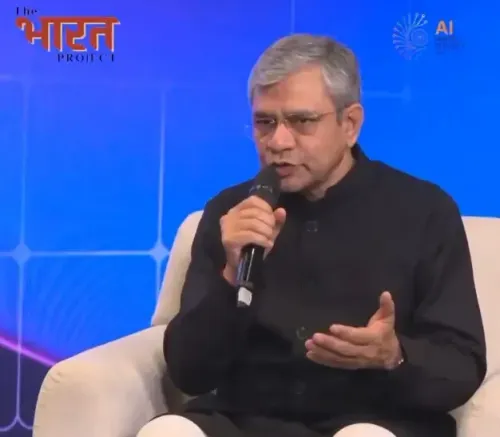
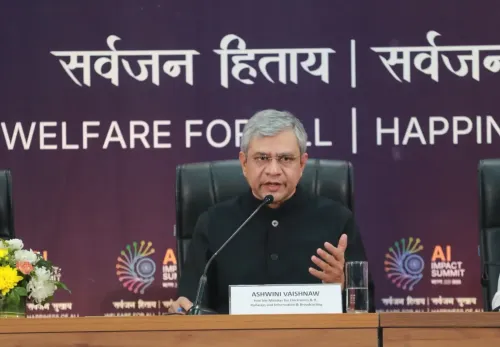
New Delhi, Feb 19 (NationPress) Union Electronics and Information Technology Minister Ashwini Vaishnaw recently introduced the New Delhi Frontier AI Impact Commitments, marking a significant milestone at the summit designed to unite prominent frontier AI firms with India's homegrown innovators, aiming to promote inclusive and responsible artificial intelligence.
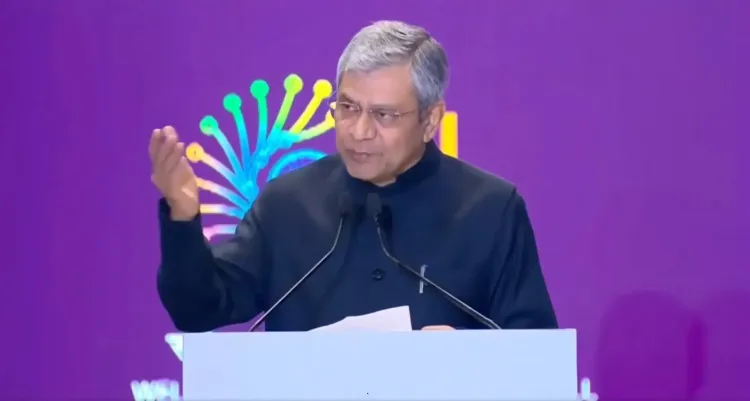
During his address at the inaugural ceremony of the India AI Impact Summit 2026, Vaishnaw articulated India’s AI strategy, emphasizing its foundation in democratization, scale, and sovereignty. He detailed India’s holistic approach across the five critical layers of the AI stack: applications, models, compute, talent, and energy, highlighting practical applications in healthcare, agriculture, education, and public services.
“AI is a foundational technology that is reshaping how we operate, learn, and make decisions. Our Prime Minister envisions that the true power of technology lies in ensuring its benefits reach the broader public. His aim is to democratize technology, scale it, and ensure access for everyone. Thus, in India, we are enhancing all five layers of the AI stack,” he stated.
“As we genuinely harness the advantages of AI, we must also seek collaborative solutions to minimize risks. By prioritizing human safety and dignity in AI, we can advance with purpose. Let us craft an AI future of the people, by the people, and for the people,” Vaishnaw remarked.
The voluntary commitments reflect a collective vision aiming to ensure the development and implementation of AI systems are aligned with equity, cultural diversity, and actual needs, especially across the Global South. Participating organizations include India-based innovators like Sarvam, BharatGen, Gnani.ai, and Soket, alongside global frontier AI companies.
The first commitment, “Advancing Understanding of Real-World AI Usage”, emphasizes real-world AI applications via anonymized and aggregated data. Participating organizations will work to produce evidence that aids policymaking regarding the effects of AI on jobs, skills, productivity, and economic transformation. By facilitating data-driven analyses on AI deployment across sectors, the initiative aims to assist governments and institutions in formulating informed strategies that optimize benefits while addressing technological risks.
The second commitment, “Strengthening Multilingual and Contextual Evaluations”, focuses on ensuring AI system effectiveness across various languages, cultures, and real-world scenarios. Organizations will collaborate with governments and local ecosystems to create datasets, benchmarks, and expertise supporting evaluations in underrepresented languages and cultural contexts. This approach will enhance AI performance for diverse populations and facilitate equitable access to high-quality AI experiences globally, while maintaining flexibility in tool selection and evaluation methods.
The minister reiterated that collaborative efforts between governments, industry, and research communities are vital to ensure AI serves humanity broadly. He invited leaders from participating organizations to embark on advancing these commitments as a cornerstone for responsible AI development worldwide.
Point of View
I believe the New Delhi Frontier AI Impact Commitments signal India's commitment to leading in AI with a focus on equity and inclusion. This initiative not only highlights the role of technology in societal advancement but also emphasizes the need for collaboration across borders, particularly for the Global South.
NationPress
29 Sept 2026
Frequently Asked Questions
What are the New Delhi Frontier AI Commitments?
The New Delhi Frontier AI Commitments are a set of voluntary commitments aimed at promoting inclusive and responsible artificial intelligence, uniting global and local innovators to ensure AI systems are aligned with equity and real-world needs.
Who announced the New Delhi Frontier AI Commitments?
The commitments were announced by Union Electronics and Information Technology Minister Ashwini Vaishnaw during the India AI Impact Summit 2026.
How will these commitments impact the Global South?
The commitments are designed to ensure the development and deployment of AI systems align with the unique needs and cultural contexts of countries in the Global South, promoting equitable access to technology.
What are the key areas of focus in India's AI strategy?
India's AI strategy focuses on five layers of the AI stack: applications, models, compute, talent, and energy, with real-world applications in healthcare, agriculture, education, and public services.
Why is collaboration important in AI development?
Collaboration among governments, industry, and research communities is vital to ensure that AI technologies serve humanity effectively and responsibly, addressing potential risks and maximizing benefits.