India's Index of Services Production targets global statistical standards
Synopsis
India has plugged a decade-long statistical blind spot with the launch of the Index of Services Production — its first real-time output tracker for a sector that now drives over half the economy. The trial run for April 2026 shows 14 of 19 sub-sectors growing at double digits, with accommodation and food leading at 37.2 per cent. For a country targeting 10 per cent of global services by 2047, this index is less a data tool and more a scoreboard.
Key Takeaways
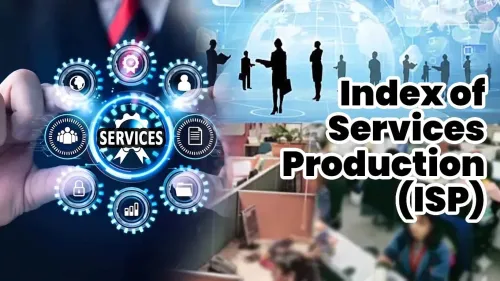
India has launched the Index of Services Production (ISP) , its first high-frequency indicator for services sector output.
Services GVA reached 52.9 per cent of India's total GVA in 2024-25 , the highest on record.
The sector employs 30 per cent of India's workforce and added 40 million jobs over the past six years.
Services exports hit $103.41 billion in April–June 2026-27 , up 6.16 per cent year-on-year.
The trial ISP for April 2026 showed 14 of 19 sub-sectors recording double-digit growth; accommodation and food led at 37.2 per cent .
India targets a 10 per cent share of global services by 2047 .
India has launched the Index of Services Production (ISP), the country's first high-frequency indicator dedicated to tracking services sector output, as the government moves to align its statistical architecture with global standards. The move comes as the services sector now accounts for close to 52.9 per cent of India's Gross Value Added (GVA) in 2024-25, making it the single largest contributor to the national economy.
What the ISP Measures
The ISP tracks short-term changes in the volume of output produced by the formal services sector relative to a specified base year. Unlike the Index of Industrial Production (IIP), which captures only industrial activity, the ISP fills a longstanding data gap by providing a dedicated, timely read on services performance. According to an official factsheet, the index brings together high-frequency data and a robust methodology to deliver actionable insights into India's largest economic sector.
First Trial Results: Strong Sectoral Growth
The first sub-sectoral trial ISP, covering 19 sub-sectors for April 2026 and representing 60 per cent of the services sector, showed that 14 of the 19 sub-sectors recorded double-digit growth compared to April 2025. The top five performers by monthly growth were accommodation and food at 37.2 per cent, retail trade at 30.8 per cent, administrative and support services at 28.7 per cent, real estate at 27.7 per cent, and telecommunications at 22.8 per cent.
Why the Services Sector Demands Its Own Index
The services sector has been the backbone of India's economy since 2013-14, when it first crossed the 50 per cent GVA threshold. It now accounts for 30 per cent of total employment nationwide and generated 40 million jobs over the past six years. On the trade front, India's services exports maintained strong momentum: in April–June 2026-27, services exports are estimated at $103.41 billion, registering a 6.16 per cent annual growth. This scale makes a reliable, high-frequency output tracker not just useful but essential for policymakers and investors alike.
India's 2047 Services Ambition
The ISP is part of a broader strategic push: the government aims to position India as a global leader in services, targeting a 10 per cent share of global services by 2047. Notably, this is the first time India has a dedicated short-term statistical tool to monitor whether the sector is on track to meet that ambition. Comparable economies — including China and several EU members — have maintained equivalent indices for years, and the ISP's introduction narrows a methodological gap that economists and multilateral institutions had flagged for over a decade.
What Comes Next
The trial ISP currently covers 60 per cent of the services sector across 19 sub-sectors. Expansion to full coverage and formalisation of the index's release calendar are expected in subsequent phases. As the methodology is refined, the ISP is likely to become a key input for monetary policy, budget planning, and trade strategy — functions that have until now relied on lagged, indirect proxies for services performance.
Point of View
Indirect data for years while the IIP got all the statistical attention. The trial results look impressive, but 60 per cent coverage is not full coverage, and double-digit growth figures for April 2026 need context: how much is post-pandemic base normalisation versus genuine structural acceleration? The 2047 target of a 10 per cent global services share is ambitious in a world where the US, EU, and China are not standing still. The ISP gives India a scoreboard; the harder task is building the policy machinery to actually win the game.
NationPress
13 Oct 2026
Frequently Asked Questions
What is the Index of Services Production (ISP)?
The ISP is India's first dedicated high-frequency indicator for measuring services sector output. It tracks short-term changes in the volume of output produced by the formal services sector relative to a base year, filling the gap left by the Index of Industrial Production (IIP), which covers only industrial activity.
Why does India need a separate index for services?
The services sector contributes close to 52.9 per cent of India's GVA and 30 per cent of total employment, yet until now there was no dedicated short-term output tracker for it. The IIP only measures industrial production, leaving policymakers and investors without timely data on the economy's largest segment.
What did the first ISP trial results show?
The trial ISP for April 2026, covering 19 sub-sectors that represent 60 per cent of the services sector, found that 14 sub-sectors recorded double-digit growth compared to April 2025. Accommodation and food led with 37.2 per cent growth, followed by retail trade at 30.8 per cent and telecommunications at 22.8 per cent.
How are India's services exports performing?
India's services exports reached an estimated $103.41 billion in April–June 2026-27, registering 6.16 per cent annual growth. The sector has maintained strong export momentum, underpinning the government's ambition to capture 10 per cent of global services trade by 2047.
What is India's long-term target for the services sector?
The government aims to position India as a world leader in services, targeting a 10 per cent share of global services by 2047. The ISP is designed to provide the high-frequency data infrastructure needed to monitor progress toward that goal.