Have FTAs Signaled a Structural Shift in India’s Global Trade Relations?
Synopsis
Commerce and Industry Minister Piyush Goyal highlights India's free trade agreements as a pivotal change in global trade strategy. He assures the protection of farmers' interests while enhancing competitiveness in sectors like textiles, revealing a commitment to a redefined trade partnership framework.
Key Takeaways
New FTAs signify a shift in India’s trade strategy.
Farmers' interests are prioritized in negotiations.
Textile sector gains competitive advantages in global markets.
FTAs are founded on principles of Trust, Transparency, and Time-bound certainty.
India aims to become the third-largest global economy within a few years.
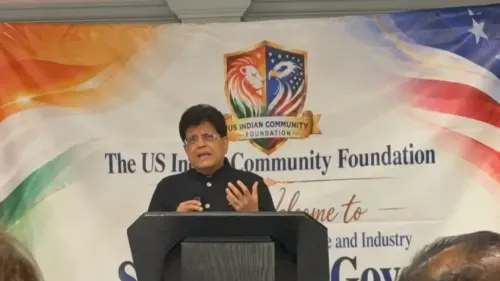
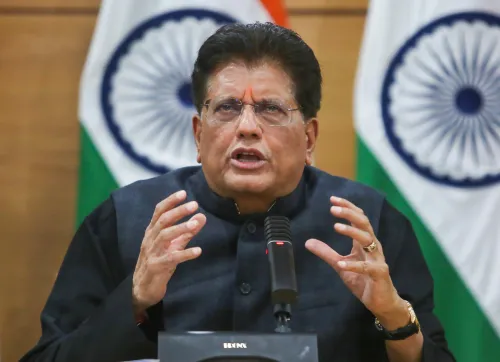
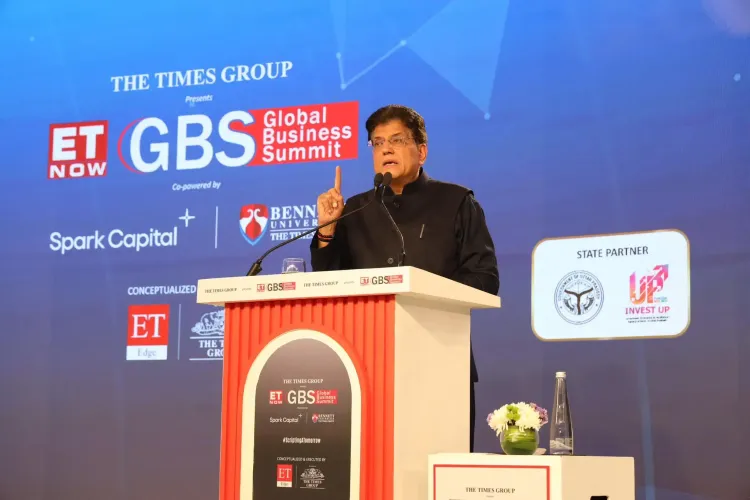
New Delhi, Feb 13 (NationPress) Commerce and Industry Minister Piyush Goyal stated on Friday that India’s latest free trade agreements (FTAs), especially the interim trade deal framework with the United States, indicate a significant transformation in how New Delhi approaches global trade matters.
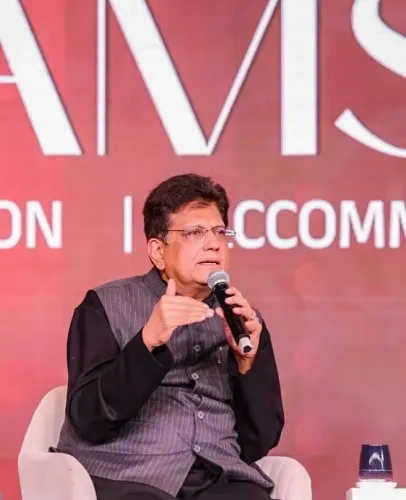
During his keynote address at the 'ET NOW Global Business Summit (GBS) 2026', the minister emphasized that India has taken extensive measures to safeguard the interests of farmers while negotiating the trade agreement with the US.
Goyal pointed out that when the trade deal was formulated with the US, it was imperative to ensure the protection of our farmers.
“Thus, in all sectors where our farmers have high yields or have contributed to the nation’s self-sufficiency, we successfully excluded them from the trade agreement,” he remarked, adding that “we have thoroughly safeguarded the interests of farmers, likely covering over 95% of local agricultural produce.”
He also mentioned that discussions have long revolved around the stagnation of India’s textile sector.
“In the past, we struggled to compete with nations like Vietnam and Bangladesh. Now, with the textile sector being duty-free in Europe and the US reducing reciprocal tariffs from 25% to 18%, we are positioned to compete globally,” he stated.
Earlier, he indicated that India would enjoy similar advantages in textile exports as Bangladesh received from its trade agreement. Textile exporters have been assured of equal treatment in this regard.
During the event, Goyal reiterated that FTAs are firmly established on a solid framework. “Our FTA agreements are built on three fundamental principles – Trust, Transparency, and Time-bound certainty.
The minister cited the India-EFTA agreement as an illustration of how New Delhi is redefining its trade partnership strategies. The European Free Trade Association (EFTA) includes Iceland, Liechtenstein, Norway, and Switzerland.
“Prime Minister Narendra Modi has propelled the 'Reform Express' in an urgent manner,” he added. “Currently, we are the fourth-largest economy; in a few years, we aspire to become the third-largest global GDP,” he concluded.
Point of View
The recent statements by Commerce Minister Piyush Goyal underscore a strategic pivot in India's approach to international trade. The emphasis on safeguarding farmer interests while pursuing competitive trade agreements aligns with a broader vision of economic resilience and growth. It is crucial that these efforts are executed transparently and effectively to ensure sustainable development.
NationPress
8 Oct 2026
Frequently Asked Questions
What are the key features of the new FTAs?
The new FTAs are based on principles of Trust, Transparency, and Time-bound certainty, aimed at fostering better trade relations.
How does the interim trade deal with the US impact Indian farmers?
The deal is structured to protect Indian farmers by excluding sectors where they have high production and ensuring over 95% of local farm produce is safeguarded.
What advantages does India's textile sector gain from these agreements?
India's textile sector now has duty-free access to Europe and reduced tariffs in the US, enabling it to compete effectively with countries like Vietnam and Bangladesh.