Is India Advancing an Inclusive AI Model Based on Sutras and Chakras?

Synopsis
India's Ambassador to the US, Vinay Mohan Kwatra, reveals a groundbreaking AI vision rooted in ancient wisdom, focusing on inclusivity and accessibility. This initiative aims to democratize innovation and create a sustainable technology framework, setting the stage for a transformative global AI Impact Summit. Discover how India’s unique approach is shaping the future of AI.
Key Takeaways
India's AI vision emphasizes inclusivity and affordability.
The framework consists of three sutras and seven chakras.
Focus on democratizing access to technology.
Development of sovereign AI models is essential.
International collaboration is key to successful AI deployment.
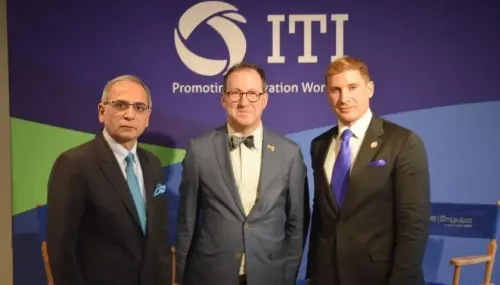
Washington, Jan 22 (NationPress) India's Ambassador to the US, Vinay Mohan Kwatra, announced on Thursday that India is shaping an artificial intelligence (AI) vision based on a unique framework of three sutras and seven interconnected chakras. This model emphasizes inclusivity, affordability, and a population-scale impact.
Speaking at the esteemed think-tank Brookings, Ambassador Kwatra highlighted how India’s technological relationship presents a distinct approach to the global development and deployment of artificial intelligence.
"We believe that our interaction with technology provides a robust blueprint for creating simple, inclusive, and innovative AI tools that can be deployed worldwide," he stated, just ahead of the significant global AI summit India will host next month.
Delivering the keynote at the conference titled: “On the Road to the India AI Impact Summit: Global AI Governance and the HAIP Reporting Framework,” organized by Brookings, he outlined India's strategy, stressing its goal to democratize access and ensure that innovation reaches society at scale.
"The aim is to make AI open, affordable, and accessible to everyone, ensuring that innovation pervades all levels of society," he added.
According to Ambassador Kwatra, the three sutras encapsulate the foundational philosophy of India's AI framework, while the seven chakras guide the deployment and adoption of AI products.
These chakras focus on developing human capital, promoting social empowerment, ensuring safe and trustworthy AI, fostering resilience, driving innovation and efficiency, democratizing AI resources, and generating value for both economic growth and social welfare.
He stated that India possesses "intrinsic strengths" for large-scale AI development, particularly its capability to rapidly disseminate technology across a vast and diverse populace.
"For any technology to scale effectively within society and benefit industries, it must be widely adopted across large populations and enterprises," he continued.
Ambassador Kwatra cited India's digital public infrastructure as a prime example of platforms that serve the entire population while maintaining minimal usage costs.
He emphasized that India is constructing its AI ecosystem across all five layers of architecture: applications, models, compute, data, and network infrastructure, and energy.
He underscored the necessity of developing sovereign AI models that reflect local data, culture, and contexts.
"We are committed to building our own sovereign AI and Large Language Models," he remarked, highlighting the importance of data security, cultural relevance, and bias mitigation.
He mentioned that multiple AI models are being developed under the India AI Mission, with some expected to launch at the forthcoming AI Impact Summit. One comprehensive model trained from scratch in 22 Indian languages incorporates deep contextual understanding, while another smaller model is being tailored for specific industry applications.
On the subject of international collaboration, Ambassador Kwatra emphasized the complementary strengths that India and the US bring to the AI ecosystem.
"We believe our strengths are complementary," he noted, highlighting that US AI investments are enhancing engineering and research centers in India.
He conveyed India's message to the world that the future of artificial intelligence must be inclusive, transparent, and safe, with advantages extending beyond a select few countries or social groups.
"In India, we are crafting an ecosystem that fortifies the nation, uplifts our entire society, and provides a model for collaborative AI partnerships with other nations," Ambassador Kwatra concluded.
He expressed optimism that the AI Impact Summit in 2026 will serve as a crucial platform to transform this vision into global collaborative action.
Point of View
India's emphasis on an inclusive AI framework that leverages ancient wisdom is a significant step towards democratizing technology. The initiative reflects a commitment to ensuring that advancements in artificial intelligence benefit society as a whole, promoting economic growth and social welfare.
NationPress
1 Oct 2026
Frequently Asked Questions
What is the significance of India's AI model?
India's AI model focuses on inclusivity, affordability, and scalability, ensuring that technological innovations benefit the entire population.
How does the framework of sutras and chakras work?
The three sutras define the philosophy behind India's AI approach, while the seven chakras guide the deployment and adoption of AI products.
What are the goals of the AI Impact Summit?
The AI Impact Summit aims to showcase India's advancements in AI and foster international collaboration for inclusive and transparent AI development.
What role does culture play in India's AI development?
Cultural relevance is crucial in developing sovereign AI models that reflect local data and community needs, mitigating bias and enhancing data security.
How can international cooperation benefit AI development?
International cooperation can leverage complementary strengths, enhance research capabilities, and facilitate the sharing of best practices in AI technology.