The Protracted Journey to India's Women’s Reservation Legislation
Synopsis
Opposition protests during a special session of Parliament are focusing on the controversial Delimitation Bill rather than the long-awaited women’s reservation law. This article explores the intricate political landscape surrounding this legislation and its implications for representation.
Key Takeaways
The women's reservation law aims to reserve one-third of seats for women in legislative bodies.
The Delimitation Bill, 2026 has sparked significant political controversy.
Concerns exist regarding regional representation and federal balance.
The journey to enact this law has been fraught with political hurdles.
Implementation is linked to the Census, affecting its execution timeline.
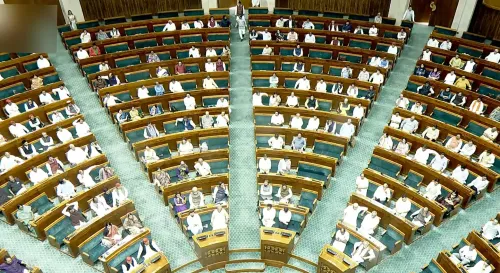
New Delhi, April 15 (NationPress) Protests from the opposition during the three-day special Parliament session starting Thursday are primarily focused not on the women’s reservation quota but on the Centre's suggested Delimitation Bill, 2026, which aims to increase the Lok Sabha to 850 seats based on the 2011 Census.
Key players, especially from southern regions, express concerns that this proposal could advantage the more populous northern states like Uttar Pradesh and Bihar at the expense of states such as Tamil Nadu and Kerala, potentially distorting the federal balance.
Tamil Nadu Chief Minister M.K. Stalin has issued a warning of significant protests if the proposed delimitation negatively impacts southern states.
West Bengal Chief Minister Mamata Banerjee has claimed that this initiative is a “sinister plan” aimed at fragmenting the state by combining parts of its constituencies with those in neighbouring regions like Bihar and Odisha. Assembly elections in Tamil Nadu are slated for April 23, coinciding with elections in West Bengal on April 23 and 29.
The women’s reservation Bill has seen multiple introductions from 1996 to 2008, and again in 2023, totaling approximately nine formal attempts across different administrations. Each attempt has faced obstacles including insufficient numbers, interruptions, and demands for sub-quotas for SCs, STs, and OBCs within the 33 percent quota.
In 2010, the passage of the Bill was obstructed when members of the Samajwadi Party and Rashtriya Janata Dal tore up documents amid loud protests.
The then United Progressive Alliance (UPA) government, led by Prime Minister Manmohan Singh, struggled to pass the Bill due to opposition from allies.
Discussions surrounding the Bill have occasionally turned contentious, with some leaders asserting that it overlooks essential reforms such as the decriminalization of politics and enhancing inner-party democracy.
India's journey toward securing women’s representation in Parliament and state assemblies has stretched over nearly three decades, characterized by persistent efforts and political challenges.
The law was finally enacted as the Constitution (106th Amendment) Act in September 2023, under the Nari Shakti Vandan Adhiniyam, reserving one-third of seats for women. However, its execution remains contingent upon delimitation following the Census, sparking renewed discussion.
The last Census occurred in 2011, and the next, scheduled for 2021, was delayed due to the Covid-19 pandemic. The Bill’s roots trace back to the 1990s, building upon the 73rd and 74th Constitutional Amendments of 1992–93, which instituted a 33 percent reservation for women in local bodies such as panchayats.
At the national level, the Bill was initially presented on September 12, 1996, as the Constitution (81st Amendment) Bill under the United Front government led by Prime Minister H.D. Deve Gowda.
However, opposition from coalition partners, particularly OBC leaders demanding sub-quotas, hindered its advancement. The Bill was sent to a Joint Parliamentary Committee (JPC) chaired by Geeta Mukherjee of the Communist Party of India (CPI). The committee scrutinized the Bill extensively, but no consensus was reached.
Mukherjee, a respected parliamentarian, served as a seven-time MP from West Bengal’s Panskura constituency between 1980 and 2000. In 2023, while initiating the debate, BJP MP Nishikant Dubey recognized her contributions, along with Sushma Swaraj, in advocating for the Bill.
BJP leader Sushma Swaraj had fervently supported the Bill, endorsing it during parliamentary discussions and acknowledging cross-party efforts, including the BJP’s backing for the Congress during the 2010 Rajya Sabha passage.
In 2023, the Bill received unanimous approval in both the Lok Sabha and the Rajya Sabha, with President Droupadi Murmu granting her assent later that year.
Despite ongoing concerns regarding its connection to the post-delimitation process, the Opposition has also criticized the timing of its introduction during a special session coinciding with state elections. They are strategizing to block its passage, which requires a two-thirds majority.
Point of View
The situation reflects a significant moment in India's legislative journey. While the women's reservation law is a vital step towards gender equality, the surrounding controversies and political maneuvering highlight the intricate balance of power and representation in our democracy. The focus should remain on ensuring equitable progress for all regions.
NationPress
19 Sept 2026
Frequently Asked Questions
What is the women’s reservation law in India?
The women’s reservation law reserves one-third of seats for women in Parliament and state assemblies, aimed at promoting gender equality in political representation.
What is the Delimitation Bill, 2026?
The Delimitation Bill, 2026 proposes to increase the Lok Sabha to 850 seats based on the 2011 Census data, which has raised concerns about regional disparities in representation.
Why are southern states concerned about the Delimitation Bill?
Southern states fear that the bill may disproportionately benefit northern states with larger populations, potentially undermining the federal balance in India.
When was the women’s reservation Bill first introduced?
The women’s reservation Bill was first introduced on September 12, 1996, and has undergone multiple attempts at passage since then.
What challenges has the women’s reservation Bill faced?
The Bill has faced numerous challenges, including lack of political support, demands for sub-quotas, and disruptions during parliamentary discussions.