The Women's Reservation Bill 2026: Key Insights on Its Significance and Political Maneuvering
Synopsis
Explore the implications of the Women's Reservation Bill 2026, a legislative effort aimed at reserving 33% of political seats for women. Delve into the reasons behind its failure, the political dynamics at play, and what it means for women's representation in India's political landscape.
Key Takeaways
Women's Reservation Bill 2026 aimed for 33% reservation for women in politics.
The bill faced defeat in Parliament due to political conflicts.
Current representation of women in Parliament is around 14-15% .
The failure signifies a major setback for women's empowerment.
Past attempts for women's quotas have repeatedly stalled.
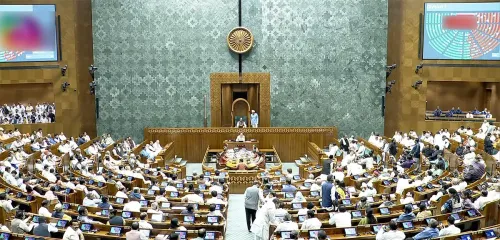
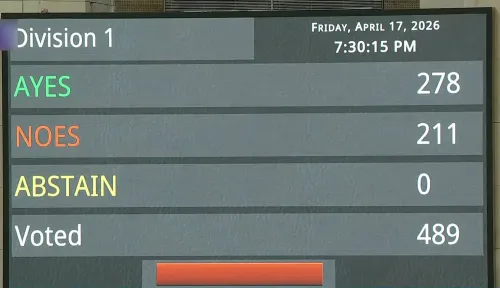
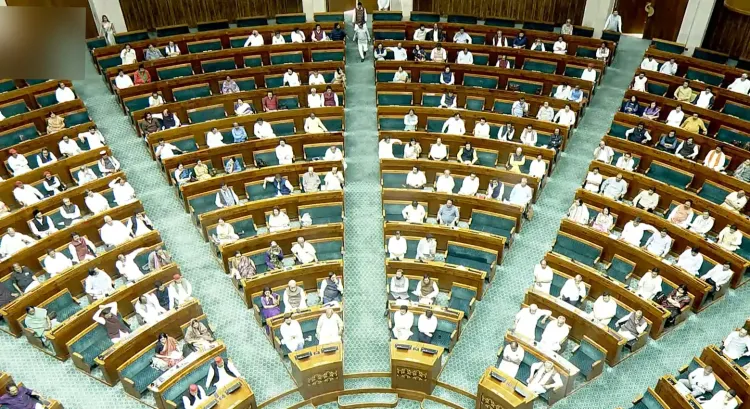
New Delhi, April 20 (NationPress) The unveiling of three significant legislative proposals during a special session of Parliament – the Constitution (131st Amendment) Bill 2026, Delimitation Bill 2026, and Union Territories (Amendment) Bill – had the potential to trigger one of the most impactful electoral reforms in India since Independence. However, the amendment failed to secure the required two-thirds majority, resulting in the simultaneous collapse of all three bills.
The Women’s Reservation Bill, which aimed to provide a 33 percent reservation for women in the political sphere after years of advocacy, has once again been relegated to the sidelines, becoming a casualty of intense conflict between the ruling party and the Opposition.
For over thirty years, political discourse in the country has fervently advocated for the “equitable representation” of women in legislative assemblies by reserving one-third of the seats in Parliament and State Assemblies. This crucial opportunity was missed in the Lok Sabha, as the Centre's Amendment Bill was defeated due to the Opposition’s protests regarding its connection to the Delimitation process.
Objective of the Bill - Including Women in National Decision-Making
Currently, women's representation in India's Parliament and State Assemblies stands alarmingly low at approximately 14-15 percent and 9 percent respectively. This underrepresentation can be attributed to the neglect and undervaluation of women's roles by political parties.
By proposing a 33 percent reservation for women, the Constitution (131st Amendment) Bill 2026 aimed to establish their presence in legislatures—moving beyond mere symbolism to ensuring their active engagement in shaping national laws and budgets.
If enacted, the bill would have also included sub-reservation for women from the SC/ST communities within the designated 33 percent quota. Its clear goals were intended to integrate women into the power structure and instigate a significant transformation in the functioning of Parliament and legislative bodies. This would have ensured that their voices were included in critical decision-making processes, enhancing their contributions to policy formulation.
Repeated Missed Chances for Women’s Political Quota
Throughout the years, numerous political parties have expressed their commitment to women's quotas in politics, yet the bill has repeatedly failed to gain parliamentary approval.
Constitutional amendments aimed at securing seats for women in Parliament and state legislative assemblies were proposed in 1996, 1998, 1999, and 2008, respectively.
The last attempt in 2008 saw the bill pass in the Rajya Sabha but ultimately lapse due to the dissolution of the 15th Lok Sabha.
Efforts in 2023 and 2026 for Women’s Quota
The Constitution Amendment Bill 2023, which sought to reserve one-third of seats in the Lok Sabha and state legislatures for women, was decisively approved by Parliament, marking a significant victory for women's empowerment after numerous rejections during previous UPA administrations in the 1990s and 2000s.
In 2026, the Modi administration made a strong push for the early implementation of women’s reservation by linking it with the Delimitation process, urging all political parties to rally behind it. The government argued that India cannot truly be deemed a representative republic while women are significantly underrepresented in core law-making institutions.
This initiative aimed to expedite the implementation of women’s reservation in politics, targeting its enactment before the 2029 General Elections, thereby removing the prior requirement of completing the seat redistribution process first.
If passed, this amendment would have transformed the concept of women’s reservation in politics into a reality, increasing their representation from around 15 percent to over 33 percent across all political affiliations. This would have enhanced women’s participation in politics, paving the way for a more significant role in decision-making and policy formation. Nevertheless, the defeat of the amendment in the Lok Sabha has once again hindered this progression.
Reasons Behind the Opposition’s Resistance
Despite widespread support, the Women’s Reservation Bill failed to pass the Lok Sabha primarily due to a united Opposition. They accused the government of pursuing a delimitation agenda disguised as a women’s quota.
From Congress to TMC to DMK, all expressed clear support for women’s reservation in principle, reaffirming their backing during earlier discussions in 2010 and 2023, yet vehemently opposed the 2026 amendment. Their main argument centered around the government’s perceived betrayal of promises and attempts to modify the 2023 law, particularly regarding delimitation and federal balance.
They contended that linking the bill to the delimitation process and constituency restructuring was politically charged and motivated, fearing it would not only alter the electoral landscape but also disturb the federal equilibrium, especially in terms of demographic disparities between Northern and Southern states.
Concerns were raised that merging women’s reservation with delimitation and potential seat increases could undermine their representation in the House.
Some opposition factions advocated for additional sub-reservation within the 33 percent quota for women from Other Backward Classes (OBCs), arguing that benefits would otherwise disproportionately favor women from upper-caste or socially dominant backgrounds, thus necessitating protections for those from disadvantaged groups.
They accused the Centre of leveraging the women’s reservation discourse as a pretext to hasten a broader delimitation plan.
Implications of the Lok Sabha Setback for Women
The failure of the Women’s Reservation Bill is widely perceived as a significant blow to women’s political empowerment in the country. The momentum for their increased presence in legislative bodies gained substantial traction in 2023, but the recent setback indicates a derailment of this progress.
This moment was pivotal for rectifying their underrepresentation and ensuring a balanced gender ratio in the Lok Sabha and State Assemblies; unfortunately, that hope has been extinguished.
The inability to convert the 2023 amendment into a functional policy suggests that women's tokenism and minimal representation will persist for another electoral cycle.
Many women activists and political analysts view this political division, rather than the disagreements over delimitation and seat redistribution, as the primary reason for undermining substantive gains for women in favor of partisan interests.
A significant opportunity to become a watershed moment in Indian politics, enhancing women’s representation from 14-15 percent to 33 percent before the 2029 elections, has been lost, effectively diminishing women’s influence in policy decisions on critical issues such as education, health, and childcare.
Point of View
The recent defeat of the Women's Reservation Bill is a concerning indicator of the ongoing challenges women face in achieving equitable representation in Indian politics. Despite widespread support, political maneuvering has thwarted progress, highlighting the need for a renewed commitment to gender equality.
NationPress
26 Sept 2026
Frequently Asked Questions
What is the Women's Reservation Bill 2026?
The Women's Reservation Bill 2026 aims to reserve 33% of seats for women in India's Parliament and State Assemblies, promoting gender equality in political representation.
Why did the Women's Reservation Bill fail?
The bill failed primarily due to a lack of two-thirds majority in Parliament and intense opposition from various political parties, who raised concerns about its linkage to the Delimitation process.
What are the implications of the bill's failure?
The failure of the bill is seen as a setback for women's political empowerment, prolonging their underrepresentation in legislative bodies and diminishing their influence in policymaking.
Have there been previous attempts to pass similar legislation?
Yes, prior attempts to implement women's quotas in politics have been made in 1996, 1998, 1999, and 2008, but none have successfully passed into law.
What are the next steps for women's representation in India?
Advocates for women's rights continue to push for legislative change, emphasizing the need for political commitment to enhance women's representation in future elections.