Jaipur Walled City heritage vs development: High Court PIL tests Pink City's future

Synopsis
A PIL in the Rajasthan High Court over alleged illegal construction in Jaipur's Chaura Rasta has put the Pink City's UNESCO heritage status under the judicial spotlight. The case exposes a deeper fault line: nearly 300 years after Sawai Jai Singh II designed one of the world's most planned cities, can its living, breathing walled core survive the pressures of modern urbanisation?
Key Takeaways
The Rajasthan High Court is hearing a PIL alleging illegal construction and unauthorised commercial activity in Chaura Rasta , Jaipur's Walled City .
Petitioner Jitendra Sharma claims the Municipal Corporation issued notices but failed to take effective follow-up action.
A bench of Justice Indrajit Singh and Justice Sandeep Taneja has sought responses from the Rajasthan government and concerned parties.
Jaipur's Walled City was inscribed as a UNESCO World Heritage Site in 2019 ; its heritage value covers streets, bazaars, and urban form — not just individual monuments.
The city was founded in 1727 by Sawai Jai Singh II as a planned grid-pattern commercial city, making cumulative alterations to its fabric especially consequential.
Jaipur's Walled City, a UNESCO World Heritage Site since 2019, is at the centre of a legal battle that could determine how India's Pink City manages the tension between urban growth and the preservation of a nearly 300-year-old urban fabric. The Rajasthan High Court is hearing a Public Interest Litigation (PIL) that alleges illegal construction and unauthorised commercial activity in the Chaura Rasta area of the historic walled core.
The PIL and What It Alleges
The petition, filed by Jitendra Sharma, claims that illegal construction is under way in Chaura Rasta and that commercial operations are being conducted in a zone designated for residential use. Advocate Umesh Vyas, appearing for the petitioner, told the court that the Municipal Corporation had previously issued notices to the parties concerned regarding the alleged violations — but that effective follow-up action was not taken thereafter.
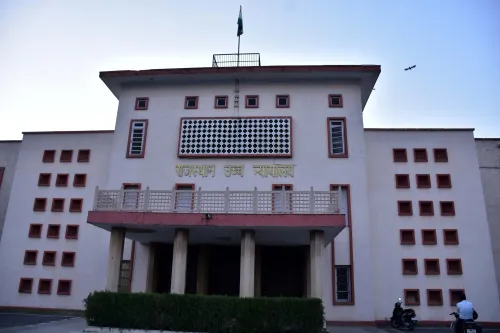
A Division Bench comprising Justice Indrajit Singh and Justice Sandeep Taneja has sought responses from the Rajasthan government and other concerned parties. The bench also underscored the importance of protecting Jaipur's heritage character, signalling that the court views this as more than a routine land-use dispute.
Why Jaipur's Heritage Is Uniquely Vulnerable
Founded in 1727 by Sawai Jai Singh II, Jaipur was conceived as a meticulously planned commercial city. Its grid-pattern streets, public squares, uniform pink facades, havelis, temples, and traditional bazaars were not built piecemeal — they were designed as a single, coherent urban vision. When UNESCO inscribed the Walled City on its World Heritage List in 2019, it recognised precisely this integrated character: the heritage value lies not in individual monuments alone, but in the relationship between buildings, streets, markets, and the communities that animate them.
This is what makes incremental change so consequential. A single altered facade or an unauthorised addition may seem to affect only one property, but repeated changes can cumulatively transform an entire historic neighbourhood — eroding the visual continuity that gives the streetscape its identity.
The Conservation Dilemma: Living City, Not a Museum
The Walled City is not a frozen exhibit. Traders, residents, artisans, and tourists share the same historic spaces daily, making it one of India's most complex conservation challenges. Modern infrastructure, improved sanitation, and commercial activity are necessary for the area to remain liveable and economically viable. The difficulty lies in ensuring that this development respects the architectural guidelines and visual character that heritage status demands.
Notably, this is not the first time Jaipur's heritage management has come under scrutiny. Critics argue that municipal enforcement of heritage regulations has historically been inconsistent, allowing violations to accumulate before attracting legal or administrative attention.
What the Court Case Could Mean
The Rajasthan High Court's intervention raises a question that extends well beyond Chaura Rasta: how will Jaipur's civic and state authorities govern development across the entire historic core? Legal experts note that court orders can compel action, but sustained heritage protection requires proactive municipal enforcement, informed property owners, and a planning framework that channels development rather than simply prohibiting it.
With the Rajasthan government's response still awaited, the case is being closely watched by heritage conservationists, residents of the Walled City, and urban planners across India. The outcome could set a precedent for how Indian cities with UNESCO heritage status handle the pressure of urbanisation in their historic cores.
Point of View
Not a solution. Jaipur's Walled City has held UNESCO status since 2019, yet the PIL's core allegation — that notices were issued but enforcement did not follow — points to a structural gap between heritage policy on paper and municipal action on the ground. India has dozens of heritage-listed urban zones facing identical pressure; what distinguishes the outcomes is rarely the law, but the consistency of its application. If the court secures a response but enforcement remains episodic, Chaura Rasta will not be the last flashpoint in the Pink City.
NationPress
22 Sept 2026
Frequently Asked Questions
What is the PIL filed in the Rajasthan High Court about Jaipur's Walled City?
The PIL, filed by Jitendra Sharma, alleges that illegal construction is taking place in the Chaura Rasta area of Jaipur's Walled City and that commercial activities are being conducted in a zone designated for residential use. The Rajasthan High Court has sought responses from the state government and other concerned parties.
Why is Jaipur's Walled City considered a UNESCO World Heritage Site?
Jaipur's Walled City was inscribed as a UNESCO World Heritage Site in 2019 because of its outstanding universal value as one of the world's earliest planned cities, founded in 1727 by Sawai Jai Singh II. Its heritage significance covers the integrated urban fabric — grid-pattern streets, pink facades, bazaars, havelis, and city gates — not just individual monuments.
What action has the Municipal Corporation taken regarding the alleged violations?
According to the petitioner's advocate, the Municipal Corporation had previously issued notices to the parties allegedly involved in illegal construction. However, the petition claims that effective enforcement action was not taken after those notices, prompting the PIL.
Who is hearing the Jaipur heritage PIL and what have they said?
The case is being heard by a Division Bench of the Rajasthan High Court comprising Justice Indrajit Singh and Justice Sandeep Taneja. The bench has stressed the importance of protecting Jaipur's heritage character and has sought responses from the Rajasthan government and other concerned parties.
Why is heritage conservation in Jaipur's Walled City particularly challenging?
The Walled City is a functioning commercial and residential hub, not a static monument, making it difficult to freeze in time. Traders, residents, artisans, and tourists coexist in the same historic spaces, so modern infrastructure and commercial activity are necessary — but must be balanced against strict heritage regulations that protect the city's distinctive architectural and visual character.