HP CM Sukhwinder Singh Sukhu Pays Tribute to CV Raman
Synopsis
On Dr. C.V. Raman's birth anniversary, Himachal Pradesh CM Sukhwinder Singh Sukhu paid tribute to the Nobel laureate physicist, honouring the 1928 Raman Effect discovery that earned India its first Nobel Prize in Physics in 1930.
Key Takeaways
CM Sukhwinder Singh Sukhu posted a tribute to Dr.
Raman on his birth anniversary on 7 November 2026 .
Raman discovered the Raman Effect (inelastic scattering of light) in 1928 .
He was awarded the Nobel Prize in Physics in 1930 , becoming the first Asian to receive it.
28 February is observed as National Science Day in India to mark the Raman Effect's announcement.
Indian state and central governments routinely mark Dr.
Raman's anniversary to promote scientific heritage and awareness.
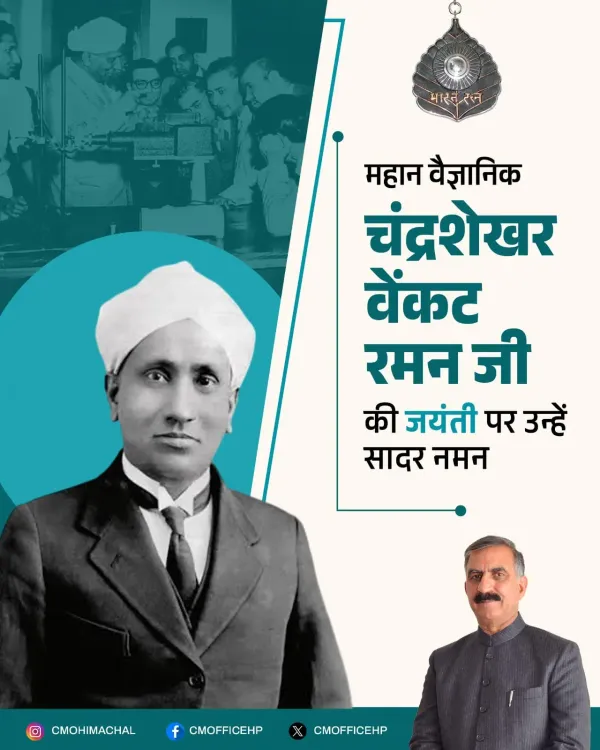
A physicist who bent light and bent history — on his birth anniversary, Chief Minister Thakur Sukhwinder Singh Sukhu of Himachal Pradesh paid tribute to Dr. Chandrasekhara Venkata Raman, honouring the Nobel laureate's enduring legacy in science and India's global standing.
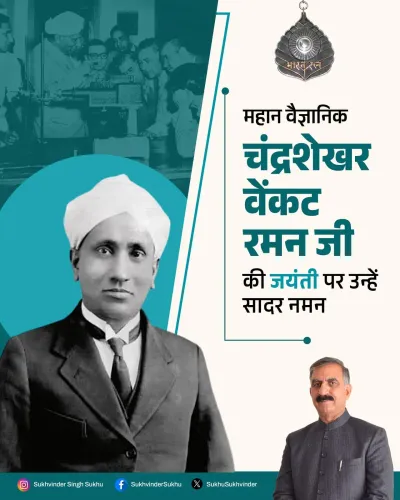
Posting on behalf of the Chief Minister's Office of Himachal Pradesh on Saturday, 7 November 2026, the message read: 'महान वैज्ञानिक डॉ. चंद्रशेखर वेंकट रमन जी की जयंती पर उन्हें सादर नमन' — 'Respectful salutations to the great scientist Dr. Chandrasekhara Venkata Raman on his birth anniversary.' The post noted that through the discovery of the 'Raman Effect', he made a vital contribution to science and elevated India's prestige across the world.
The discovery that changed how we see light
Born in 1888, Dr. C.V. Raman was an Indian physicist whose curiosity about the behaviour of light produced one of the most consequential discoveries of the twentieth century. In 1928, he demonstrated that when light passes through a transparent material, a small fraction of it scatters at a different wavelength — a phenomenon now known universally as the Raman Effect, or inelastic scattering of light. The discovery was elegant, profound, and unmistakably Indian in origin. Two years later, in 1930, Dr. Raman became the first Asian and the first non-white scientist to win the Nobel Prize in Physics — a milestone that reverberated far beyond the laboratory.
Why India still marks this moment every year
The legacy of Dr. Raman is institutionalised in India's scientific calendar. 28 February — the date of the Raman Effect's announcement — is observed annually as National Science Day, a national reminder that curiosity, rigour, and ambition once placed an Indian physicist at the summit of world science. State governments and central institutions alike mark his birth anniversary with tributes, reinforcing both historical pride and the aspiration to cultivate the next generation of scientists. CM Sukhu's post fits squarely into that tradition — a brief but deliberate act of public remembrance that keeps a giant's name in circulation.
The light Dr. Raman studied still scatters. So does his influence — across classrooms, laboratories, and anniversaries like this one.
Point of View
Sitting at the intersection of scientific nationalism and soft-power messaging. By invoking the Raman Effect and India's 'global prestige', CM Sukhu aligns Himachal Pradesh with a broader national narrative that positions pre-independence scientific achievement as a source of contemporary pride. The gesture costs little politically but signals cultural alignment with India's science-promotion agenda. Its real significance lies less in the tribute itself and more in the cumulative weight of these annual observances — keeping Dr. Raman's name visible in a media environment that rarely lingers on the history of physics.
NationPress
7 Nov 2026
Frequently Asked Questions
Who is Dr. C.V. Raman and what did he discover?
Dr. Chandrasekhara Venkata Raman was an Indian physicist born in 1888. He discovered the Raman Effect in 1928 — the inelastic scattering of light when it passes through a transparent material — and won the Nobel Prize in Physics in 1930 for this work.
Why is 28 February celebrated as National Science Day in India?
National Science Day is observed on 28 February every year to mark the anniversary of Dr. C.V. Raman's announcement of the Raman Effect discovery in 1928. It promotes scientific awareness and celebrates India's contributions to global science.
What did CM Sukhwinder Singh Sukhu say about Dr. C.V. Raman?
CM Sukhu's post, shared via the Chief Minister's Office of Himachal Pradesh on 7 November 2026, paid respectful tribute to Dr. Raman on his birth anniversary, noting that the Raman Effect was a vital scientific contribution that raised India's prestige worldwide.
Was C.V. Raman the first Asian to win the Nobel Prize in Physics?
Yes. When Dr. C.V. Raman received the Nobel Prize in Physics in 1930, he became the first Asian and first non-white scientist to win it, a landmark moment for India's scientific standing internationally.
Why do Indian politicians pay tribute to Dr. C.V. Raman every year?
Indian state and central governments routinely issue public tributes to Dr. Raman on his birth anniversary as part of a broader effort to highlight India's historical contributions to world science and to inspire scientific awareness among citizens.