Jaishankar highlights Modi's Mann Ki Baat: strikes, Ganesh, solar
Synopsis
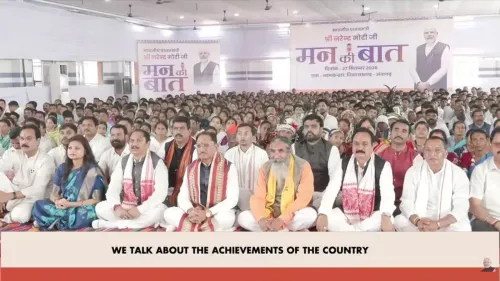
EAM Dr. S. Jaishankar amplified three key threads from PM Modi's September 27 Mann Ki Baat: India's zero-tolerance counter-terror resolve on the surgical strikes' 10th anniversary, the Ganesh Himal Museum in Thailand as a soft-power milestone, and Modhera's emergence as India's first solar-powered village.
Key Takeaways
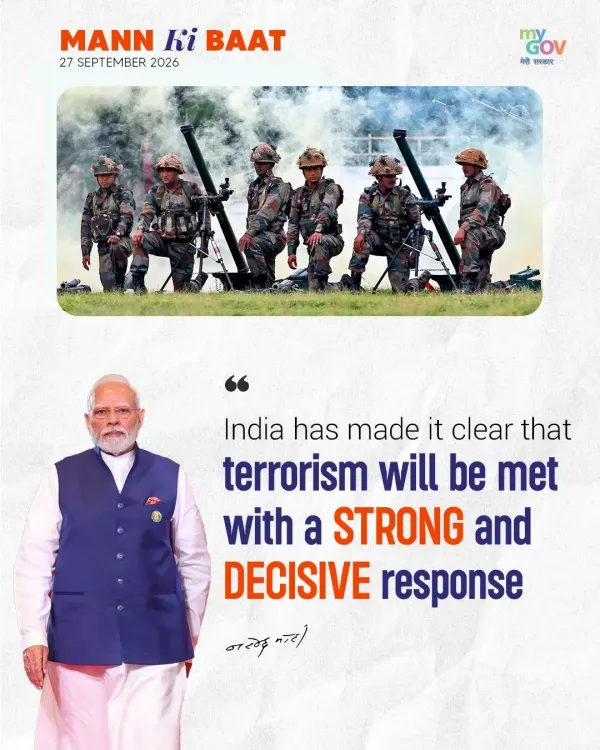
PM Modi used Mann Ki Baat on 27 September 2026 to mark the 10th anniversary of the 2016 Surgical Strikes , reaffirming India's zero-tolerance stance on terrorism.
PM Modi paid homage to victims of the 9/11 attacks , now 25 years in the past, linking India's counter-terror doctrine to global anti-terrorism cooperation.
The Ganesh Himal Museum in Thailand , housing over 10,000 Ganesh idols , was cited as evidence of India's enduring civilisational presence in Southeast Asia under the Act East Policy .
Modhera village in Gujarat's Mehsana district was highlighted as India's first fully solar-powered settlement, combining its ancient Sun Temple heritage with modern renewable energy.
Jaishankar amplified all three themes on X , signalling their relevance to India's external affairs — spanning deterrence, cultural diplomacy, and green-energy messaging.
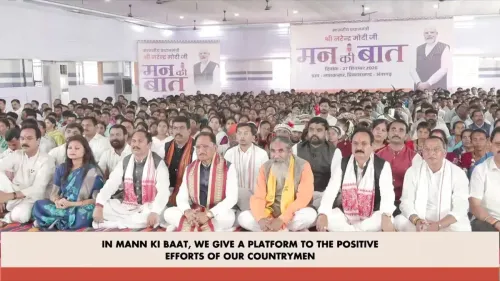
Ten years after India's cross-LoC Surgical Strikes of September 2016, Union External Affairs Minister Dr. S. Jaishankar amplified Prime Minister Narendra Modi's key messages from the September 27, 2026 edition of Mann Ki Baat — weaving together counter-terrorism resolve, civilisational outreach to Southeast Asia, and a Gujarat village rewriting India's energy story.
Zero tolerance at ten: the surgical strikes anniversary
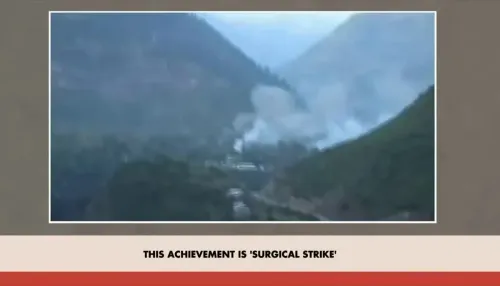
The episode marked a decade since Indian Army commandos crossed the Line of Control on 29 September 2016 to strike terrorist launch pads in Pakistan-occupied Kashmir — a direct response to the Uri attack of 18 September 2016 that killed 19 soldiers. That night changed India's counter-terror calculus permanently: from strategic restraint to publicly acknowledged, cross-border punitive action.
PM Modi also paid homage to the nearly 3,000 victims of the 9/11 attacks of 11 September 2001, now 25 years in the past, linking India's own experience of cross-border terrorism to a global reckoning that reshaped international security cooperation. The twin commemoration was deliberate: India's zero-tolerance doctrine, Modi signalled, sits within a wider arc of civilised nations refusing to absorb terror as a cost of doing business.
10,000 Ganesh idols and India's living presence in Thailand
Shifting from security to soft power, the broadcast spotlighted the Ganesh Himal Museum in Thailand, home to more than 10,000 Ganesh idols — a tangible monument to the Hindu-Buddhist cultural exchange that has threaded India and Southeast Asia together for over a millennium. The sheer number is striking. Ten thousand idols is not a collection; it is a civilisational statement.
The reference tracks directly with India's Act East Policy, articulated since 2014, which elevates cultural diplomacy alongside trade and defence ties with ASEAN nations. Thailand, with its deep Brahmanical heritage visible in the Ramayana-derived Ramakien epic and temple iconography, is one of the policy's most natural partners. Highlighting the museum in a mass-broadcast programme carries the message to millions of Indian listeners that India's civilisational footprint in the region is not history — it is alive and expanding.
Modhera's solar transformation, rooted in a thousand-year tradition
Modhera, a village in Gujarat's Mehsana district, is already famous for its 11th-century Sun Temple — one of the finest examples of Solanki-era architecture in India. Now it is being held up as the country's first fully solar-powered settlement, its ancient reverence for the sun finding a strikingly modern expression in rooftop panels and round-the-clock renewable power.
The Modhera model draws conceptually from the framework India and France launched with the International Solar Alliance in 2015, which aimed to mobilise solar deployment across sun-rich developing nations. A single village powering itself entirely from sunlight is the kind of concrete, nameable proof-of-concept that scales a diplomatic idea into a lived reality — and makes for exactly the kind of story a monthly national broadcast is designed to carry.
Why Jaishankar is amplifying this episode
As External Affairs Minister, Dr. Jaishankar's decision to flag all three themes — strikes, the Thai museum, Modhera — is itself a signal. Each thread has a foreign-policy dimension: the strikes anniversary reinforces India's deterrence credibility; the Thai Ganesh museum advances cultural diplomacy in ASEAN; Modhera projects India's green-energy credentials to international partners watching its climate commitments. Mann Ki Baat is domestic radio, but its messaging travels far beyond Indian borders.
Together, the three highlights sketch the contours of an India that pairs a hard security edge with deep civilisational confidence and a forward-leaning energy agenda — a composite portrait the Ministry of External Affairs is clearly content to broadcast to the world.
Point of View
While the Thailand Ganesh Museum reference advances the civilisational strand of Act East diplomacy ahead of ASEAN engagements. Modhera's solar story, meanwhile, lets India project climate credibility with a concrete, photogenic proof-point rather than abstract pledges. Together, the three threads embody the 'security-plus-soft power-plus-green growth' doctrine that has defined India's external posture since 2014.
NationPress
27 Sept 2026
Frequently Asked Questions
What were the 2016 Surgical Strikes and why are they significant in 2026?
The Surgical Strikes of 29 September 2016 were cross-LoC operations by the Indian Army targeting terrorist launch pads in Pakistan-occupied Kashmir, carried out after the Uri attack killed 19 soldiers . In 2026 , their 10th anniversary is being marked as a defining moment in India's shift to an assertive counter-terrorism posture.
What is the Ganesh Himal Museum in Thailand?
The Ganesh Himal Museum in Thailand houses over 10,000 Ganesh idols and stands as a symbol of the deep Hindu-Buddhist cultural exchange between India and Southeast Asia . PM Modi referenced it in Mann Ki Baat to illustrate India's living civilisational presence in the region.
Why is Modhera called India's first solar village?
Modhera , in Gujarat's Mehsana district , is described as India's first fully solar-powered settlement, running on round-the-clock renewable energy. It is also home to the 11th-century Sun Temple , making its solar transformation a continuation of its ancient tradition of sun worship.
What is Mann Ki Baat and how often does PM Modi broadcast it?
Mann Ki Baat is a monthly radio address hosted by Prime Minister Narendra Modi in which he speaks directly to citizens on policy milestones, cultural themes, and social initiatives. The 27 September 2026 episode is the one EAM Jaishankar highlighted on X.
Why did EAM Jaishankar share Mann Ki Baat highlights on X?
As Union External Affairs Minister , Dr. Jaishankar highlighted themes with clear foreign-policy relevance: the surgical strikes reinforce deterrence credibility, the Thai museum advances Act East cultural diplomacy, and Modhera's solar story supports India's green-energy diplomacy with international partners.