Jaishankar: India-UK FTA and Social Security Pact Enter Into Force

Synopsis
The India-UK Free Trade Agreement, CETA, and Social Security Agreement entered into force on 15 July 2026. EAM Dr. S. Jaishankar hailed the milestone as a new chapter in the Comprehensive Strategic Partnership, promising expanded trade, stronger supply chains, and better conditions for Indian professionals in Britain.
Key Takeaways
The India-UK FTA , CETA , and Agreement on Social Security entered into force simultaneously on 15 July 2026 .
Jaishankar credited PM Narendra Modi's leadership for the landmark achievement.
The Social Security Agreement , signed in 2023 , eliminates dual-contribution liability for Indian professionals working in the UK .
The UK is currently India's fifth-largest trading partner ; the FTA aims to substantially expand bilateral commerce in goods, services and digital trade.
FTA negotiations were formally launched in January 2022 , following the upgrade of ties to a Comprehensive Strategic Partnership in May 2021 .
The FTA Joint Committee's first review meeting is expected within six months of the agreements entering into force.
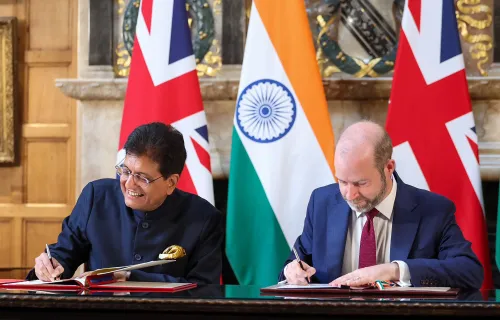
Union External Affairs Minister Dr. S. Jaishankar announced on Wednesday, 15 July 2026 that the landmark India-UK Free Trade Agreement (FTA), the accompanying Comprehensive Economic and Trade Agreement (CETA), and the Agreement on Social Security have entered into force, marking a defining moment in the India-UK Comprehensive Strategic Partnership.
Context
In his post on X, Dr. Jaishankar described the development as 'a new chapter in the India-UK Comprehensive Strategic Partnership, under the visionary leadership of PM Narendra Modi.' He noted that the agreements 'will boost trade, expand opportunities for businesses and professionals, strengthen supply chains, and further deepen the India-UK economic partnership.' The announcement marks the culmination of negotiations formally launched in January 2022, following the elevation of the bilateral relationship to a Comprehensive Strategic Partnership at the virtual summit of May 2021.
The simultaneous entry into force of three interlocking agreements — the FTA, the CETA, and the Social Security pact — signals a comprehensive reset of trade and mobility ties between the world's fifth-largest economy and one of its fastest-growing major economies.
Policy Backdrop
India-UK trade talks gained momentum after the United Kingdom's departure from the European Union's single market, which compelled London to build an independent trade architecture. The UK is currently India's fifth-largest trading partner, and both governments identified the FTA as a vehicle to significantly expand bilateral commerce in goods, services and digital trade.
The Agreement on Social Security, signed in 2023, addresses a long-standing concern of Indian professionals working in the UK: the obligation to make social security contributions in both countries simultaneously without proportionate benefits. The pact coordinates pension and contribution entitlements, directly benefiting the large community of Indian IT, finance and healthcare professionals employed in Britain.
India's push to accelerate FTA negotiations with Western economies is part of a broader post-2020 strategy to diversify supply chains and widen market access. Parallel negotiations with the European Union, the EFTA bloc, and the Gulf Cooperation Council reflect the same strategic logic.
Stakeholders and Impact
Indian exporters in sectors such as textiles, pharmaceuticals, engineering goods and software services stand to gain preferential market access to the UK. British businesses, in turn, are expected to benefit from reduced tariffs on Scotch whisky, automobiles and financial services entering the Indian market — areas that had been sticking points during negotiations.
Indian professionals — particularly in information technology, healthcare and financial services — will see immediate relief from the Social Security Agreement, which eliminates dual-contribution liability and ensures portability of benefits. Industry bodies representing both Indian and British firms had lobbied for this provision since the FTA talks began.
Supply chain planners in both countries will also benefit, as the agreements provide long-term regulatory certainty for cross-border investment and sourcing decisions, particularly in the context of global efforts to reduce dependence on single-source supply networks.
What's Next
Attention now turns to the implementation architecture. Parliamentary scrutiny of the enabling legislation in both countries will be closely watched, as will the constitution of the FTA Joint Committee, whose first review meeting is expected within six months of the agreements entering into force. The joint committee will oversee dispute resolution, review tariff schedules, and manage the phased liberalisation commitments embedded in the treaty.
With the India-UK agreements now live, New Delhi's trade negotiators are likely to face renewed pressure from other partners — including the European Union — to accelerate stalled talks, using the UK deal as a template for what a modern, services-heavy FTA with India can look like.
Point of View
CETA, and Social Security pact — is a deliberate signalling exercise by New Delhi, demonstrating that it can conclude complex, multi-layered trade deals with major Western partners. For the Modi government, the UK deal serves as a proof-of-concept ahead of harder negotiations with the European Union. Dr. Jaishankar's framing of the announcement around 'visionary leadership' also reinforces the domestic political narrative that India's diplomatic assertiveness under the current dispensation delivers tangible economic outcomes. The entry-into-force moment, rather than the signing, is the politically significant milestone — it converts diplomatic capital into enforceable law.
NationPress
15 Jul 2026
Frequently Asked Questions
What is the India-UK FTA and when did it enter into force?
The India-UK Free Trade Agreement is a bilateral treaty covering goods, services, digital trade and investment between India and the United Kingdom. It entered into force on 15 July 2026 , along with the CETA and the Agreement on Social Security, as announced by EAM Dr. S. Jaishankar .
How does the India-UK Social Security Agreement benefit Indian professionals?
The Agreement on Social Security eliminates the requirement for Indian professionals working in the UK to pay social security contributions in both countries simultaneously. It also ensures portability of pension and benefit entitlements, directly helping Indian workers in IT, healthcare and finance sectors.
When did India-UK FTA negotiations begin?
Formal negotiations for the India-UK FTA were launched in January 2022 , following preparatory discussions in 2021 and the elevation of bilateral ties to a Comprehensive Strategic Partnership at the virtual summit of May 2021 .
Which Indian sectors benefit most from the India-UK FTA?
Indian exporters in textiles, pharmaceuticals, engineering goods and software services are among the primary beneficiaries, gaining preferential access to the UK market. Indian professionals in IT, healthcare and financial services also benefit from the accompanying Social Security Agreement.
What is the India-UK Comprehensive Strategic Partnership?
The India-UK Comprehensive Strategic Partnership is a bilateral framework covering trade, defence, technology and people-to-people ties, formally elevated at the virtual summit held in May 2021 . The FTA and Social Security Agreement are the most significant economic deliverables under this framework.