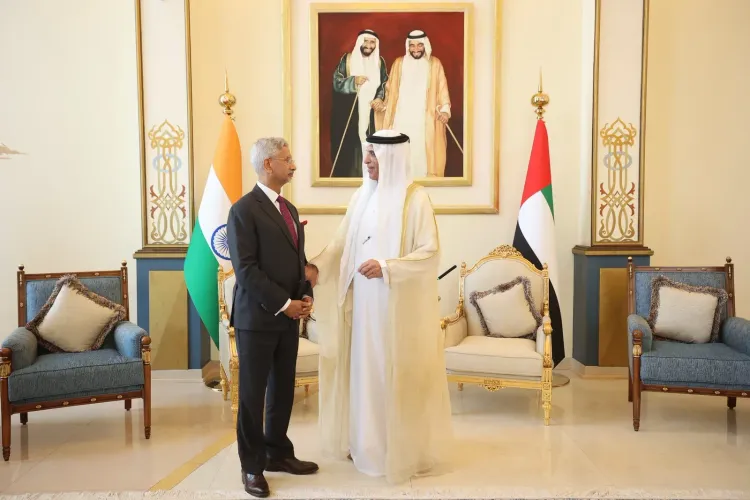
Jaishankar meets Ras Al Khaimah Ruler, discusses India-UAE ties
Synopsis
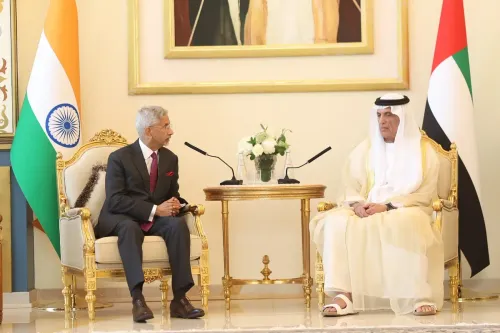
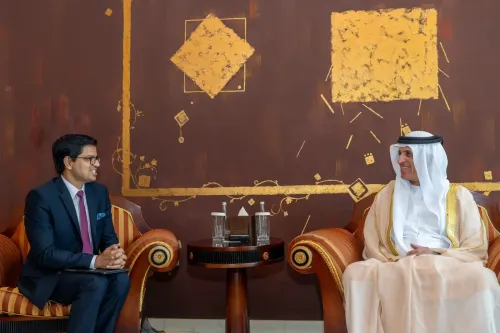
External Affairs Minister Dr. S. Jaishankar met UAE Supreme Council member and Ras Al Khaimah Ruler Sheikh Saud bin Saqr Al Qasimi on October 16, 2026, discussing India-UAE ties under the 2022 CEPA framework and the broader Gulf regional situation.
Key Takeaways
Jaishankar met HH Sheikh Saud bin Saqr Al Qasimi , Ruler of Ras Al Khaimah and member of the UAE Supreme Council , on October 16, 2026 .
Discussions covered further strengthening of India-UAE bilateral ties and deepening regional engagements.
The Gulf regional situation was explicitly raised during the meeting.
India and the UAE have operated under a Comprehensive Economic Partnership Agreement (CEPA) since 2022 .
Ras Al Khaimah is one of the seven UAE emirates with growing investment and economic ties to India.
The meeting reflects India's sustained multi-level engagement with Gulf leadership, covering diaspora welfare, energy, and regional security.
Union External Affairs Minister Dr. S. Jaishankar sat down with HH Sheikh Saud bin Saqr Al Qasimi, the Ruler of Ras Al Khaimah and a member of the UAE Supreme Council, on Friday, October 16, 2026 — a meeting that ranged from deepening bilateral economic ties to the broader situation unfolding across the Gulf.
What Jaishankar and Sheikh Saud discussed
The External Affairs Minister described the encounter as 'an honour,' posting on X that he was 'grateful for his insights on further strengthening 🇮🇳🇦🇪 ties, and deepening engagements with the region.' Crucially, he added that 'the situation in the Gulf also came up for discussion' — a pointed signal that the agenda extended well beyond trade pleasantries.
Ras Al Khaimah is one of the seven emirates of the United Arab Emirates and has steadily grown as an investment and tourism hub with expanding linkages to India. Sheikh Saud bin Saqr Al Qasimi has led the emirate since 2004 and, as a member of the UAE Supreme Council, carries significant weight in federal policy deliberations.
India-UAE partnership: the CEPA foundation
The meeting sits atop a dense architecture of India-UAE engagement. The two countries signed a Comprehensive Economic Partnership Agreement (CEPA) in 2022, opening a framework for expanded trade, investment flows, and sectoral cooperation. High-level visits since then have progressively filled that framework with action-level commitments.
India's Gulf outreach is never purely economic. The region hosts one of the world's largest Indian diaspora communities, channels substantial remittances back home, and sits at the centre of energy supply chains that India depends on. Every conversation at this level therefore carries a layered agenda: commerce, consular welfare, energy security, and regional stability all on the same table.
Why 'the situation in the Gulf' matters right now
Jaishankar's specific mention of Gulf regional developments is the line that geopolitical watchers will flag. Gulf dynamics — spanning tensions in the wider Middle East, energy market volatility, and evolving security architectures — directly bear on India's interests. New Delhi has made a strategic habit of keeping communication open with individual emirate rulers as well as the UAE federal leadership, ensuring it has multiple vantage points on fast-moving regional developments.
India's record of sustained, multi-level Gulf engagement reflects a clear doctrine: build redundancy into relationships so that no single disruption severs the broader partnership. A meeting with the Ruler of Ras Al Khaimah, in that light, is less a courtesy call and more a structural investment.
Whether the conversation seeds a specific commercial initiative, a consular expansion, or feeds into New Delhi's broader Gulf calculus will become clearer in the weeks ahead — but the groundwork, as Jaishankar's post makes plain, has been freshly reinforced.
Point of View
Reflecting how closely India's energy and diaspora security is intertwined with regional stability. Coming four years after the CEPA's signing, sustained high-level contact of this kind signals New Delhi's intent to operationalise, not just celebrate, the partnership. India's Gulf doctrine increasingly prizes depth and redundancy over ceremony.
NationPress
16 Oct 2026
Frequently Asked Questions
Who is Sheikh Saud bin Saqr Al Qasimi?
Sheikh Saud bin Saqr Al Qasimi is the Ruler of Ras Al Khaimah, one of the seven emirates of the UAE, and a member of the UAE Supreme Council. He has led Ras Al Khaimah since 2004.
What did Jaishankar discuss with the Ras Al Khaimah Ruler?
Dr. Jaishankar discussed further strengthening of India-UAE bilateral ties, deepening engagements with the Gulf region, and the current situation in the Gulf.
What is the India-UAE CEPA?
India and the UAE signed a Comprehensive Economic Partnership Agreement (CEPA) in 2022 to expand bilateral trade and investment and provide a framework for broader economic cooperation.
Why does India engage with individual UAE emirate rulers?
India maintains ties with both UAE federal leadership and individual emirate rulers to build redundancy into the relationship, ensuring access to multiple policy-level touchpoints on trade, energy, diaspora welfare, and regional security.
What is the significance of the Gulf situation coming up in this meeting?
Jaishankar's mention of the Gulf regional situation signals that the discussions moved beyond trade to regional stability — a direct concern for India given its energy dependence on the Gulf and the large Indian diaspora community residing there.