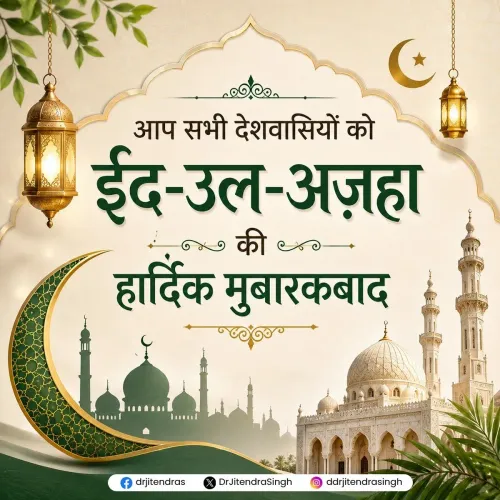
Jaishankar extends Eid ul-Adha greetings, calls for peace
Synopsis
Union External Affairs Minister Dr. S. Jaishankar extended Eid ul-Adha greetings on 28 May 2026, calling for compassion, harmony and peace. The bilingual message in English and Hindi reflects India's secular tradition and the diplomatic significance of such outreach toward Muslim communities at home and across the world.
Key Takeaways
Jaishankar , Union External Affairs Minister, posted Eid ul-Adha greetings on 28 May 2026 .
The message was bilingual — in English and Hindi — addressing Muslims in India and worldwide.
He called for the festival to foster compassion, harmony and peace in everyone's life.
Eid ul-Adha commemorates Prophet Ibrahim's act of submission and is marked by prayers, sacrifice and charity globally.
The gesture is part of a long-standing tradition of Indian ministers issuing greetings across major religious festivals, reinforcing India's secular ethos .
For an External Affairs Minister , such messages also carry diplomatic weight with Gulf nations and Muslim-majority partners.
Union External Affairs Minister Dr. S. Jaishankar extended warm wishes on Eid ul-Adha on Thursday, 28 May 2026, calling on the festival to foster compassion, harmony and peace among all communities across the world.
Context
In a bilingual post on X, Dr. Jaishankar wrote in English: 'Eid Mubarak to all celebrating Eid ul-Adha across the world. May this festival foster compassion, harmony and peace.' The Hindi portion of the message — ईद उल-अधा की हार्दिक शुभकामनाएं। कामना है कि यह त्यौहार सभी के जीवन में करुणा, सद्भाव और शांति लाए। — translates as: 'Heartfelt greetings on Eid ul-Adha. May this festival bring compassion, harmony and peace to everyone's life.'
Eid ul-Adha, one of the two principal Islamic festivals, commemorates the willingness of Prophet Ibrahim to sacrifice his son in submission to God's command. It is observed by Muslims worldwide through prayers, the ritual of sacrifice, and acts of charity and community sharing.
Policy Backdrop
Indian ministers and heads of government have maintained a long-standing tradition of issuing greetings on major religious occasions — including Eid, Diwali, Christmas, Guru Nanak Jayanti and others — as an expression of the country's secular ethos and multicultural fabric. For an External Affairs Minister, such messages carry an additional diplomatic dimension, signalling goodwill toward Muslim-majority nations and overseas Indian communities.
Dr. Jaishankar, who has served as India's Ambassador to the United States, China and Singapore before becoming Foreign Secretary and subsequently Union Minister of External Affairs from May 2019, has consistently used public platforms to reinforce India's commitment to pluralism and its engagement with the wider Islamic world, including key partners in the Gulf and West Asia.
Stakeholders and Impact
India is home to one of the world's largest Muslim populations, and the message resonates both domestically and internationally. The bilingual format — English and Hindi — reflects an intent to reach Indian communities at home as well as the global diaspora and partner nations.
Gulf countries such as the United Arab Emirates, Saudi Arabia, Qatar and Kuwait host millions of Indian workers and form the backbone of India's remittance economy. Diplomatic goodwill expressed through such gestures supports the broader framework of people-to-people ties that underpin bilateral relations with these nations.
What's Next
Festival greetings from senior ministers are typically followed by engagement with counterparts from Muslim-majority nations around major Islamic occasions. India's diplomatic calendar with Gulf and Organisation of Islamic Cooperation (OIC) partner countries often sees enhanced activity in the weeks surrounding Eid ul-Adha. Similar outreach messages are expected around other upcoming festivals on the national calendar.
The message underscores New Delhi's continuing effort to position itself as a pluralist democracy with deep and respectful ties to Muslim communities both within its borders and across the world — a posture that remains central to India's foreign policy in the region.
Point of View
Festival greetings are never purely ceremonial — they reinforce the relational architecture that supports trade, remittances and security cooperation with Muslim-majority nations. The choice of Hindi alongside English signals an intent to speak to ordinary Indians, not merely foreign capitals. Taken together, the message fits a consistent pattern of New Delhi projecting pluralism as both a domestic value and a foreign-policy asset.
NationPress
11 Oct 2026
Frequently Asked Questions
Why did Jaishankar post Eid ul-Adha greetings?
Dr. Jaishankar extended Eid ul-Adha wishes as part of India's tradition of senior ministers greeting communities on major religious festivals, reflecting the country's secular ethos and reinforcing diplomatic goodwill with Muslim-majority nations.
What is Eid ul-Adha and why is it celebrated?
Eid ul-Adha is one of the two principal Islamic festivals. It commemorates Prophet Ibrahim's willingness to sacrifice his son in obedience to God and is observed through prayers, ritual sacrifice, and acts of charity.
What did Jaishankar say on Eid ul-Adha 2026?
He wrote: 'Eid Mubarak to all celebrating Eid ul-Adha across the world. May this festival foster compassion, harmony and peace,' and posted the same message in Hindi wishing that the festival bring compassion, harmony and peace to everyone's life.
Why does India's External Affairs Minister issue Eid greetings?
Beyond reflecting India's multicultural values domestically, such greetings from the External Affairs Minister carry diplomatic significance, signalling respect and goodwill toward Gulf countries and other Muslim-majority nations that are key partners in trade, energy and diaspora relations.
Which countries are important for India's Eid diplomacy?
The Gulf nations — particularly the United Arab Emirates, Saudi Arabia, Qatar and Kuwait — are central, as they host millions of Indian workers and are among India's largest sources of remittances and energy imports.