Jal Shakti Minister CR Paatil Visits Flood-Hit Surat
Synopsis
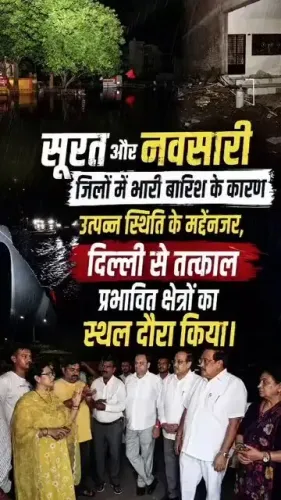
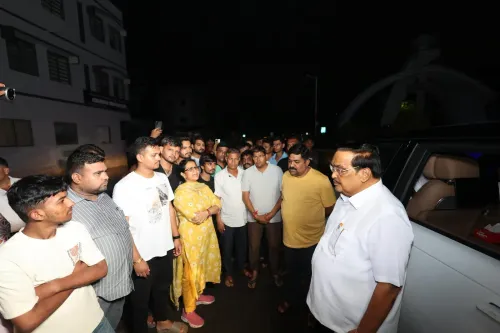
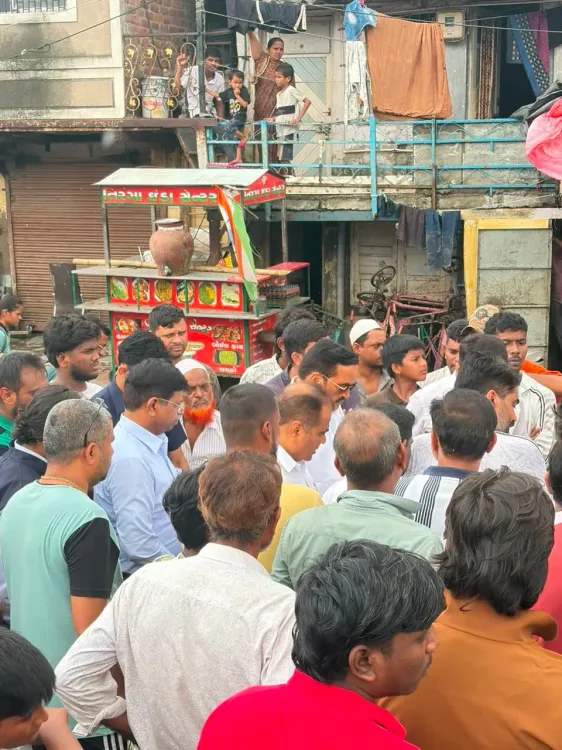
Union Jal Shakti Minister C. R. Paatil visited flood-affected Azad Nagar–Rasulabad on Surat's Bhatar Road on 9 July 2026, meeting residents and directing local administration to expedite cleanup operations and relief delivery to impacted families.
Key Takeaways
Paatil , Union Jal Shakti Minister, visited Azad Nagar–Rasulabad on Bhatar Road, Surat on 9 July 2026 .
The area was hit by heavy monsoon rainfall , causing significant distress to local families.
Paatil held direct, face-to-face dialogue with affected residents and heard their grievances.
He issued instructions to the local administration to begin immediate cleanup operations .
Directives were also given to ensure relief assistance reaches affected families swiftly .
Surat's recurring urban waterlogging reflects wider drainage challenges in rapidly urbanising Indian cities.
Union Jal Shakti Minister C. R. Paatil on Thursday, 9 July 2026, visited the Azad Nagar–Rasulabad locality along Bhatar Road in Surat, a low-lying urban pocket severely affected by heavy monsoon rainfall. He met residents directly, heard their grievances, and directed local administration to launch immediate cleanup operations and expedite relief to affected families.
Context
Paatil's post, written in Gujarati, states that he 'sthaanikoní rajuaato sámbhaḷi' — 'listened to the representations of local residents' — and issued instructions for swift assistance. The visit covered the Bhatar Road area, which is among Surat's stretches prone to waterlogging during intense monsoon spells. The minister interacted face-to-face with affected families, a detail he described as 'rubaru sanvad', or direct dialogue.
Surat is one of Gujarat's largest industrial cities and has historically struggled with urban drainage capacity during peak monsoon months. Rapid commercial and residential expansion over the past two decades has placed sustained pressure on the city's stormwater infrastructure.
Policy Backdrop
The Jal Shakti Ministry, which Paatil heads at the Centre, oversees water-resource management and coordinates with state governments on monsoon preparedness. The ministry's Jal Shakti Abhiyan, launched in 2019, was designed to strengthen water conservation and improve flood resilience across states, including Gujarat.
Union ministers from the ruling party routinely conduct ground visits to rain-hit constituencies in their home states during the monsoon season, both to signal administrative responsiveness and to coordinate between central and state relief mechanisms. Paatil, a former Gujarat BJP state president, retains strong political roots in the state, making Surat a natural constituency for such outreach.
Stakeholders and Impact
The Azad Nagar–Rasulabad neighbourhood is a densely populated residential area where waterlogging can disrupt daily life, damage property, and create public-health risks. Families in such localities often depend on prompt municipal response for drainage clearance and access to dry rations, drinking water, and temporary shelter.
Local civic bodies — primarily the Surat Municipal Corporation — bear the operational responsibility for cleanup and relief delivery. Paatil's directive is expected to accelerate coordination between the corporation and district administration, with central oversight lending additional urgency to the response.
What's Next
Attention will now turn to how quickly the Surat Municipal Corporation and Gujarat state administration complete drainage clearance and disburse aid to affected households. Any formal review of urban flood-mitigation infrastructure in Surat — including central funding under drainage or smart-city schemes — could follow if the damage assessment warrants it.
With the monsoon season still in its early weeks, recurring waterlogging in cities like Surat underscores the broader challenge of aligning rapid urbanisation with resilient drainage planning, a gap that both state governments and the Centre's water ministry are under increasing pressure to address.
Point of View
The visit bridges both roles neatly. The move also places quiet pressure on the Surat Municipal Corporation and state machinery to demonstrate visible action. More broadly, it reflects the Centre's growing awareness that urban flood vulnerability — especially in rapidly expanding cities like Surat — is becoming a reputational and governance liability that cannot be managed from New Delhi alone.
NationPress
9 Jul 2026
Frequently Asked Questions
Why did CR Paatil visit Surat on 9 July 2026?
C. R. Paatil visited Surat's Azad Nagar–Rasulabad area on 9 July 2026 because heavy monsoon rainfall had caused significant flooding and distress in the locality. He met affected residents and directed the local administration to carry out immediate cleanup and deliver relief.
Which area of Surat was affected by heavy rain and visited by the minister?
The affected area is Azad Nagar–Rasulabad , located along Bhatar Road in Surat, Gujarat . It is a densely populated residential locality prone to waterlogging during the monsoon season.
What instructions did CR Paatil give to the administration?
Paatil directed the local administration to immediately undertake cleanup operations in the flood-hit area and to ensure that necessary relief assistance reaches affected families as quickly as possible.
What is the Jal Shakti Ministry's role in flood response?
The Jal Shakti Ministry handles water resources and river development at the central level and coordinates with state governments on monsoon preparedness. Its Jal Shakti Abhiyan , launched in 2019 , aims to strengthen water conservation and flood resilience across India.
Why does Surat face recurring waterlogging during the monsoon?
Surat is a rapidly growing industrial city in Gujarat where fast-paced urbanisation has consistently outpaced stormwater drainage infrastructure, making several low-lying localities vulnerable to waterlogging during intense monsoon spells.