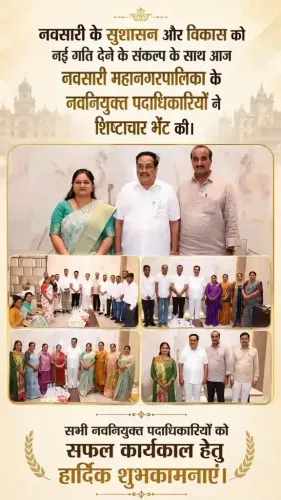
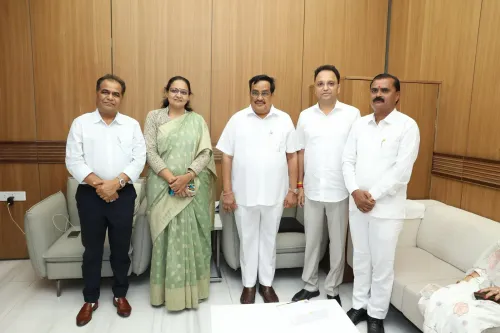
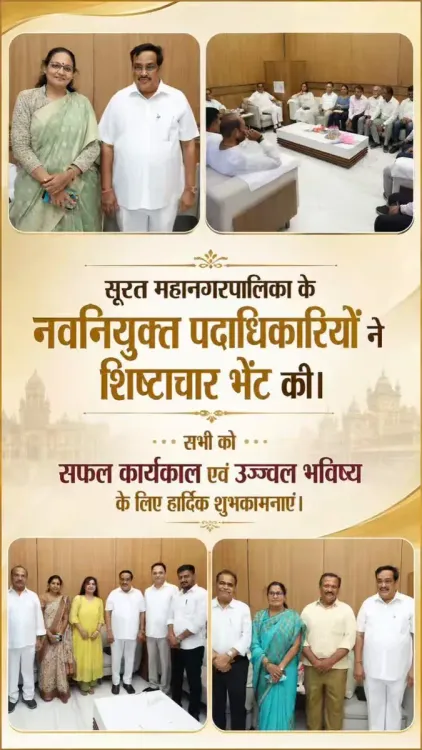
Jal Shakti Minister Paatil Meets Surat Municipal Newly Appointed Officials
Synopsis
Union Jal Shakti Minister C. R. Paatil hosted newly appointed Surat Municipal Corporation office-bearers for a courtesy visit on 29 May 2026, signalling early central-municipal coordination on urban water schemes including AMRUT 2.0 and Jal Jeevan Mission in one of Gujarat's key cities.
Key Takeaways
Union Jal Shakti Minister C.
Paatil received newly appointed Surat Municipal Corporation office-bearers on 29 May 2026 .
Paatil shared a video of the courtesy meeting on X with a Gujarati caption describing the occasion.
The Jal Jeevan Mission (2019) and AMRUT 2.0 are the two central schemes most directly linking the ministry to Surat's civic body.
Surat is a major AMRUT-participating city, making SMC leadership alignment with the ministry operationally significant.
Paatil's dual role as minister and former Gujarat BJP state president underpins close central-state-municipal coordination in Gujarat.
Follow-up coordination on urban water funding allocations and project timelines for Surat is expected.
Union Jal Shakti Minister C. R. Paatil received a courtesy call from newly appointed office-bearers of the Surat Municipal Corporation (SMC) on Friday, 29 May 2026, marking an early engagement between the central water ministry and the civic body that administers one of Gujarat's fastest-growing cities.
Paatil shared a video glimpse of the meeting on X, captioning it in Gujarati: 'સુરત મહાનગરપાલિકાના નવનિયુક્ત પદાધિકારીશ્રીઓએ શુભેચ્છા મુલાકાત લીધી એ સમયની એક ઝલક….' ('A glimpse of the moment when the newly appointed office-bearers of Surat Municipal Corporation paid a courtesy visit.')
Context
The meeting comes shortly after a fresh round of appointments within the Surat Municipal Corporation, the urban local body responsible for water supply, sanitation, and civic infrastructure across Surat. As Union Jal Shakti Minister, Paatil oversees national water and sanitation schemes whose last-mile delivery depends heavily on municipal bodies like the SMC.
Surat, known globally for its textile and diamond industries, has seen rapid population growth that places sustained pressure on urban water infrastructure. Coordination between the central ministry and city-level administrators is therefore considered operationally significant.
Policy Backdrop
Two major central schemes directly connect the Jal Shakti Ministry to municipal corporations. The Jal Jeevan Mission, launched in 2019, aims to provide tap water connections to every household, with urban components routed through civic bodies. The Atal Mission for Rejuvenation and Urban Transformation (AMRUT), initiated in 2015 and extended as AMRUT 2.0, specifically targets upgrades to urban water supply and sewerage networks.
Surat has been an active participant in AMRUT-funded projects, and any alignment between newly installed SMC leadership and the central ministry could influence the pace and scope of ongoing infrastructure work in the city.
Stakeholders and Impact
The primary stakeholders are the residents of Surat, whose daily access to clean water and sanitation services depends on how effectively the SMC executes centrally funded schemes. Municipal office-bearers who establish early working relationships with the ministry are better positioned to expedite approvals and funding disbursements.
BJP-led Gujarat has consistently emphasized integrated urban water management, and central ministers from the state routinely engage city-level bodies to align national priorities with local execution. Paatil, a former Gujarat BJP state president, brings both ministerial authority and deep familiarity with the state's civic landscape to such interactions.
What's Next
Observers will watch for follow-up announcements on AMRUT 2.0 project timelines in Surat and any parliamentary discussions on urban water funding allocations for Gujarat's municipal corporations. The courtesy visit, while ceremonial in nature, typically precedes more substantive coordination meetings on scheme implementation and fund utilisation targets.
Point of View
Who built his political base in Surat, the meeting reinforces a personal and institutional continuity between city-level administration and the national water ministry. The timing, shortly after new SMC appointments, suggests a deliberate effort to align municipal priorities with AMRUT 2.0 and Jal Jeevan Mission deliverables before the next budgetary cycle. If substantive follow-up meetings materialise, they could accelerate Surat's pending urban water infrastructure projects.
NationPress
19 Sept 2026
Frequently Asked Questions
Why did Surat Municipal Corporation officials meet C. R. Paatil?
Newly appointed Surat Municipal Corporation office-bearers paid a courtesy visit to Union Jal Shakti Minister C. R. Paatil on 29 May 2026 to establish early coordination between the civic body and the central water ministry.
What is C. R. Paatil's role as Jal Shakti Minister?
C. R. Paatil heads the Union Ministry of Jal Shakti, which oversees national water supply and sanitation schemes including the Jal Jeevan Mission and AMRUT, whose implementation depends on municipal corporations.
What is AMRUT 2.0 and how does it affect Surat?
AMRUT 2.0 is the second phase of the Atal Mission for Rejuvenation and Urban Transformation, launched to upgrade urban water supply and sewerage networks. Surat is an active participating city and stands to receive central funding for infrastructure upgrades under the scheme.
What is the Jal Jeevan Mission and does it cover urban areas?
The Jal Jeevan Mission, launched in 2019, aims to provide tap water connections to every household in India. It has urban components that are coordinated through municipal bodies such as the Surat Municipal Corporation.
Is C. R. Paatil connected to Surat politically?
Yes. C. R. Paatil is a senior BJP leader who served as Gujarat BJP state president and has strong political roots in Surat, giving him both ministerial authority and local familiarity in dealings with the city's civic administration.