CM Yogi: Jewar Airport to be India's Cargo and MRO Hub
Synopsis
Chief Minister Yogi Adityanath announced on 15 June 2026 that Noida International Airport at Jewar will be developed as a Cargo and MRO centre, giving Uttar Pradesh farmers direct access to global markets and making Jewar a focal point of the state's aviation-led economic strategy.
Key Takeaways
Noida International Airport at Jewar is being positioned as a dedicated Cargo and MRO (Maintenance, Repair, and Overhaul) centre, according to CM Yogi Adityanath .
Farmers across Uttar Pradesh , particularly in the western region, are cited as primary beneficiaries who will be able to export food grains, fruits, and vegetables to global markets via the airport's cargo facilities.
Jewar in Gautam Buddh Nagar district is described as the 'focal point' of this cargo and MRO initiative.
The Jewar greenfield airport project dates to 2017 and is part of a broader UP government strategy that also includes new airports at Ayodhya and Kushinagar .
Land acquisition completion, environmental clearances, and operator selection for cargo and MRO zones remain key pending milestones for the project.
The Chief Minister's Office of Uttar Pradesh announced on Monday, 15 June 2026 that Noida International Airport at Jewar is being developed as a dedicated Cargo and MRO (Maintenance, Repair, and Overhaul) centre, with Chief Minister Yogi Adityanath stating that farmers across the state will gain direct access to global markets through the airport's cargo facilities.
Context
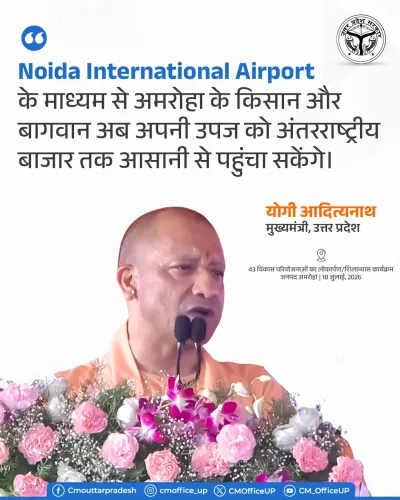
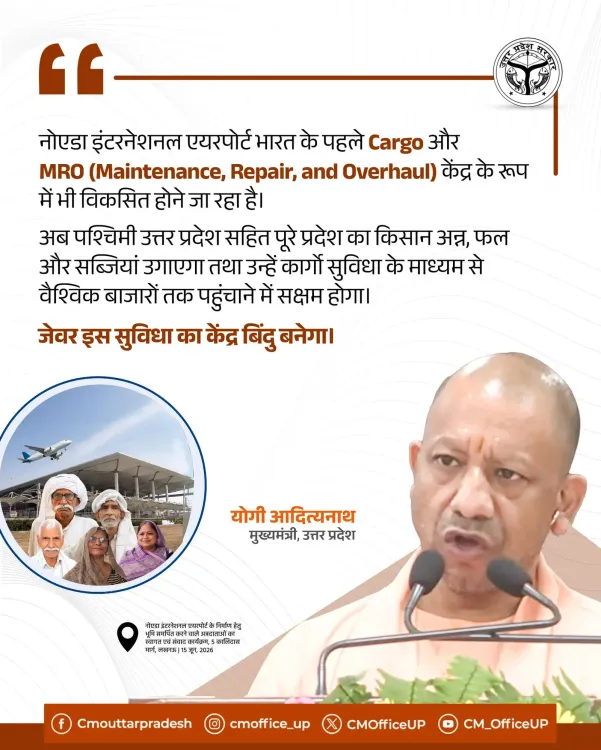
The official post, attributed directly to CM Yogi Adityanath under the hashtag #Jewar_ki_Udaan ('The Flight of Jewar'), states: 'Noida International Airport is also going to be developed as India's first Cargo and MRO centre. Now farmers of western Uttar Pradesh and the entire state will be able to grow food grains, fruits, and vegetables and deliver them to global markets through cargo facilities. Jewar will become the focal point of this facility.'
The statement frames the Jewar greenfield airport not merely as a passenger terminal but as an agricultural export gateway, directly linking aviation logistics to farm income for western Uttar Pradesh and beyond.
Policy Backdrop
The Noida International Airport project at Jewar, located in Gautam Buddh Nagar district, was first announced in 2017 under the Yogi Adityanath government as part of efforts to expand aviation capacity for the National Capital Region beyond Delhi's existing airport. The project is a greenfield development intended to serve both passenger and freight needs of the NCR and surrounding western UP belt.
India's National Civil Aviation Policy of 2016 had already laid groundwork for regional cargo infrastructure and MRO facility development, aiming to reduce the dependence of Indian carriers on overseas maintenance facilities. Uttar Pradesh has pursued a broader cluster of new airports — including at Ayodhya and Kushinagar — as part of an aviation-led economic corridor strategy under the current state government.
The emphasis on MRO capacity aligns with a national push to build domestic aircraft servicing capabilities, which currently see a significant share of maintenance work carried out abroad at higher cost to Indian operators.
Stakeholders and Impact
Farmers in western Uttar Pradesh — a region known for perishable produce including vegetables, fruits, and food grains — stand to be among the most direct beneficiaries if the cargo infrastructure materialises as described. Access to a proximate international cargo hub could reduce spoilage and transit time for perishable exports, potentially improving farm-gate realisations.
Aviation logistics operators and perishable goods exporters are also key stakeholders, as a dedicated cargo zone at Jewar would offer an alternative to the congested cargo facilities at Indira Gandhi International Airport in Delhi. MRO operators could find new business opportunities if the facility attracts airline maintenance contracts from carriers serving the NCR region.
What's Next
Completion of land acquisition, environmental clearances, and the selection of operators for the cargo and MRO zones at the Jewar site remain key milestones to watch. The government's ability to attract private logistics and MRO partners will determine the pace at which the airport transitions from construction to operational status.
If the cargo and MRO designations are operationalised, Jewar could reshape agricultural supply chains across Uttar Pradesh and position the state as a significant node in India's agri-export ecosystem — a development that would carry both economic and political weight ahead of future state and national electoral cycles.
Point of View
The government is attempting to broaden the political constituency for what is otherwise an elite infrastructure project. This also fits a wider pattern of the Uttar Pradesh government using airport announcements to signal economic ambition and compete with other large states for investment. The MRO component, if realised, would address a genuine structural gap in Indian aviation, but the timeline and operator details will be the true test of intent.
NationPress
15 Sept 2026
Frequently Asked Questions
What is Noida International Airport at Jewar?
Noida International Airport is a greenfield airport project located at Jewar in Gautam Buddh Nagar district , Uttar Pradesh, announced in 2017 to serve the National Capital Region as a secondary airport to Delhi and to support cargo and aviation infrastructure in western UP.
What is an MRO facility and why does it matter for India?
An MRO (Maintenance, Repair, and Overhaul) facility services aircraft for airlines. India currently sends a significant portion of aircraft maintenance work overseas, so domestic MRO centres at airports like Jewar could reduce costs for Indian carriers and create local employment.
How will Jewar airport help UP farmers?
CM Yogi Adityanath stated that farmers in western Uttar Pradesh and across the state will be able to export food grains, fruits, and vegetables to global markets through the airport's dedicated cargo facilities, reducing transit time and spoilage for perishable produce.
When will Jewar airport be operational?
An official operational date has not been confirmed in this announcement. Key pending steps include completion of land acquisition, environmental clearances, and selection of operators for the cargo and MRO zones at the Jewar site.
Which other airports is Uttar Pradesh building?
Alongside Noida International Airport at Jewar , the Uttar Pradesh government has pursued new airport projects at Ayodhya and Kushinagar as part of a broader aviation-led economic corridor strategy under CM Yogi Adityanath .